Bain Just Made AI Referral Traffic a 25% Number. What Yours Looks Like Matters.
- Author
- By Dor
- Publication date
- Published
- Reading time
- 7 min read
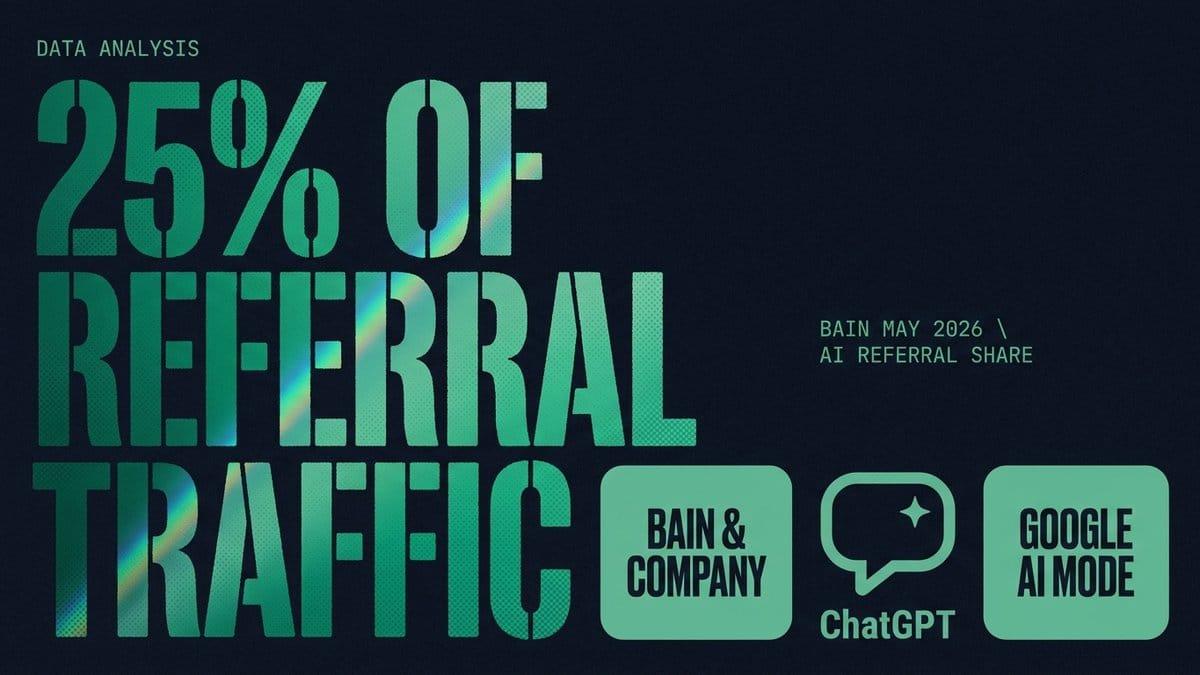
Bain & Company put hard, multi-country data behind agentic commerce this week. ChatGPT shopping referrals more than doubled year over year across the US, UK, Germany, and France. Eight percent of US consumers now start their online shopping journey with a generative AI chatbot. And AI accounts for up to 25% of referral traffic at some retailers. "No data yet" just ended.
TL;DR: Bain's May 13 brief and its May 18 Retail Times rerun give the agentic commerce category its first tier-1 consultancy benchmark. ChatGPT shopping referrals more than doubled YoY across four major markets. AI is up to 25% of referral traffic for some retailers. The new question is not whether AI is sending real traffic. It is whether your share of that 25% is climbing or flat, and the answer lives in your product data.
The Bain data does two things at once. It validates a category that was still being called "speculative" in retail-CFO decks three months ago, and it gives every brand a benchmark. Twenty-five percent of referral traffic is no longer a 2028 estimate. It is what the leaders are doing right now.
What did Bain actually publish?
Bain published two companion briefs: "Agentic AI in retail: How autonomous shopping is redefining the customer journey" and "Rewiring demand generation in the age of AI agents." Retail Times re-ran the headline findings on May 18.
The data points worth memorizing:
- ChatGPT shopping referrals more than doubled year over year across the US, UK, Germany, and France.
- 8% of US consumers now begin their online shopping journey with a generative AI chatbot.
- AI accounts for up to 25% of referral traffic at some retailers, though still under 1% of total traffic on average.
- 44% of online buyers either start in an LLM or split between AI and traditional search.
- 64% of US consumers have used or are open to AI to complete a purchase.
- Fully agentic commerce will be a $300-500B US market by 2030, up to 25% of total US e-commerce.
25% of referral traffic for the leaders. Less than 1% of total traffic on average. The gap between those two numbers is where every retailer's AI readiness work happens this year.
The 8% is lower than the 17% who said in November 2025 holiday surveys they planned to start with AI. Intent ran ahead of behavior, as usual. The 8% is what is actually happening today.
Why 25% of referral traffic is the only number that matters
The headline most people will quote is "AI is still less than 1% of total traffic." That number is misleading and it lets executives convince themselves the AI shift is theoretical. The number to internalize instead is 25% of referral traffic at the leaders.
Referral traffic is the closest analog to discovery. It is people arriving at your store after being recommended somewhere else, which is exactly how AI shopping agents send buyers your way. ChatGPT recommends; the user clicks through to buy. That click is referral traffic, and Shopify's Q1 reporting shows it converts better than average.
The 25% leader figure also tells you the variance is enormous. Some retailers get a quarter of their referral traffic from AI. Others get effectively zero. The pattern is consistent with what Shopify shared in earnings: AI-driven traffic up 8x year over year in Q1 2026, AI-search orders up nearly 13x. When a channel grows that fast, small differences in catalog readiness compound into large differences in share.
The question for any retailer reading the Bain brief is no longer "is AI traffic real." It is "what is my share, and which sub-queries am I winning or losing in the fan-out?" That is measurable and fixable.
What changes when a tier-1 consultancy publishes the data?
Three things shift the moment Bain numbers enter the rotation.
First, the agentic commerce optimization category gets investor-grade citations. Bain joins Morgan Stanley ($385B US agentic commerce by 2030), and Bain's number is materially larger. The framing also legitimizes AI share of voice as a metric retailers actually report on, alongside organic and paid share.
Second, brand CFOs and CMOs stop being able to say "the data is not there yet." The next memo from Investor Relations will ask "what is our posture on agentic commerce" and expect a numerate answer. "Monitoring the space" is about to age very badly.
Third, the trust gating layer becomes the story. Bain found roughly 50% of consumers are still cautious about letting AI complete a purchase. The journey now looks like: discover with AI, validate on your site, buy on your site. The pre-purchase discovery moment is being captured by AI today. The conversion still happens on the retailer's domain. Good news if you own the post-discovery experience. Bad news if you are not getting recommended in the first place.
How does the funnel actually work now?
Bain's framing implies a funnel that looks materially different from the one most ecommerce teams optimize for. Here is the comparison.
| Funnel layer | Pre-AI shopping (2019-2024) | AI-mediated shopping (2026 per Bain) |
|---|---|---|
| Initial discovery | Google search, Amazon search, direct | 8% start with AI chatbot, 44% split AI + search, 70% still start on Amazon, 50%+ start on Google |
| Product comparison | Multiple browser tabs, retailer sites | AI-generated comparison embedded in chat or Google AI Overview |
| Decision | Reviews on retailer or aggregator | AI summary of reviews + retailer brand authority |
| Purchase | Retailer site or marketplace | Still retailer site or marketplace (autonomy concerns gate the in-AI purchase) |
| Post-purchase | Email, retention | Same, plus AI-driven re-engagement |
The shift is concentrated at the top of the funnel. By the time the buyer is ready to transact, they are back on a retailer's site. But the brand they considered, the product they shortlisted, and the comparison they trusted were all shaped by AI before they opened a tab.
This is why structured product data and product-feed management are now the bottleneck. The AI agent has to read your catalog cleanly to consider you. If your title is "Blue Shirt - Best Seller!" and your description has no fit, fabric, or material attributes, you will not be considered. Your competitor with 30 structured attributes per SKU will. The hardest number to move is your AI product found rate, and it is mostly a function of attribute completeness.
How is the AI referral share split by category and surface?
Bain does not break the 25% leader figure down by category, but Shopify and Salesforce reporting suggests where the variance lives. Categories where AI helps reduce decision complexity (electronics, beauty, home goods, fashion with fit info) over-index. Commoditized short-consideration categories lag.
By surface, Google AI Mode shopping and ChatGPT shopping are the two largest contributors today. Perplexity shopping is growing fast off a smaller base. Amazon's Alexa for Shopping is a closed garden where brand-direct referral economics differ. The category retailers tend to misjudge is the digital shelf, which is no longer just retailer-site placement; it now includes the AI-rendered comparison card.
The implication for any retailer above a few thousand SKUs: your AI readiness is not one number. It is one per surface, per category, per persona. The leaders pulling 25% are not winning every fan-out. They are winning enough of the ones that matter for their category.
What to do this week
- Get a real number for your AI referral share. Set up source-level reporting in GA4 or Shopify analytics that breaks out traffic from chatgpt.com, perplexity.ai, copilot.microsoft.com, gemini.google.com, and claude.ai. The data is usually in the platform but not in the default dashboards.
- Run a discovery audit on your top 25 category queries. Pick the 25 queries most relevant to your category and a few personas, run them through AI shopping search surfaces (ChatGPT, Google AI Mode), and log whether you appear as a product card, a brand mention, or not at all. Tools like our AI Readiness Report automate this, but a manual sample is fine to start.
- Stack-rank your catalog by attribute completeness. Product data enrichment is the lever that moves AI visibility most reliably. Most enterprise catalogs have 5-8 attributes per SKU. Agentic commerce surfaces expect 30+.
- Pick one surface to win first. Optimizing for ChatGPT, Google AI Mode, Perplexity, and Copilot at once is how a quarter ends with no measurable lift. Pick the surface where your category is most active and concentrate the catalog work there.
- Write the board-deck slide now. When the IR question lands next month, you want one slide that says "we are at X% AI referral share, the leaders are at 25%, and here is our plan."
Frequently asked questions
Did Bain say 25% of all traffic comes from AI?
No. Bain said AI accounts for up to 25% of referral traffic for some retailers, while AI is still under 1% of total traffic on average. Total includes direct, organic search, email, and paid, where AI is not yet a major contributor. The 25% applies to the slice agentic commerce is reshaping fastest.
How is "starting with AI" measured?
Bain measured self-reported consumer-survey behavior across the US, UK, Germany, and France. Respondents indicated which channel they used first when starting their online shopping journey. The 8% who chose ChatGPT or another generative AI is below the 17% intent figure from a November 2025 survey. Eight percent is the current real-world floor.
Is the 25% referral figure verifiable for a specific retailer?
Bain did not name retailers in the public brief; the 25% appears to be drawn from Bain client analytics. Independent confirmation comes from Shopify's Q1 2026 reporting on 8x AI traffic growth and 13x AI-search order growth, and from Salesforce reporting on AI agents driving a share of Cyber Week 2025 orders.
Where should mid-market retailers start if they are below $50M in revenue?
Same playbook, smaller blast radius. Pick one category, one AI surface, and the top 25 queries your buyers use. Run the audit by hand and fix the worst catalog gaps first. Mid-market catalogs are smaller, so the data work is faster.
The Bain brief is the moment the AI shopping conversation moved from "interesting trend" to "audit-grade benchmark." A quarter of referral traffic is real, and somebody is already getting it. The only question that matters is whether the share showing up in your analytics is your fair share, or whether your competitor's catalog is doing the work yours is not.
How AI-ready are your products?
Check how ChatGPT, Google AI, and Perplexity evaluate any product page. Free score in 30 seconds.