Start with your buyers and priority products
Choose the categories and shopping questions you want to follow. Paz records the answers so you can compare product appearances, examine competitors and decide where to investigate.
What Paz.ai measures
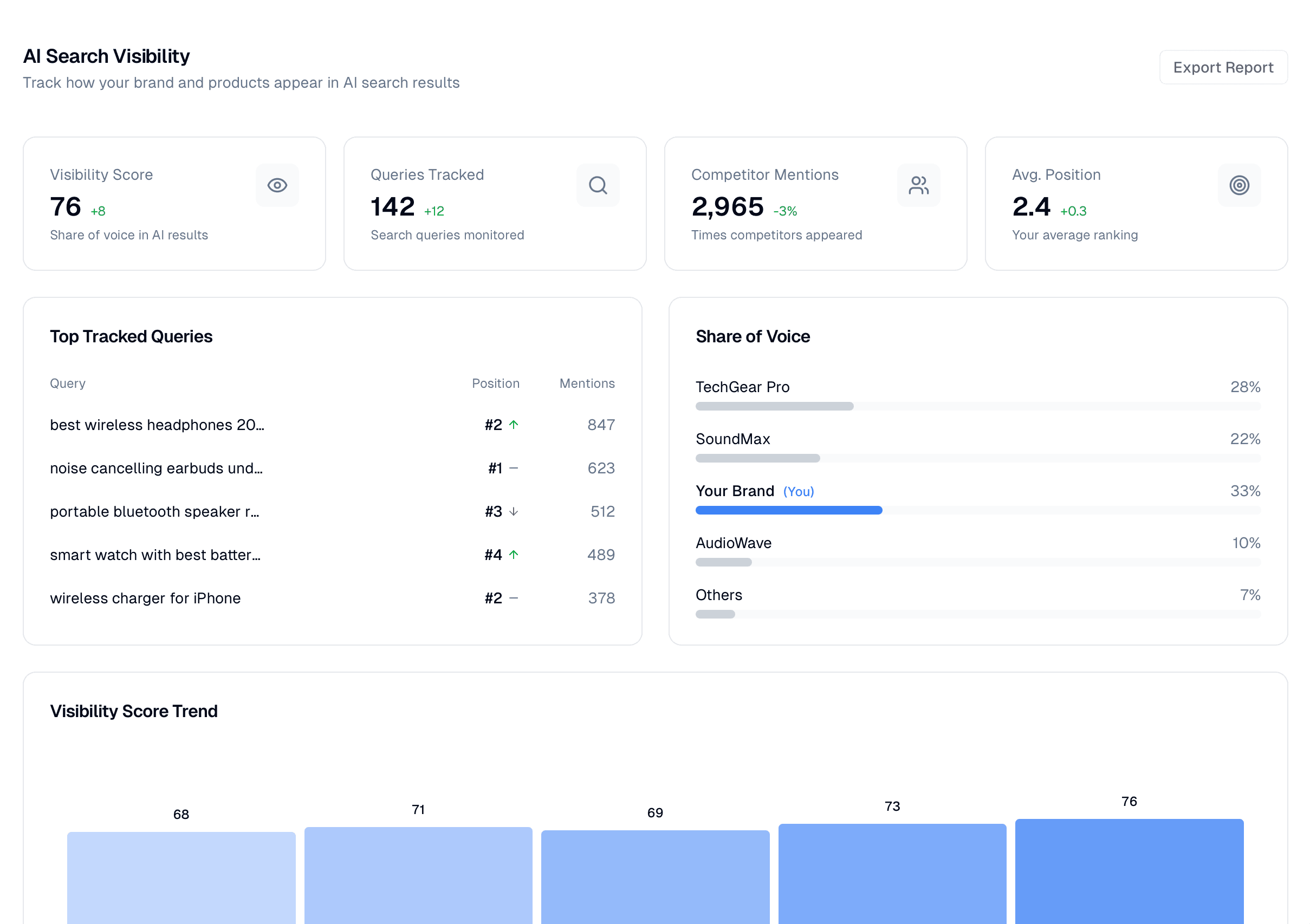
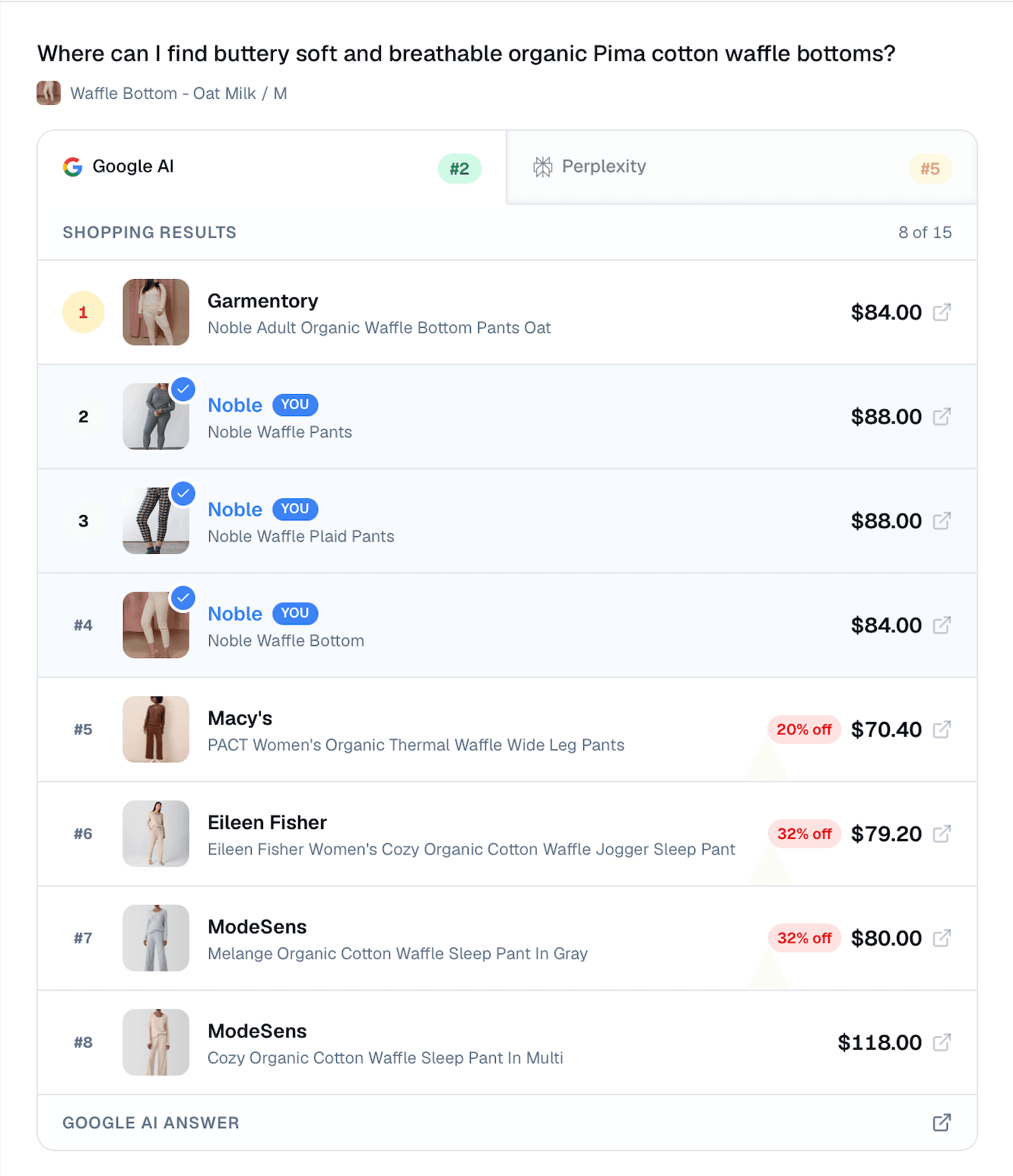
For each configured query and engine, Paz records product cards, product mentions, brand mentions and source citations, alongside position, found rate and trends.
Product card
A structured product result the engine renders, such as an image, price, merchant, and link where the engine provides them.
Product mention
A natural-language reference to a merchant product in the response without a structured card.
Brand mention
A reference to the merchant brand in the response without a specific product.
Source citation
An outbound URL the engine cites as a source for the response.
Paz records brand mentions and source citations separately. Read the methodology page for reporting definitions and how found rate is calculated.
Which AI engines Paz.ai monitors
- Google AI Mode: monitored with per-engine appearance counts, found rate, position, and trends.
- ChatGPT: monitored with per-engine appearance counts, found rate, position, and trends.
- Perplexity: monitored with per-engine appearance counts, found rate, position, and trends.
- Google AI Overviews: captured and displayed with a tri-state outcome (present, not shown, failed). Diagnostic in Shopping Visibility and reported separately.
Monitoring follows the schedule configured for the agreed work. Review the reporting period and data freshness alongside each result.
Read the answers behind the result
Review query results and the types of appearances recorded for each answer.
Turn a finding into product work
Use a visibility finding to decide what to investigate next. Compare the cited information with your catalog and check whether shoppers have the details they need to choose.
Review proposed product updates, choose the publishing destination and follow the results in later checks.
Workflow coverage by plan
AI visibility, product information, catalog-related channel corrections and recurring commercial-performance investigations are part of the managed service, which covers one brand and one primary storefront. Connections and actions are confirmed for the selected work. See plans and pricing for commercial terms.
See public pricing for current plan details.
Frequently asked questions
What is an AI shopping visibility platform?+
Which AI engines does Paz.ai monitor?+
How often does Paz.ai monitor?+
How does Paz.ai help teams improve AI shopping visibility?+
Choose your next step
Start with a product-level readiness check, explore other ecommerce workflows or compare plans.
Related
- Shopping Visibility methodology : engines, cadence, definitions, and reporting methods
- AI visibility for commerce : definition
- Answer engine optimization (AEO) : definition
- Generative engine optimization (GEO) : definition
- How to optimize a product feed for AI search : eight-step checklist
- AEO and GEO optimization software for ecommerce : software selection
- AI Readiness : evaluate a product URL
- Pricing : current plan details
- Press : public partner evidence