Google Says AEO Is "Still SEO." It's Right and Also Incomplete.
- Author
- By Dor
- Publication date
- Published
- Last updated
- Updated
- Reading time
- 7 min read
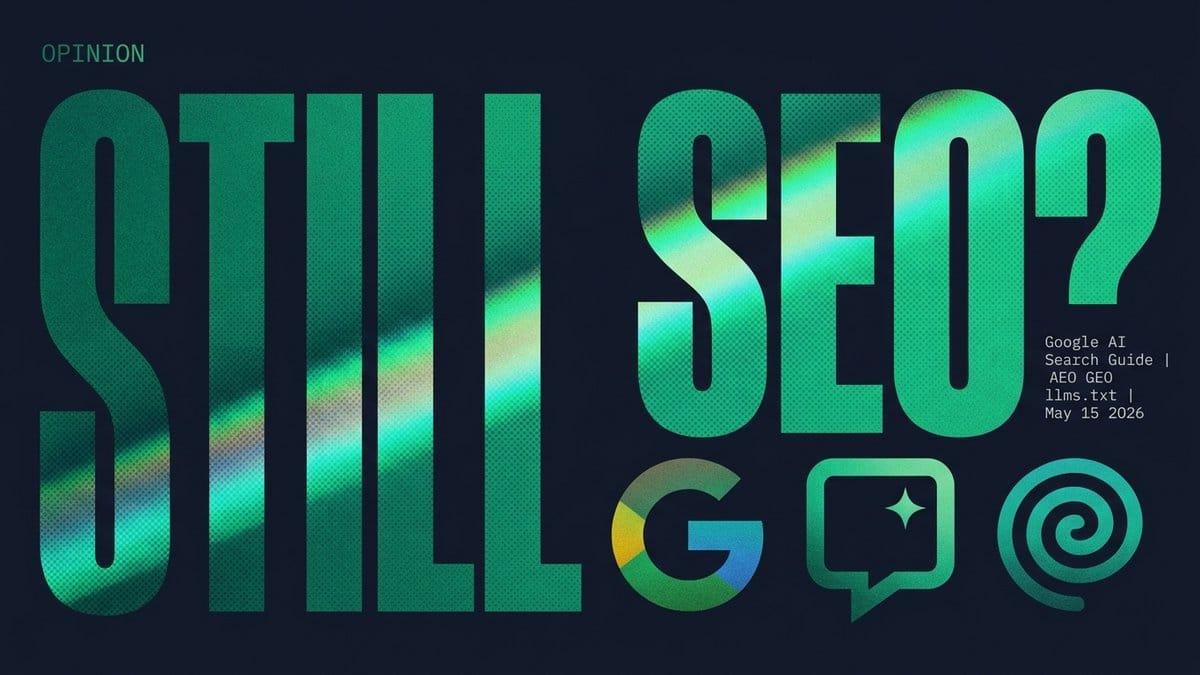
Google published its first official AI search optimization guide on May 15. The core message: optimizing for AI Overviews and AI Mode is "still SEO." There is no separate AEO or GEO discipline from Google's perspective. Site owners do not need llms.txt files, content chunking, AI-specific schema, or AI-targeted rewrites. For Google's surface, that is mostly true. For the rest of the agentic web, it is exactly the wrong takeaway.
TL;DR: Google's May 15 guide formally folds AEO and GEO into SEO for its own surface, and it specifically tells site owners to ignore llms.txt files, content chunking, and special schema. That is correct for Google because AI Overviews ride on top of the same crawl/index/rank stack. It is incomplete for ChatGPT, Perplexity, Copilot, and Claude, which do not share Google's index and where structured product data and platform-specific feeds materially change discoverability.
The guide is Google's first formal statement on the AEO and GEO category. Until now, the official position lived inside Gary Illyes conference quotes and offhand Search Central remarks. As of May 15 it is a published page on developers.google.com, citable in policy debates and vendor pitches. That elevates the conversation, and it also exposes a real fault line.
What did Google actually say?
Google's official documentation is short, direct, and unusually opinionated. The headline framing: "From Google Search's perspective, optimizing for generative AI search is optimizing for the search experience, and thus still SEO." AI features are "rooted in our core Search ranking and quality systems," using retrieval-augmented generation and query fan-out against Google's existing index.
The "Mythbusting" section is where the news lives. Google explicitly tells site owners they can ignore:
- llms.txt files. "You don't need to create machine-readable files, AI text files, markup, or Markdown to appear in generative AI search."
- Content chunking. No requirement to break content into AI-friendly fragments.
- AI-targeted rewrites. AI systems handle synonyms and meaning; no keyword-variation rewrites needed.
- Inauthentic "AI citation" mentions. Citation-farming "isn't as helpful as it might seem."
- Special AI schema.org markup. Structured data only matters for rich-results eligibility.
For context: 48% of Google searches in March 2026 already show an AI answer at the top, up from 34.5% in December 2025. The AI surface is now the dominant search experience, and Google is asserting that the same SEO work that ranks you in classic search also makes you visible in AI Overviews.
Why Google is right about Google
The "still SEO" framing is technically accurate for Google's surface. AI Overviews and AI Mode are not a parallel system. They are a generation layer riding on top of the existing crawl, index, and rank stack. The same content quality signals, link authority, structured data, and topical depth that earn organic visibility also earn AI Overview citations.
So if you are a retailer optimizing your category pages for traditional organic search, most of the same work pays off in Google AI Mode shopping results. Structured data still matters for product cards and rich results. Page quality still matters for which sources Google's query fan-out selects, and passage-level retrieval means individual sections of your page can be cited even when the page as a whole is not. The mythbusting section also lands honestly. The cottage industry of "llms.txt as a service" and "AI-specific schema" vendors had been overselling tactics that simply do not move Google rankings, and now Google has said so on the record.
The catch is in the phrase "from Google Search's perspective." That qualifier carries a lot of weight.
Why Google is incomplete for everyone else
Google's surface is not the only AI surface, and the agentic commerce category is multi-platform by definition. ChatGPT, Perplexity, Copilot, Claude, and Amazon's Alexa for Shopping all sit on different infrastructure with different signals and different ingestion paths.
| Surface | Index source | What moves discoverability |
|---|---|---|
| Google AI Mode / Overviews | Google's own crawl + index | Classic SEO, structured data, page quality |
| ChatGPT | OAI WebGPT crawl + Bing index + product feeds | Direct product feed submission, product feed management, schema, llms.txt does help here per Shopify's native rollout |
| Perplexity | Mixed (Brave + Bing + its own crawl) | Source authority, structured citations |
| Microsoft Copilot | Bing index | Bing-flavored SEO, schema |
| Amazon Alexa for Shopping | Amazon catalog data | Marketplace listing optimization, A+ content |
llms.txt is the clearest example of the asymmetry. Shopify shipped native llms.txt support across its merchant base just before Google's guide dropped, and Anton Ekström spotted it in the wild. Shopify is shipping that feature because ChatGPT and other non-Google agents respond to it. Google telling site owners not to bother with llms.txt is fine for Google. It says nothing about whether ChatGPT will reward you for shipping one.
This is the inverse of the old SEO debate where "Bing-only" tactics were a niche concern. In 2026 the non-Google AI surfaces are no longer niche. Bain's May 13 brief put ChatGPT shopping referrals at more than doubled year over year in four major markets, with AI accounting for up to 25% of referral traffic at some retailers. A "Google-first" optimization strategy now leaves 25% of your referral upside on the table.
What changes for your AI visibility strategy
Three changes are worth making in the next 30 days.
First, separate your Google-AI work from your non-Google-AI work in planning and reporting. The Google work is "SEO+", a continuation of what your organic team already does. The non-Google work is platform-specific and needs its own owner, its own metrics, and its own AI share of voice tracking. Conflating them is how 2025-era teams ended up optimizing for ChatGPT using Google playbooks, with predictable results.
Second, treat structured product data as a multi-surface asset. The thing Google's guide is most right about is that good structured data is the floor, not the ceiling. The thing it is most quiet about is that the structured data your team produces also feeds OpenAI's product feed format, Google Merchant Center, and Amazon catalogs. Investing in product data enrichment and a clean source-of-truth catalog is the cheapest way to move across all the surfaces at once.
Third, do not throw out llms.txt yet. If your platform supports it (Shopify just shipped native support), keep it. The cost of leaving it on is roughly zero. The upside if ChatGPT, Perplexity, or Claude reward it is real. Google has told you it does not matter to Google, which is a useful clarification. It has not told you it does not matter on every surface.
How Paz reads the Google guide
For Paz's customers, the Google guide is mostly good news. It reinforces the thesis that fixing your product data is the lever, not buying a parallel AI-only optimization stack. The product schema markup work, the catalog enrichment work, the AI product found rate tracking - all of that gets validated by Google's own framing.
What Google's guide does not say, and what Paz's customers should still budget for, is the multi-platform work. Running a discovery audit across ChatGPT, Google AI Mode, Perplexity, and Copilot tells you where your share is concentrated and where it is leaking. The same product data, scored against five different surfaces, produces five different visibility numbers. Google saying "it's still SEO" does not change that.
What to do this week
- Read Google's guide end to end with your SEO lead. Walk through the Mythbusting section together and identify any vendors or workstreams in your current stack that just got delegitimized for Google specifically. Cancel those line items.
- Inventory your non-Google AI investments. llms.txt files, ChatGPT product feed submission, Perplexity source signals, Copilot Bing schema. Keep the ones that map to non-Google surfaces. Document why.
- Set up source-broken-out AI referral reporting. GA4 or Shopify analytics, broken out by chatgpt.com, perplexity.ai, copilot.microsoft.com, gemini.google.com, claude.ai. You cannot manage what you do not measure, and Google AI Mode traffic shows up differently from ChatGPT traffic.
- Re-run your structured data audit. Google's reinforcement of "structured data only matters for rich-results eligibility" means rich-product-card eligibility is now the bar. Make sure every catalog page passes Google's Rich Results test and that prices, availability, and reviews are in the markup, not just on the rendered page.
- Pick one non-Google surface to win this quarter. ChatGPT is the obvious first pick for most retailers given Bain's referral data. Concentrate the catalog and feed work there. Treat the Google AI Mode work as continuation of organic SEO, not a separate project.
Frequently asked questions
Is GEO dead now that Google said it's "still SEO"?
No. Google said GEO is still SEO from Google's perspective. That qualifier matters. ChatGPT, Perplexity, Claude, and Copilot do not share Google's index, do not share Google's ranking signals, and in several cases respond to artifacts (like llms.txt or platform-specific feeds) that Google explicitly says not to bother with. Multi-platform GEO is alive and well.
Should I delete the llms.txt file my team built?
Probably not. Google has said it does not move Google rankings, which is useful. But Shopify just shipped native llms.txt support for its merchants because non-Google agents do use it. The cost of keeping the file is trivial. The upside if it helps on ChatGPT, Perplexity, or Claude is real. Keep it, monitor, revisit if no surface ever credits it.
Does Google's guide help or hurt vendors selling AI visibility tools?
Both. It hurts vendors who built a moat on "AI-specific" tactics that Google just named and dismissed. It helps vendors whose pitch is "fix your product data and your AI visibility follows" because Google just validated that thesis for its own surface. Multi-platform vendors with diagnostic depth are the relative winners.
How big is the gap between Google AI search and non-Google AI search?
Big enough to matter. 48% of Google searches now show an AI answer at the top, but ChatGPT shopping referrals more than doubled YoY per Bain. Both surfaces are growing fast and they reward different signals. A Google-only strategy plus a non-Google plan is the safer bet through 2026.
The Google guide is the clearest market signal yet that the AI visibility category is splitting into "still SEO" and "not just SEO." Most retailers will get the first half right by accident, because they already do SEO. The second half is where the next 25% of referral traffic lives, and it is not in Google's documentation.
How AI-ready are your products?
Check how ChatGPT, Google AI, and Perplexity evaluate any product page. Free score in 30 seconds.