JPMorgan: Agentic Commerce Starts on Your Site, Not ChatGPT
- Author
- By Dor
- Publication date
- Published
- Reading time
- 7 min read
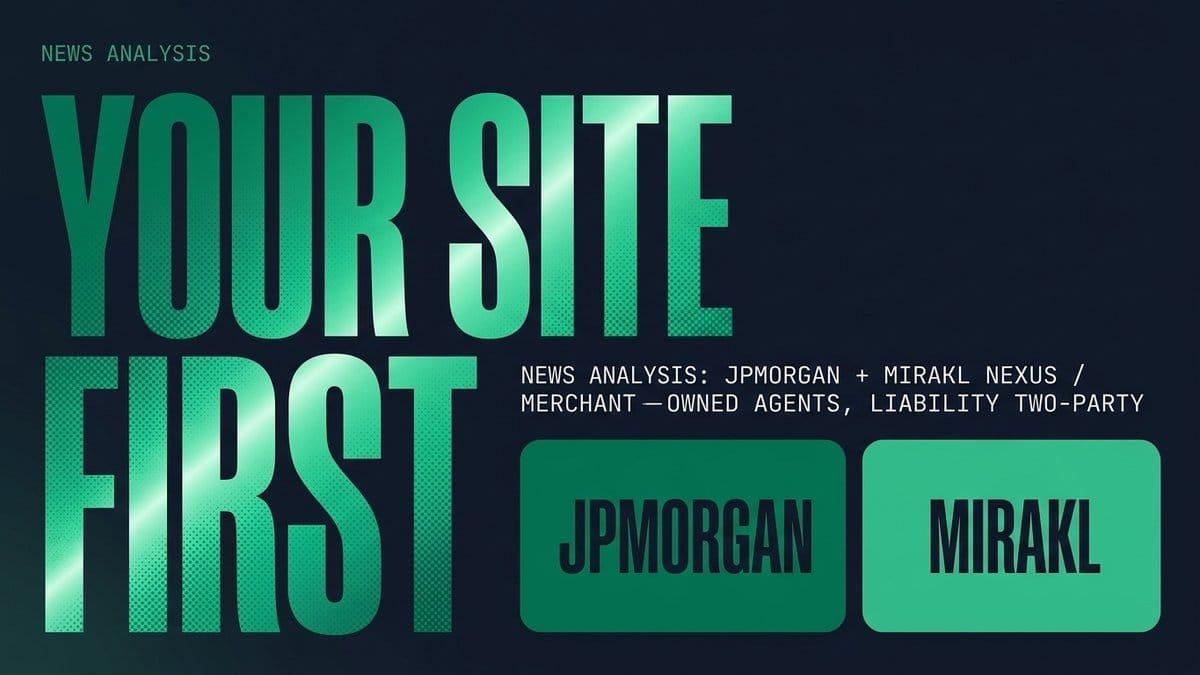
The largest US credit card issuer and merchant acquirer just broke its silence on agentic commerce. JPMorgan Payments expects the first wave of autonomous AI transactions to happen on merchants' own websites, with merchants' own agents. Not inside ChatGPT. Not inside Gemini. On your domain, against your catalog. And the gating factor is whether your product data is detailed enough to be picked at all.
TL;DR: In a long-form American Banker interview published May 18, JPMorgan Payments executive director Prashant Sharma said autonomous agentic transactions will land first on merchant-owned sites with merchant-owned agents, not third-party AI surfaces. The bottleneck he named on the record: catalogs without enough detail will get skipped. Mid-market retailers should stop treating their own domain as the legacy stack and start treating it as the primary agentic surface.
Why does JPMorgan matter on this call?
JPMorgan is the largest US credit card issuer by purchase volume and the largest US merchant acquirer. When the bank on both sides of the rails publishes a thesis about where agentic transactions will first appear, retailers should read it as a forward-looking risk model, not a press release. JPM had been deliberately quiet on agentic commerce until it had a settled view.
That view landed this week in two pieces. The JPMorgan Payments and Mirakl partnership wires JPM's payment infrastructure and risk controls into Mirakl Nexus, a layer that lets AI agents query merchants' catalogs, pricing, and inventory. The Sharma interview spells out the bet: AI-embedded commerce on third-party surfaces is one channel. Autonomous agentic transactions, where the agent acts days later on a stored mandate, start somewhere else.
Where does Sharma say agentic commerce will start?
"Autonomous agentic transactions to first appear on merchants' own websites, using their own agents."
That single line reframes the category. The dominant narrative for two years has been ChatGPT-as-storefront, Gemini-as-storefront, Copilot-as-storefront. Sharma is saying the first wave is brand-owned and retailer-owned agentic storefronts, with the third-party surfaces acting as a parallel discovery channel.
This aligns with the structural shift that started in March 2026, when OpenAI rolled back Instant Checkout. ChatGPT now operates as a discovery and recommendation engine, redirecting users to merchant sites for purchase. Walmart's in-ChatGPT app with account linking and loyalty was the first signal that retailers refused to be reduced to anonymous fulfillment. If the purchase happens on the retailer's site anyway, the agent that completes it should be the retailer's agent too.
There is a second reason JPMorgan would want this: liability. With a merchant-owned agent acting on stored consent, the four-party liability mess (consumer, agent, retailer, bank) collapses back into something closer to today's two-party flow. The bank can underwrite that. It cannot easily underwrite a third-party agent it does not control buying a wrong product on a stored mandate three days later.
What did Sharma name as the catalog bottleneck?
The most quotable line in the interview is the one most retailers have not yet internalized:
"Conversational commerce is very different from keyword-based search. There is just so much data that users are providing as a part of conversational commerce. If the merchant catalog does not have that level of detail, these products are not going to be shown."
This is the largest US merchant acquirer telling retailers, on the record, that catalog depth determines whether an agent surfaces a product at all. Not whether it ranks well. Whether it surfaces.
The mechanism is the same one Google productized at I/O 2025. AI surfaces decompose a single shopper instruction into 8 to 12 parallel sub-queries via query fan-out. A Surfer SEO analysis of 173,902 URLs from December 2025 found that 68% of AI-cited pages are not in the top 10 organic results, because the page that wins on a sub-query is rarely the page that wins on the top-level query. Catalogs designed for keyword search miss most of the fan-out.
Sharma is naming the same thing from the acquirer side. Five product attributes will get you skipped. Thirty will get you considered. The retailers running product data enrichment workflows that take catalogs from 5-8 attributes to 30+ are the ones who will appear when Mirakl Nexus queries their catalog three days from now.
The "AI-embedded commerce" framing matters
Sharma also planted a flag on terminology. He called what ships today "AI-embedded commerce": "another channel where the consumer is making a purchase." True agentic commerce, in his framing, is the autonomous step where the agent acts on a stored mandate.
| Phase | Where it happens | Who acts | Status |
|---|---|---|---|
| AI-embedded commerce | ChatGPT, Gemini, Copilot | Consumer in the loop, AI assists | Live, scaling |
| Merchant-owned agentic | Brand site, retailer agent | Retailer's agent acts on consent | Beta (JPM+Mirakl, Walmart) |
| Cross-surface agentic | Any AI surface | Third-party agent acts on mandate | Liability unresolved |
The middle row is where JPMorgan is placing its first commercial bet. It is the row most mid-market retailers do not have a strategy for, because they are still arguing about whether to feed ChatGPT.
What this means for the protocol stack
The protocol layer is converging around two open standards. ChatGPT and 25+ live merchants run on the Agentic Commerce Protocol (ACP). Google AI Mode, Gemini, and the Shopify+Salesforce stack run on the Universal Commerce Protocol (UCP), with Microsoft Advertising and Merchant Center going live with UCP setup and Copilot Checkout in May 2026 (per Microsoft's Agentic Commerce page).
JPMorgan's bet sits underneath both. Whatever protocol a retailer publishes to, the catalog feeding it has to be detail-dense enough to surface inside a fan-out. The protocol is the pipe. The catalog is what flows through it. And the merchant-owned agent layer that JPMorgan is wiring into Mirakl is a third surface that consumes the same underlying product data through its own commerce AI integration, with the brand controlling the recommendation rather than OpenAI or Google.
Retailers should budget for three reads of their catalog, not one. ACP. UCP. Their own agent. That is the working definition of multi-channel AI commerce in 2026.
What about loyalty and the multi-product problem?
Two practical issues Sharma flagged:
- Loyalty has no native path on third-party agents yet. "Most of the large merchants have some kind of loyalty platform. We all love our points." Merchants who let a third-party agent transact on their behalf give up the loyalty surface. Merchant-owned agents preserve it.
- Single-product transactions do not scale. Early protocol implementations supported one product per agent transaction. Five items from one merchant meant five separate transactions, five shipments.
Both push in the same direction as Sharma's "merchant-owned first" thesis. The retailer's own agent sees loyalty state, batches a cart, and preserves the customer relationship the brand has spent decades building. That is what a credible AI commerce platform does, regardless of surface.
What to Do This Week
- Audit your catalog against agent depth, not keyword SEO. Pull 20 products and ask: would an AI agent decomposing a shopper query into 12 sub-queries find a relevant attribute on each? If most products have under 15 structured attributes, you are below the JPM/Mirakl threshold. A free AI Readiness Report gives you a baseline.
- Run an AI visibility check across ChatGPT, Google AI Mode, and Perplexity before scoping a merchant agent. If you are not appearing on third-party surfaces today, you have a catalog problem that will follow you into your own agent.
- Map loyalty to your future agent strategy. Decide which transactions you will hand to a third-party agent (and lose loyalty signal) and which stay on a merchant-owned agent. Get the policy in writing before the protocol forces the choice.
- Open a conversation with your acquirer. If you bank with JPM, ask where you sit on the Mirakl Nexus beta. If you bank elsewhere, ask what your acquirer's roadmap looks like. Acquirers are about to be a channel decision, not just a back-office one.
- Stand up an agent mandate policy for one product category. Spend limits, refund rules, identity checks. The liability model Sharma flagged as unresolved at the industry level gets resolved one merchant at a time, on contract terms you write.
Frequently Asked Questions
Is JPMorgan saying ChatGPT and Gemini are not real channels?
No. Sharma was explicit that JPM works closely with OpenAI, Google, and Meta. The interview separates AI-embedded commerce on third-party surfaces (live and scaling) from autonomous agentic transactions (which JPM expects to land first on merchant-owned sites). Both channels matter. The merchant-owned layer is the under-built one.
What is Mirakl Nexus?
Mirakl Nexus is Paris-based Mirakl's agentic commerce infrastructure. It lets AI agents query merchants' product catalogs, pricing, and inventory in a structured way. The JPMorgan partnership adds JPM's payment processing, tokenization, and fraud protection. The combined stack is in beta with select retailers, broader rollout later in 2026.
How is "AI-embedded commerce" different from agentic commerce?
Sharma uses AI-embedded commerce for today's flow, where the consumer is in the loop and AI assists discovery. True agentic commerce is autonomous: the agent acts on a stored mandate, days after the original instruction. The first is mainstream now. The second is gated by liability and catalog depth.
Does this change how I should think about ACP vs UCP?
It adds a third read. ACP serves OpenAI surfaces, UCP serves Google plus Microsoft plus Salesforce, and the merchant-owned agent layer serves the brand's own site. All three consume the same catalog. Catalog quality is more consequential than the protocol pick.
What is the liability problem Sharma kept circling?
When an agent transacts on a stored consent and the wrong product arrives, today's card-network liability model does not cleanly assign fault. Consumer, merchant, agent platform, or bank? Sharma said the industry has not solved this. Merchant-owned agents shrink the question to a familiar two-party flow.
Does Paz help with this?
Paz.ai, an agentic commerce optimization platform, monitors how products appear across ChatGPT, Google AI Mode, and Perplexity, enriches catalog data to the depth AI surfaces require, and publishes feeds to AI commerce channels. The same catalog work that lifts third-party visibility is what feeds a merchant-owned agent.
The retailers who win the next 18 months are the ones who treat their own site as the primary agentic surface, not the residual one. JPMorgan, sitting on both sides of every card transaction in the United States, just told you where it expects the volume to land first. Build the catalog that survives a fan-out, write the mandate policy that survives a liability dispute, and stop assuming the third-party surfaces are where this fight ends.
How AI-ready are your products?
Check how ChatGPT, Google AI, and Perplexity evaluate any product page. Free score in 30 seconds.