Shopify Merchants Now Run Their Stores From Inside ChatGPT. The Discovery Surface Just Became the Admin Surface.
- Author
- By Dor
- Publication date
- Published
- Reading time
- 7 min read
TL;DR: On May 4, Shopify launched two connector apps that let merchants manage their entire store from inside ChatGPT or Claude: look up orders, update prices, check collection performance. Shopify's internal survey says 83% of merchants already use ChatGPT. This collapses two surfaces into one - the place merchants run their business and the place their customers now discover products are the same chat window. If you sell on Shopify, the question shifts from "should we be ready for AI shopping" to "the merchant tweaking a price in chat is the same merchant whose products are invisible in chat." If you sell on BigCommerce, Salesforce, or Magento, no comparable native admin connector exists today. The catalog gap stops being abstract.
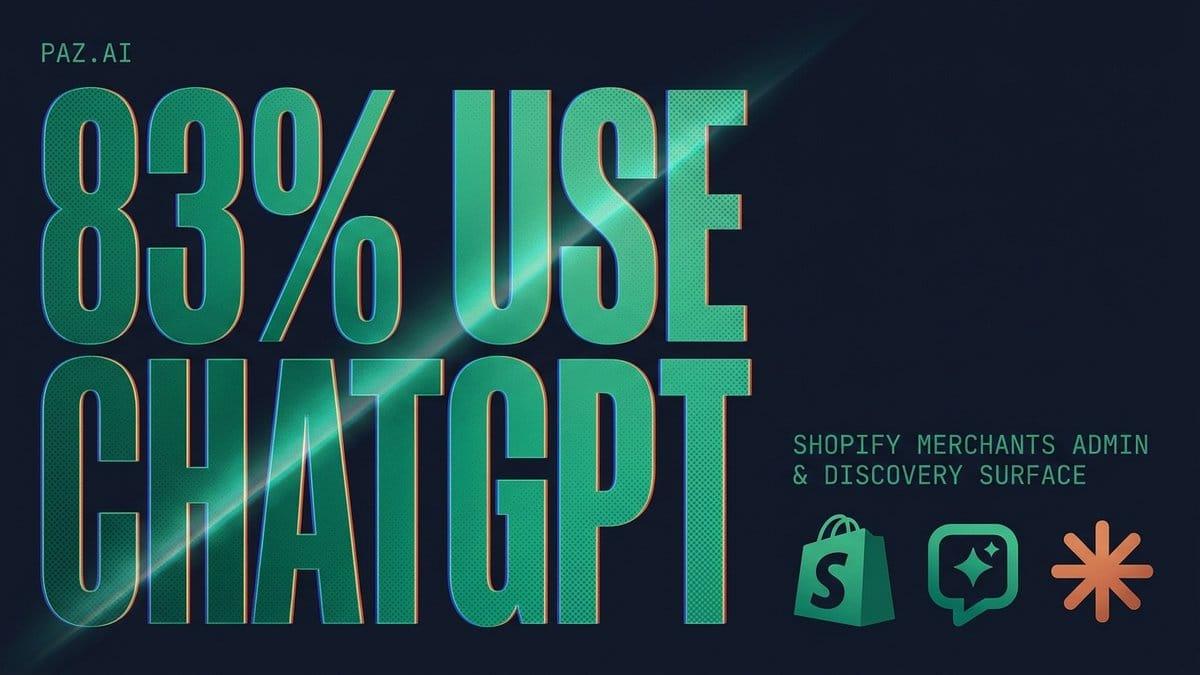
Shopify President Harley Finkelstein posted the announcement on LinkedIn and X on May 4, 2026. The framing was simple: 83% of merchants already work inside ChatGPT, so Shopify wired the store into the chat. The ChatGPT and Claude connector apps went live the same day. Coverage followed across The Keyword and Flatline Agency over the following 72 hours.
What got missed in the coverage: the merchant admin surface and the consumer discovery surface are now the same chat window. That changes how mid-market retailers should think about agentic commerce work this quarter.
What the connector apps actually do
The apps are not a Shopify-themed chatbot bolted onto ChatGPT. They are real connectors built on the OpenAI Apps SDK and Anthropic's Claude connector spec, with read and write access into a merchant's Shopify admin. From inside ChatGPT or Claude, a merchant can preview and claim a store, look up an order by number or customer name, update product prices and inventory in real time, check sales and collection performance, and chain those actions in plain language.
This is distinct from two earlier Shopify moves people keep conflating with it. Shopify Sidekick is the native AI assistant inside the Shopify admin; Finkelstein confirmed it is staying. The Shopify AI Toolkit released April 9 is developer-facing and connects coding agents like Claude Code and Cursor to a store. The May 4 connector apps are different: merchant-facing, conversational, and hosted inside ChatGPT or Claude rather than the Shopify admin.
The phone is the practical use case. Finkelstein framed it as "manage your store from your phone without opening the app." Founders and ops people who already have ChatGPT open get a price update done in seconds without a context switch.
Why 83% matters more than 10%
The 83% figure - Shopify's internal merchant survey on ChatGPT usage - is the number that should reset planning assumptions. Compare it to the 10 percent of consumers currently using AI tools for shopping in any given week. The merchant side is eight times more saturated with ChatGPT than the customer side.
Key stat: 83% of Shopify merchants already use ChatGPT, per Shopify's internal merchant survey cited at the May 4 connector launch. That is roughly 4.6 million stores - Shopify reported 5.6M active shops in Q1 2026 earnings.
Two implications fall out of that ratio.
First, merchants will feel the agentic commerce shift before their customers do. They notice when a competitor's product comes up in their own ChatGPT thread and theirs doesn't. Diffusion of awareness gets compressed.
Second, the AI assistant becomes the multi-tool. Sidekick handles the in-Shopify view; the new connector handles the in-ChatGPT view. The interface unification across discovery, ops, and support inside one chat window is the actual structural change.
Mid-market retailers on platforms that do not yet have this kind of connector should not read this as "we have 18 months." Shopify just compressed a behavior change that was going to happen anyway.
The surface-collapse problem
Here is the awkward consequence the Shopify announcement is glossing over.
The same ChatGPT thread where a merchant updates a product price is the same ChatGPT thread where their customer asks for product recommendations. Those are not really two separate surfaces. They are two conversations on the same surface, separated only by which account is logged in.
That means AI shopping visibility and merchant operations have collapsed into one workflow. A merchant who lives in ChatGPT all day for ops will eventually try a shopping query for their own store. When the first product that comes back is a competitor's, the gap moves from theoretical to "I just watched it happen on my phone."
PayPal's merchant survey, presented this weekend at Consensus Miami, put a number on the gap: 95% of merchants now see AI agent traffic, but only 20% have machine-readable catalogs ready for it. The 75-point gap is mostly invisible today because the merchant is not standing inside the agent's view of their store. Once they are - which is exactly what the Shopify connector enables - the gap becomes legible in a way it was not before.
What about non-Shopify merchants
If you are on BigCommerce, Salesforce Commerce Cloud, Adobe Commerce, or WooCommerce, no native first-party connector app for ChatGPT or Claude exists today.
| Platform | Native ChatGPT/Claude merchant connector | Closest equivalent | Status |
|---|---|---|---|
| Shopify | Yes - launched May 4, 2026 | Sidekick (in-product) | Live |
| BigCommerce | No | BigCommerce MCP server (developer-facing, May 7) | Live for devs |
| Salesforce Commerce Cloud | No | Agentforce in Commerce Cloud | In-product only |
| Adobe Commerce / Magento | No | Adobe AI Assistant | In-product only |
| WooCommerce | No | Third-party plugins only | Fragmented |
This is not a permanent moat. Salesforce, Adobe, and BigCommerce will ship their own connectors. A Salesforce retailer waiting for the equivalent should be doing the work now on product feed management and product data enrichment, because the connector is the easy part. The catalog readiness behind it is the slower lift.
The harder reality: the Shopify connector ships on top of Shopify's underlying agentic storefront infrastructure - the same one that auto-enrolled Shopify stores into ChatGPT Shopping discovery. On other platforms, the equivalent of that surface still has to be built or stitched together. The connector is the visible feature. The plumbing underneath is where the gap actually lives.
What this signals about the next two quarters
Three things to watch.
First, Shopify Sidekick gets pressure. If a merchant can do 60% of their daily ops inside ChatGPT, the bar for going back into Sidekick is higher. Expect Shopify to push Sidekick capabilities aggressively into Q3.
Second, the OpenAI Apps SDK is becoming a merchant-side platform, not just a consumer-side one. ChatGPT now has Etsy, Shopify (consumer + merchant), and the Salesforce ChatGPT syndication pilot on the same infrastructure. The shape of OpenAI's 2026 commerce play is "be the operating layer for both sides of the transaction." Bigger than "be a discovery surface."
Third, Anthropic and Google will copy this. Claude already launched its merchant connector the same day. Google's AI Mode shopping experience is still consumer-side, but the Workspace product has the merchant relationship and an admin surface waiting. By year-end, all three major assistants will likely have a merchant admin view of any major commerce platform.
What to do in the next 30 days
-
If you are on Shopify: install the connector app on a test store, give it to one ops person, and let them run a week of price updates and order lookups inside ChatGPT. Don't pilot it on the whole team yet. Find the friction points before you scale.
-
Run a shopping query for your own brand in ChatGPT. Use the same account you use for store ops. Note which competitors come up, which of your products do, which don't, and what attributes get cited. Tools like the Paz AI Readiness Report can do the same diagnostic at scale across multiple agents.
-
Audit five product pages for the basics: structured data completeness, attribute coverage (material, dimensions, color, gender, age group), feed-level pricing accuracy, and entity disambiguation. The PayPal 20%-catalog-ready stat is everyone's starting point, not yours specifically. Find out where you actually are.
-
If you are NOT on Shopify: do not wait for your platform's equivalent connector. Get the catalog work done now so that when Adobe, Salesforce, or BigCommerce ship their version, the visibility lift shows up the day the connector launches. The catalog work is the slow part; the connector is the fast part.
-
Set a 30-day check-in. Schedule a calendar block for early June to re-run the shopping query for your brand in ChatGPT. The carousel composition is moving every two to three weeks right now. What you find today will not be what you find then.
FAQ
Q: Is this the same as Shopify Sidekick?
No. Sidekick is Shopify's native AI assistant inside the Shopify admin. The May 4 connector apps live inside ChatGPT and Claude and let those assistants read and write to your store. Sidekick and the connectors will coexist, with Sidekick remaining the in-product agent.
Q: Are these connector apps available to all Shopify merchants?
Per the May 4 announcement, both apps are live for Shopify merchants on supported plans. Setup connects ChatGPT or Claude to your store via OAuth.
Q: Does this change anything for my customers?
Not directly. These are merchant-facing connectors, not consumer-facing. But your customers' shopping experience inside ChatGPT is shaped by the same product data your merchant connector touches.
Q: What about BigCommerce, Salesforce, or Adobe Commerce?
No native first-party connector exists today. BigCommerce shipped an MCP server for developers on May 7, but it is not merchant-facing. Expect the others to follow within 6-12 months.
Q: How does this connect to UCP and ACP?
The connectors sit on top of UCP and ACP-compatible plumbing on Shopify's side. The protocols define how product data flows to AI assistants; the connectors define how merchants interact with that data. Same stack, two layers.
Q: How should mid-market retailers prioritize this?
The connector itself is low-stakes - install it, try it, find what works. The higher-stakes work is the catalog readiness underneath: structured data, attribute coverage, entity completeness. That is what determines whether your products surface inside the same assistant you are using to manage them.
The next time a Shopify merchant updates a price from ChatGPT, that update hits the same chat surface where their next ten customers are asking for product recommendations. Those two flows are no longer separable. The work that closes the gap is on the catalog side, and the merchants who notice that first will be the ones who started doing it before the connector made it obvious.
How AI-ready are your products?
Check how ChatGPT, Google AI, and Perplexity evaluate any product page. Free score in 30 seconds.