AI Shopping Hit Mainstream in Q1 2026. Most Brands Aren't Ready.
- Author
- By Dor
- Publication date
- Published
- Last updated
- Updated
- Reading time
- 8 min read
TL;DR
In Q1 2026, five independent consumer polls and Adobe's commerce analytics landed on the same story. Between 30% and 50% of US online adults used AI for shopping in some form, with an IBM-NRF global study of 18,000 consumers reporting 45%. AI-referred traffic to US retailers grew 393% year over year. AI visitors now convert 42% better than humans. The question stopped being "will consumers use AI to shop?" It is now "which brands are visible when they do?"
What five independent surveys actually show
AI shopping stats arrive almost weekly. IBM-NRF says 45%. Harris says 51%. Adobe says 39%. Visa says 40%. Morgan Stanley tracks 20 to 40% across different AI platforms. Individually, any one of these is easy to dispute. Read together, they describe a market that has already turned.
This post pulls together five independent consumer surveys fielded or published in Q1 2026, plus Adobe's observed commerce dataset, and looks at where they agree and what it means for brands whose products need to show up inside AI answers.
The sources
- IBM Institute for Business Value with National Retail Federation: n=18,000 consumers across 23 countries plus 200 industry executives, fielded Q3 2025. Published January 7, 2026. Largest sample in the field.
- Adobe 2026 AI and Digital Trends Consumer Report: n=5,000 US consumers, fielded approximately March 2026. Paired with Adobe Analytics observed data on 1 trillion+ US retail visits. Published April 16, 2026.
- Harris Poll x Quad: The New Rules of Retail Trust in the Age of AI: n=2,180 US adults 18+, fielded February 5 to 7, 2026. Published April 13, 2026.
- Visa Business-to-AI Report with Morning Consult: n=2,000 US adults plus 512 business decision-makers, fielded January 29 to February 6, 2026. Published April 2, 2026.
- Morgan Stanley AlphaWise AI Shopping Tracker: n=2,000 US consumers aged 16 to 75, fielded January 22 to 26, 2026. Referenced across Morgan Stanley's agentic commerce research, with time-series data from October 2025 through February 2026.
Five surveys, combined sample size over 29,000 consumers. Different fielders. Different sponsors. Different phrasing. Overlapping Q4 2025 to Q1 2026 window. That's the working condition for a real cross-check.
Finding 1. Consumers are already using AI for shopping

Each poll asked a slightly different question. That's the point. If five different questions, asked by five different firms to five different samples, all land in the same band, the band is the reality.
📊 The number to remember: roughly 4 in 10 US consumers used AI to shop in Q1 2026.
- IBM-NRF: 45% of surveyed consumers turn to AI during their buying journey (41% for research, 33% to interpret reviews, 31% to hunt for deals).
- Harris/Quad: 51% prefer AI-powered shopping tools to reduce purchase risk (62% among Gen Z and Millennials).
- Visa: nearly 40% of Americans have made a purchase they would not have considered because of an AI agent.
- Adobe: 39% of US consumers have used generative AI for online shopping.
- Morgan Stanley AlphaWise: between 20% and 40% of consumers made a purchase based on an AI recommendation in February 2026, depending on the AI platform. Cross-platform average around 32%.
The five measurements converge between 30% and 50% of the online adult population. A separate McKinsey AI Discovery Survey (October 2025) found half of all consumers now use AI when searching the internet, and Morgan Stanley projects US agentic commerce will reach $385 billion by 2030. The Q1 2026 data is the early slope of that curve.
Finding 2. AI wins on research. Not on checkout.

This is the finding that explains the market's biggest Q1 2026 reversal. Visa asked the same 2,000 US adults about four AI shopping actions, ordered from pure research to fully autonomous transaction:
- 58% comfortable with AI comparing prices.
- 55% comfortable with AI applying discounts.
- 38% comfortable with AI completing a purchase on their behalf.
- 27% comfortable with AI spending money without approval.
A separate 60% said they would not allow AI to spend any amount without their approval at all.
"People are open to AI acting for them, not instead of them. Trust is the adoption switch for agentic commerce. Consumers are willing to let AI act on their behalf, but only when they retain visibility, control and the ability to intervene."
Frank Cooper III, Chief Marketing Officer, Visa (Visa B2AI Report, April 2, 2026)
Comfort falls off a cliff the moment AI moves from discovery to execution. This is exactly why OpenAI quietly retreated from in-chat Instant Checkout in March 2026, pivoting to let merchants own the transaction. Consumers were not asking AI to be their wallet. They were asking AI to be their shopping agent. Big difference.
Harris/Quad reinforces the same pattern: only 39% trust AI agents for everyday purchases, and only 34% for larger items.
The practical read for brands. The battleground is product discovery and recommendation, not the checkout flow. Optimize for where the decision is formed, which is inside the AI's answer, not at the payment page. That's the core of agentic commerce optimization.
Finding 3. Gen Z and Millennials are not waiting

The polls that broke out generational cohorts found the same pattern: younger consumers are structurally further along.
- 62% of Gen Z and Millennials prefer AI shopping tools, versus 51% of the overall population (Harris/Quad).
- 48% of Gen Z trust payment-network-backed AI, versus 20% of Boomers (Visa).
- 60% of Millennials, 54% of Gen Z, and 45% of all Americans say AI gives more unbiased shopping recommendations than in-store associates (Harris/Quad).
The gap runs 11 to 28 percentage points across every metric. The consumers currently in their mid-20s to early 40s, who have their highest earning years ahead, have already normalized asking AI to shop for them. If your product is invisible in their AI tools today, it will not be in their consideration set when they are in-market.
Finding 4. The observed-data reality check

Stated-preference data is useful. It is also imperfect. Consumers are poor predictors of their own future behavior. The stronger test is observed commerce data.
Adobe runs the largest one in US retail. Its analytics division sees over 1 trillion US retail visits per year. In Q1 2026 (Adobe Analytics, April 2026):
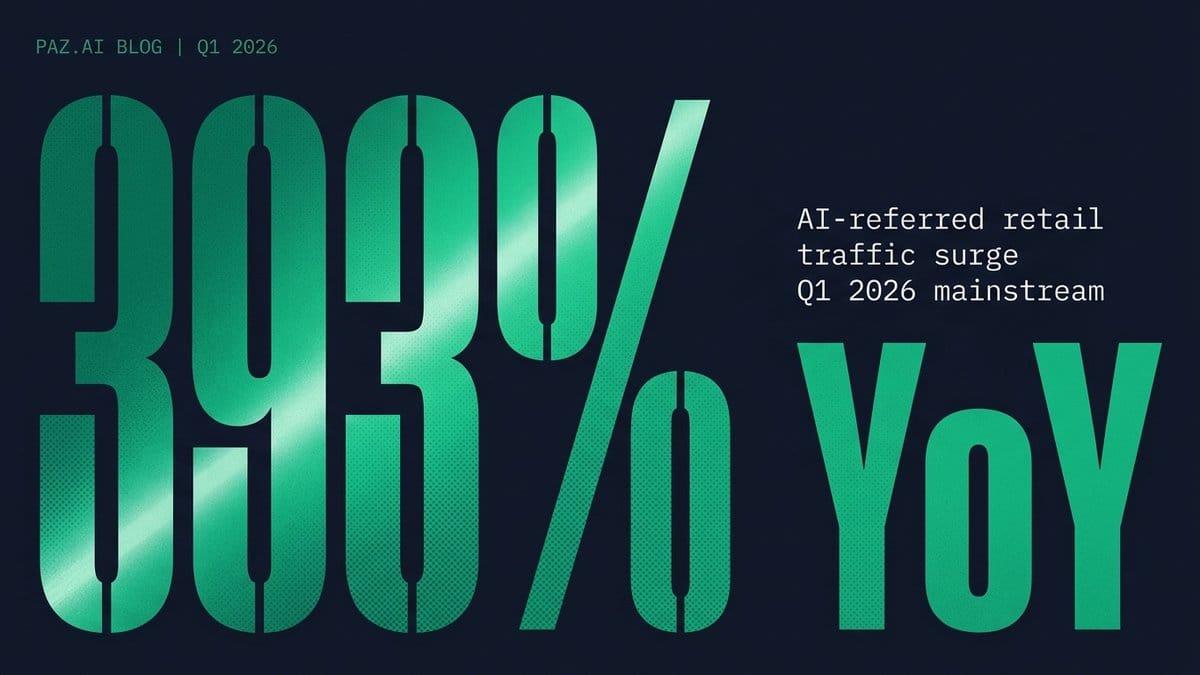
- AI-referred traffic to US retailers rose 393% year over year in Q1 2026.
- AI traffic converted 42% better than human traffic in March 2026. A year earlier, AI traffic converted 38% worse. That is an 80-point reversal in 12 months.
- AI visitors spent 48% longer on product pages, viewed 13% more pages per visit, and produced 37% higher revenue per visit than non-AI traffic.
- Roughly 34% of product pages on US retailer sites cannot be properly accessed by LLMs, per Adobe's AI Content Visibility Checker.
📊 The number brands cannot ignore: AI traffic now converts 42% better than humans. A year ago it converted 38% worse.
The observed data ends the "stated versus real" debate. Consumers are not just telling pollsters they use AI to shop. Retailers are recording the traffic. And that traffic is now worth more than the old channel.
What it all means
Three conclusions hold up across every source, stated and observed.
-
AI is now a real acquisition channel. Five surveys with combined sample size over 29,000 consumers put Q1 2026 AI shopping adoption between 30% and 50%. Adobe's observed data confirms it with a 393% YoY traffic surge. The "is this real?" debate is over.
-
AI wins on research, not checkout. Comfort with AI comparing prices sits at 58%. Comfort with AI spending money without approval is 27%. Brands should invest where the decision is formed, inside the AI response, not at the transaction layer.
-
The generational lead is structural. Gen Z and Millennial adoption runs 11 to 28 points ahead of older cohorts on every metric. These consumers are forming brand preferences right now that will carry forward. AI shopping is not a "will it last" question. It is a "who owns it" question.
The supply-side gap consumers don't see yet
One more signal is worth surfacing. Adobe's AI Content Visibility Checker found that about 34% of US retailer product pages cannot be properly accessed by LLMs. Even if 40% of consumers are asking AI to shop for them, more than a third of product pages are effectively invisible to the models answering.
Demand is here. Brand readiness is not. That gap, between AI shopping demand and AI-readable product data, is the central operating question for ecommerce leaders in 2026. You can run a free AI Readiness Report on any product page to see where your products land in ChatGPT, Google AI, and Perplexity today.
Frequently asked questions
How many consumers used AI for shopping in Q1 2026?
Between 30% and 50% of US online adults, depending on question phrasing. The IBM Institute for Business Value survey with the National Retail Federation (n=18,000 across 23 countries) says 45% of consumers turn to AI during their buying journey. Harris/Quad (n=2,180) says 51% prefer AI-powered shopping tools. Visa (n=2,000) says nearly 40% made a purchase they would not have considered because of AI. Adobe (n=5,000) says 39% have used generative AI for online shopping. Morgan Stanley AlphaWise (n=2,000) shows 20 to 40% across specific AI platforms.
What percentage of AI-referred traffic converts to purchases?
Adobe Analytics found AI-referred traffic converted 42% better than human traffic in March 2026. A year earlier, AI traffic converted 38% worse than humans. The reversal is one of the largest channel conversion shifts ever recorded in ecommerce.
Are consumers comfortable letting AI make purchases for them?
Partially. 58% are comfortable with AI comparing prices and 55% with AI applying discounts. Only 38% are comfortable with AI completing a purchase, and just 27% with AI spending without approval. OpenAI's March 2026 retreat from in-chat Instant Checkout aligns with this signal. Discovery is the opportunity. Checkout is not.
Are younger consumers using AI for shopping more than older ones?
Yes, by a large margin. Gen Z and Millennial adoption runs 11 to 28 percentage points higher than the overall population or older cohorts on every metric measured. 62% of Gen Z and Millennials prefer AI shopping tools, versus 51% overall. 48% of Gen Z trust payment-network-backed AI, versus 20% of Boomers.
What share of US retailer product pages are accessible to AI?
Adobe's AI Content Visibility Checker found about 34% of US retailer product pages cannot be properly accessed by LLMs as of Q1 2026. Demand for AI shopping exists at scale. Supply-side readiness lags.
Which AI shopping platforms are consumers using most?
Morgan Stanley AlphaWise tracks platform-specific usage. As of February 2026, Amazon Rufus holds around 40% usage, Meta AI grew by 4 points quarter over quarter after product cards rolled out, ChatGPT shopping and Google AI Mode remain in the 20 to 35% range, while Walmart Sparky and Target's TSA declined.
How AI-ready are your products?
Check how ChatGPT, Google AI, and Perplexity evaluate any product page. Free score in 30 seconds.