Salesforce Just Joined Shopify and commercetools in Syndicating to ChatGPT
- Author
- By Dor
- Publication date
- Published
- Last updated
- Updated
- Reading time
- 7 min read
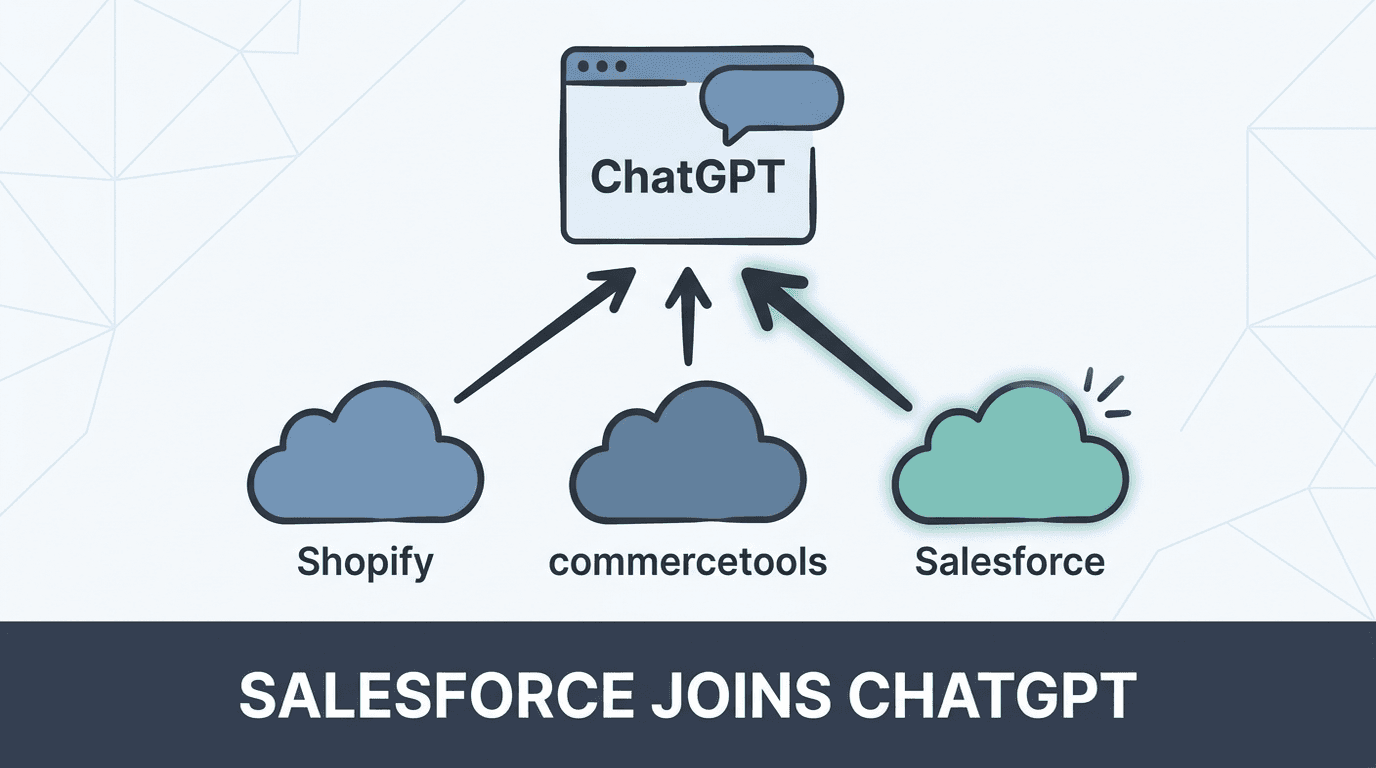
Salesforce Commerce Cloud confirmed on April 13 that its ChatGPT integration pilot is live, with Crocs and Pacsun among "dozens of retailers" already enrolled. With Salesforce in, all three major enterprise commerce platforms are now publicly syndicating merchant catalogs to ChatGPT for product discovery. Shopify was first. commercetools followed. Salesforce closes the set. If you run on Salesforce Commerce Cloud, the decision you were planning to make next year needs to be on this quarter's agenda.
TL;DR: Salesforce Commerce Cloud enrolled Crocs, Pacsun, and dozens of other retailers in a live ChatGPT syndication pilot announced April 13, 2026. All three enterprise commerce platforms (Shopify, commercetools, Salesforce) now syndicate product data to ChatGPT for discovery, not checkout. Platform-level syndication gets your products in the consideration set. Whether they actually get recommended is a separate layer of work on the merchant's side.
What Salesforce Actually Announced
Salesforce Commerce Cloud CMO Gordon Evans confirmed the pilot to Digital Commerce 360: the integration is syndication-based, meaning Salesforce merchants feed their product catalog to ChatGPT so the AI can discover and recommend products. It is explicitly not in-chat checkout. Shoppers still click through to the retailer's own site to buy. [Source: Digital Commerce 360, April 13, 2026].
Evans's own framing: "The idea is that we have syndication between the merchant's product catalog and ChatGPT so that it makes the merchant's product catalog more discoverable, more accurate and generally delivering better results for the shopper."
The scale of the footprint matters. 78 of the top 2,000 North American online retailers run on Salesforce Commerce Cloud, and those retailers combined for $192.6B in 2025 web sales. When that much revenue gets a standardized path into ChatGPT discovery, the competitive pressure on non-enrolled brands compounds fast.
The Enterprise Platform Landscape in April 2026
The three major enterprise commerce platforms each now have a public syndication story:
| Platform | ChatGPT Syndication | Notable Merchants | Launched |
|---|---|---|---|
| Shopify | Live via Shopify Agents | Published: 15x AI-driven order growth Q4 2025 | 2025 |
| commercetools | Live via composable commerce integration | Agentic-first posture across composable stack | Early 2026 |
| Salesforce Commerce Cloud | Live pilot | Crocs, Pacsun + "dozens" | April 13, 2026 |
Adobe Commerce / Magento is the notable absentee from the enterprise syndication club. They are active in agentic commerce (see the April 2026 Adobe AI Content Visibility Checker), but public syndication announcements have not yet landed at the same scale as Salesforce's pilot.
For Salesforce merchants specifically, the question shifts from "when will the platform support this?" to "how do we get the most out of the pilot we are already in?"
Key Stat: 78 of the top 2,000 North American online retailers run on Salesforce Commerce Cloud, combining for $192.6B in 2025 web sales. That is the catalog breadth now flowing into ChatGPT discovery.
Platform Syndication Is the Floor, Not the Ceiling
Here is the part that gets missed in most platform announcements. Syndication puts your catalog in the consideration set. It does not guarantee you get recommended.
Consider what happens after the feed lands inside ChatGPT:
- AI evaluates product attributes. If your Salesforce catalog has 5-8 structured attributes per SKU and a competitor's Shopify catalog has 30+, the competitor's product surfaces with a product card (image, price, availability). Yours gets a text mention, if that.
- AI ranks against the query. "Best sneakers for flat feet with arch support" does not match "Running Shoes - Men's." Category-level descriptions lose to attribute-rich product data every time.
- AI cross-references merchant info. Returns policy, shipping speed, warranty, price clarity. Missing fields reduce confidence and suppress recommendations.
- AI prefers product cards over mentions. Product cards drive purchases. Mentions drive awareness. The gap between "mentioned" and "shown as a product card" is where sales get lost.
The Salesforce syndication pilot solves step 1 in a generic sense (the feed exists) but not the attribute richness, merchant info completeness, or query-level ranking questions that determine which products AI actually recommends.
"AI agents are no longer just a cost-saving measure. They're a purchase and productivity accelerator."
- Caila Schwartz, Director of Consumer Insights, Salesforce
That quote aged well. The agents are accelerating sales, but they are accelerating them for the retailers whose data is ready to be accelerated.
Why Crocs and Pacsun Are a Signal
Crocs and Pacsun are not accidents. Both brands have been publicly invested in agentic commerce infrastructure. Both run rich product catalogs with detailed material, fit, use-case, and seasonality attributes. Both already compete against retailers like Zappos, Nordstrom, and Urban Outfitters that are live on ChatGPT via ACP.
For Crocs, the pilot is about defending share in footwear queries where Nike, Adidas, and Hoka are already recommended. For Pacsun, it is about capturing apparel queries where URBN brands (Anthropologie, Free People, Urban Outfitters) have been ranked for months.
The brands that enrolled first did so because they already knew where they stood in AI shopping results. They had been monitoring, they saw the gap, and they moved fast. The brands that will enroll in month three will be the ones that discover, belatedly, that their products are not being recommended.
What Should Non-Enrolled Salesforce Retailers Do This Month?
Five specific moves for any Salesforce Commerce Cloud merchant reading this:
- Ask your Salesforce account team about the ChatGPT syndication pilot. If you are eligible, get in. The Digital Commerce 360 report confirms "dozens of retailers" are already in, which means enrollment has rolling capacity.
- Audit attribute depth on your top 20% of SKUs by revenue. Count structured attributes per SKU. Anything under 15 will underperform against attribute-rich catalogs on Shopify. Anything under 8 is effectively invisible. (See our primer on product data enrichment for AI agents.)
- Clean up merchant info fields. Returns policy, shipping speed, warranty coverage, stock levels. AI agents surface these details inside product recommendations. Missing or stale values reduce your win rate.
- Run ghost queries. Pick five product queries that matter most in your category. Ask ChatGPT directly. See which brands show up, whether they show up as a product card or just a mention, and how your brand currently ranks. Repeat weekly.
- Decide who owns AI visibility. This work does not sit naturally inside SEO, paid search, or the PIM team. It spans all three. Someone needs the number, the budget, and the mandate before next quarter's planning cycle.
The Cross-Platform Reality Most Retailers Are Missing
Here is the part Salesforce's pilot does not solve: ChatGPT is one AI shopping surface. Google AI Mode is another. Perplexity is a third. Microsoft Copilot is a fourth. Gemini is a fifth. Each uses different protocols (ACP for ChatGPT and Copilot, UCP for Google surfaces, MCP for deeper integrations) and different data formats.
Salesforce's syndication pilot addresses ChatGPT specifically. It does not address Google AI Mode, which is now receiving 75M+ daily active users and recently added local in-stock inventory lookups plus side-by-side shopping in Chrome. It does not address Perplexity, whose ARR jumped from $67M in February to $100M in March 2026 [Source: PYMNTS, April 8, 2026]. It does not address Microsoft Copilot commerce surfaces.
A retailer optimizing only for ChatGPT leaves the other 4 major surfaces on autopilot. In April 2026, that is already a measurable gap.
The Competitive Clock Is Running
Here is what retailers often miss about platform integrations like this one: the pilot phase is short. Shopify's ChatGPT integration launched with partners in 2025 and was broadly available within months. commercetools followed quickly. Salesforce's pilot will follow the same curve. Within 6-9 months, the feature will not be a differentiator; it will be a baseline.
The differentiator is always one layer up. In a baseline where every major platform syndicates to ChatGPT, the differentiator becomes which brands have structured their data to be recommended. That is the work that does not happen at the platform level, and that is the work that takes months to produce results.
If you are still a year out from taking agentic commerce seriously, you will be a year behind when baseline syndication is universal. The retailers who moved in April 2026 will be the ones winning queries in April 2027.
Frequently Asked Questions
Is Salesforce's ChatGPT pilot actually live or a future announcement?
Live. Digital Commerce 360 confirmed on April 13, 2026 that Salesforce Commerce Cloud has enrolled "dozens of retailers," including Crocs and Pacsun. CMO Gordon Evans described the integration in past tense, indicating active syndication.
Does the pilot include in-chat checkout?
No. The integration is syndication-based. Salesforce merchants feed product catalogs to ChatGPT for discovery. Shoppers click through to the retailer's own site to complete purchases. This matches the architecture OpenAI moved to after discontinuing Instant Checkout in March 2026.
What do I do if I'm on Salesforce but not invited to the pilot?
Contact your Salesforce Commerce Cloud account team directly. Enrollment is rolling. In parallel, start the product data optimization work (attribute depth, merchant info completeness, weekly ranking checks) that determines whether your products will actually be recommended once the feed is live.
How is this different from Shopify's approach?
Both are syndication-based, not checkout-based. Shopify has been live longer and reports 15x AI-driven order growth in Q4 2025. commercetools took a similar composable approach. The three platforms increasingly look like a standardized baseline: all three syndicate, and the merchant's own data quality decides who gets recommended.
What about Adobe Commerce / Magento merchants?
Adobe has been investing in agentic commerce tooling (the Adobe AI Content Visibility Checker launched in April 2026), but has not announced a ChatGPT syndication pilot at the scale of Salesforce's. Adobe Commerce merchants should monitor Adobe's next round of announcements and, in the meantime, prepare product data for protocol-compliant feeds independently.
Will this drive measurable traffic?
For retailers who structure their catalogs well, yes. Adobe Q1 2026 data shows AI referral traffic grew 393% year-over-year and converts 42% better than typical visitors. For retailers who rely on the platform syndication alone without attribute optimization, the traffic lift will be modest at best.
Conclusion
Salesforce's pilot closes the enterprise platform set. The syndication layer is now standard. The differentiator has moved upstream, to product data quality, attribute depth, and protocol coverage across ChatGPT, Google AI Mode, Perplexity, and more. For Salesforce Commerce Cloud retailers, the work to capture what this pilot enables starts today, not when the pilot goes GA.
See exactly how your products are showing up across ChatGPT, Google AI Mode, and Perplexity. Run a free AI Readiness Report at paz.ai in under a minute.
Paz.ai, an agentic commerce optimization platform, helps retailers monitor how their products appear across ChatGPT, Google AI Mode, and Perplexity, enrich catalog data for AI comprehension, and distribute protocol-compliant feeds to every major AI shopping surface.
How AI-ready are your products?
Check how ChatGPT, Google AI, and Perplexity evaluate any product page. Free score in 30 seconds.