AI Traffic Is Small. Shopify's Q1 2026 Data Shows Why It Still Matters
- Author
- By Dor
- Publication date
- Published
- Last updated
- Updated
- Reading time
- 5 min read
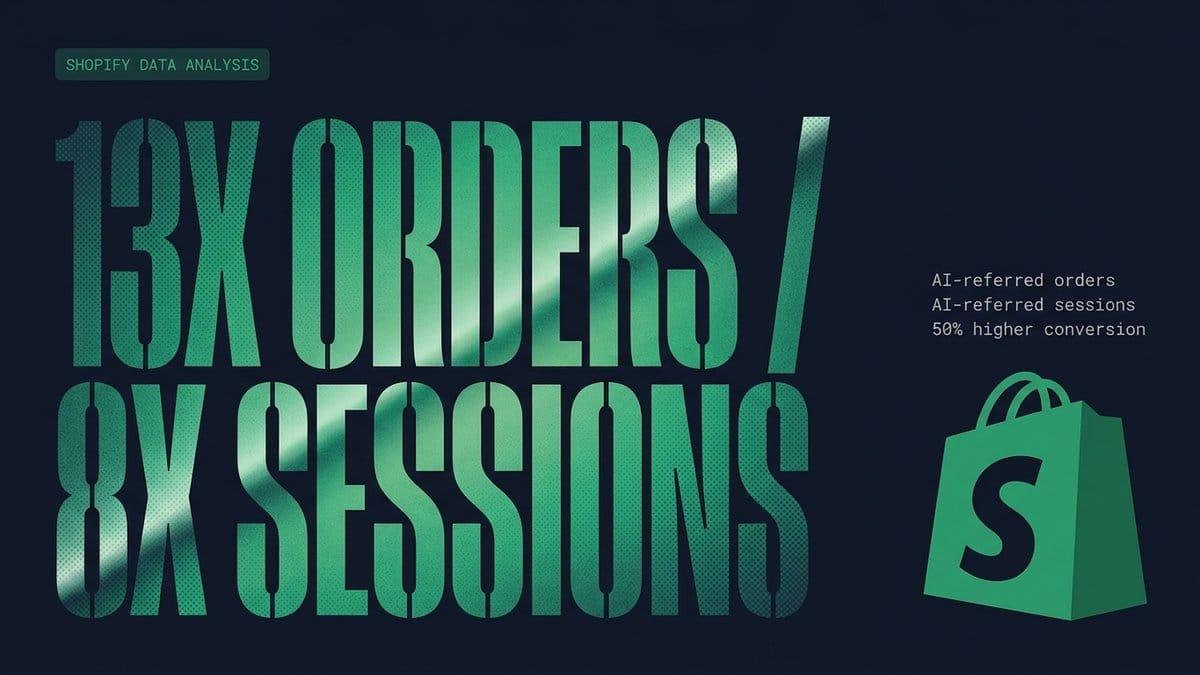
AI assistants send a small share of your sessions, and someone on the team wants to know why that deserves attention when organic search still carries the store. Shopify's Q1 2026 commerce data, published in May 2026, is the clearest answer so far. AI-referred orders on Shopify grew nearly 13x year over year while AI-referred sessions grew more than 8x. Orders outran visits by a wide margin. The traffic is not only growing, it is worth more per visit.
Most coverage of AI shopping fixates on volume. The more useful signal in Shopify's numbers is how differently the traffic behaved once it landed, and what decided whether it converted.
Why did AI orders outgrow AI sessions?
Because shoppers arriving from ChatGPT, Gemini, Perplexity, Copilot or Claude convert more often and spend more. Per Shopify's Q1 2026 data, AI-referred sessions convert at nearly 50 percent higher rates than organic search, and the orders carry 14 percent higher average order values. Fewer visits, more purchases per visit.
The reason is intent. More than half of AI-referred sessions start on a product page, compared with 20 percent for organic search, per the same Shopify data. An organic visitor often lands on a category page or a blog post and browses. A shopper who asked an assistant to compare options lands on the specific product it recommended. The research happened before the click. Adobe saw the same higher-intent pattern earlier in the year, which we covered in AI shoppers convert 42 percent better.
The pattern held across categories, not only in aggregate. On product page sessions, Shopify reported AI-referred conversion beat organic in 23 of 25 merchant categories, by an average of 56 percent within those categories. This is not a quirk of one vertical. It is the shape of the channel.
Is AI traffic big enough to matter yet?
Not in raw session volume, and that is the honest caveat. Organic search still refers more sessions to Shopify merchants than every tracked AI platform combined, and same-store organic sessions were up roughly 5 percent over the same period, per Shopify's Q1 2026 data. Anyone telling you AI has replaced search is selling something.
Two things complicate the too-small-to-bother reading. First, the growth curve. Shopify compared the 13x order growth to the early trajectories of mobile and social, channels that went on to reshape commerce. Second, the measurement gap. Shopify notes that some AI-assisted pathways, including Google AI Overviews, send referrals that standard analytics classify as organic search rather than AI. Google documents the same behavior for Google AI Mode.
The real share of AI-influenced orders is higher than the referral column shows. We walked through the fix in how to measure AI referral traffic in GA4 and Shopify.
So the channel is small, compounding, and partly hidden. That is the point at which the brands whose product data is already in order build a lead that is slow to close later.
What decides whether you get the conversion premium?
The premium is real, but it is conditional. It depends on whether the assistant could read your product information cleanly when it chose what to recommend. PYMNTS, covering the same Shopify quarter, reported that traffic from catalog-powered AI searches converts at twice the rate of general AI searches that rely on scraped or outdated data. In the same coverage, Shopify President Harley Finkelstein said the company has structured more than 1 billion products with clean attributes, real-time pricing and accurate inventory.
Read that twice. The 50 percent conversion lift is not a gift that arrives with every AI visitor. It is what happens when the assistant surfaced your product because it could resolve the price, the variants, the availability and the attributes without guessing. When the data is thin or stale, the assistant either skips the product or sends a shopper to a page that does not match what it described, and the premium disappears.
That is why the work sits in product content and in the feed rather than in a new channel strategy. When a shopper asks for the best waterproof hiking boots under $150 for wide feet, the assistant looks for products whose data answers each part of that question. If your page says "premium all-weather performance" and nothing about width or waterproof rating, you are not in the comparison.
How AI-referred and organic traffic compared
Here is the Q1 2026 contrast in one view, all figures from Shopify's Q1 2026 data.
- Session growth, year over year: AI-referred more than 8x. Organic search roughly 5 percent, same store.
- Order growth, year over year: AI-referred nearly 13x. Organic not broken out.
- Conversion rate: AI-referred nearly 50 percent higher than organic search.
- Average order value: AI-referred 14 percent higher than organic search.
- Sessions starting on a product page: more than half for AI-referred, about 20 percent for organic.
Organic is the larger, steadier base. AI is the smaller, faster, higher-value layer growing on top of it. For a lean team this is not a choice between the two. It is a reason to make sure the products an assistant would recommend are products it can describe accurately.
What a lean team should decide
You do not need a platform migration to act on this. You need to know where you stand and fix the product information that gates the premium.
- Measure the split. In GA4, separate sessions from chatgpt.com, perplexity.ai, gemini.google.com, copilot.microsoft.com and claude.ai from organic search, and compare conversion rate and average order value. If you see the Shopify pattern, the channel is already paying you.
- Check the product pages shoppers land on. More than half of AI sessions start on a product page. Open your top 20 sellers and confirm price, availability, variants and the attributes shoppers ask about are stated on the page and match the feed.
- Fix price, stock and attribute mismatches first. A product whose feed price differs from its page price, or whose stock status is stale, is the fastest way to lose a recommendation or send a mismatched click.
- Ask the questions yourself. Put a handful of real customer questions to ChatGPT, Gemini and Google AI Mode. Note whether you appear, on which products, and whether you appear as a product card or only a link. Absence is the diagnosis. The free AI readiness report runs this check for you.
Frequently asked questions
Why did AI orders grow faster than AI sessions on Shopify?
Because AI-referred shoppers convert at higher rates and spend more. Per Shopify's Q1 2026 data, AI-referred sessions convert nearly 50 percent higher than organic and carry 14 percent higher average order values, so each additional visit produced more orders than an organic visit would.
Is organic search dead for ecommerce?
No. Shopify reports organic still refers more sessions than all tracked AI platforms combined, and same-store organic sessions grew about 5 percent year over year. AI is a fast-growing, high-value layer on top of organic, not a replacement for it.
Why do AI-referred shoppers convert better?
Intent and timing. More than half of AI sessions start on a product page versus 20 percent for organic, because the shopper already compared options with an assistant before clicking. They arrive closer to a purchase decision.
Does clean product data really affect conversion?
Yes. PYMNTS reported that catalog-powered AI searches convert at twice the rate of AI searches relying on scraped or outdated data. If an assistant cannot read your price, variants and availability, it either skips you or sends a mismatched click.
The headline number from Shopify's quarter is not the 13x. It is the gap between 13x orders and 8x sessions. That gap says the new traffic is worth more per visit, and that it is worth more only when the assistant can read what you sell.
This is the work Paz does for lean ecommerce teams: a Paz expert finds the gaps in your product data and feed, proposes the fixes with evidence, you approve, and the platform publishes them and tracks the before and after in AI visibility, sessions and orders. Talk to us.
How AI-ready are your products?
Check how ChatGPT, Google AI, and Perplexity evaluate any product page. Free score in 30 seconds.