How to Measure AI Referral Traffic in GA4 and Shopify
- Author
- By Dor
- Publication date
- Published
- Reading time
- 6 min read
GA4 finally gave AI traffic its own row. On May 13, 2026, Google added a native "AI Assistant" channel that classifies visits from ChatGPT, Gemini, and Claude with zero setup. That sounds like the measurement problem is solved. It isn't. The new channel counts the floor of your AI traffic, not the ceiling, and it leaves your biggest AI source hiding in plain sight.
TL;DR: GA4's native "AI Assistant" channel (live May 13, 2026) auto-classifies ChatGPT, Gemini, and Claude referrals, but 20 to 40 percent of AI visits arrive with no referrer and land in Direct, and Google's own AI Mode still counts as Organic Search. To measure AI traffic honestly you need a custom channel group, a UTM discipline for feeds, and a way to reconcile GA4 with Shopify's own analytics. Here is the setup.
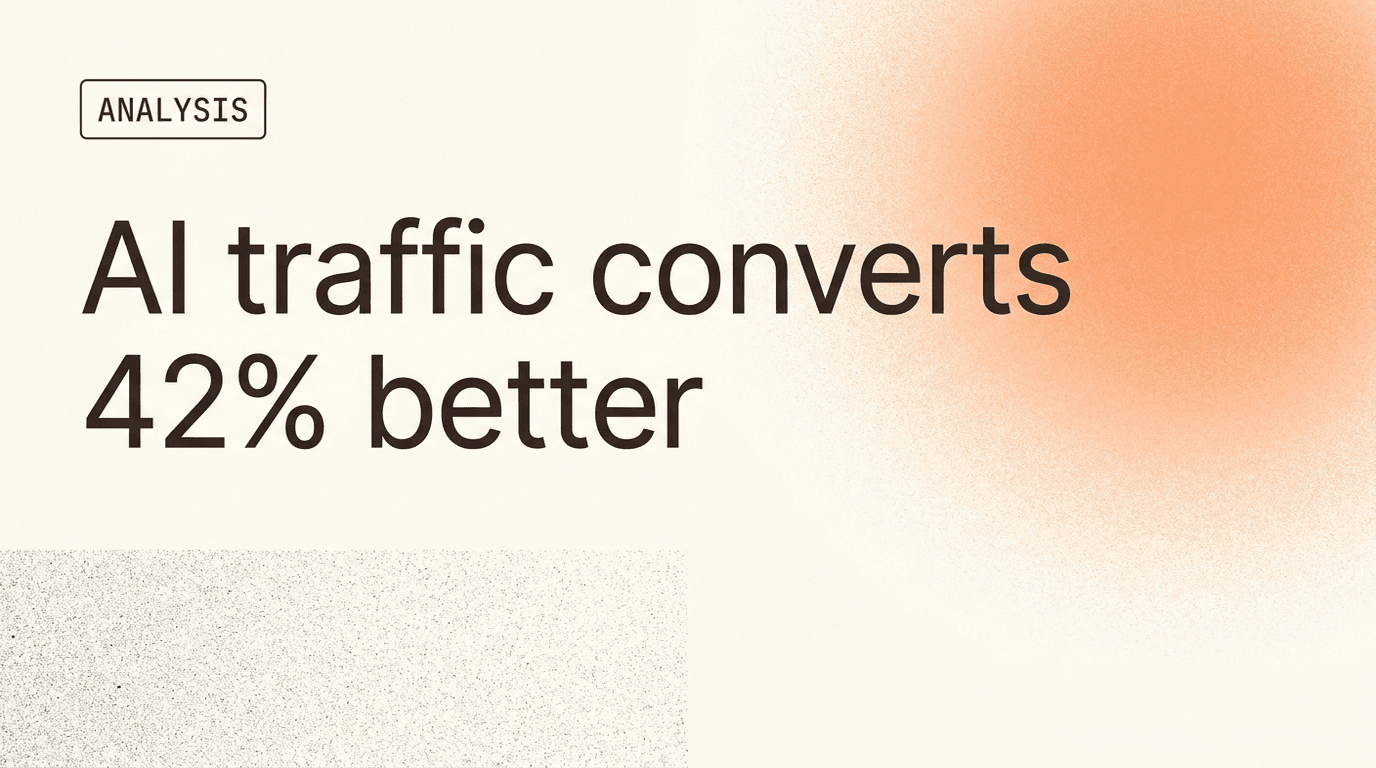
Adobe Digital Insights found that AI-driven traffic converted 42% more often than non-AI traffic as of March 2026, a full reversal from a year earlier when AI visitors converted at roughly half the rate (Digital Commerce 360). If your best-converting channel is the one you can't measure cleanly, you are flying blind on the fastest-growing source of qualified shoppers you have.
What did GA4 actually change on May 13, 2026?
GA4 added an "AI Assistant" channel to the Default Channel Group. When Google detects a referrer matching a recognized AI assistant, it assigns "ai-assistant" as the medium, groups the session under "AI Assistant," and labels the campaign "(ai-assistant)." No regex, no custom setup (Search Engine Journal).
Google has confirmed ChatGPT, Gemini, and Claude as recognized referrers but has not published the full list. Two limits matter for retailers. The change is not retroactive, so May 13 is your baseline and everything before it stays miscategorized. And the channel only catches visits that carry a referrer header. That is the catch that undoes the convenience.
Why the native channel undercounts your real AI traffic
The native channel captures the floor, not the ceiling. Between 20 and 40 percent of AI-originated visits arrive with no referrer header and get bucketed as Direct (SEO Sherpa). Mobile apps, in-app browsers, and agent browsers commonly strip the referrer, so a shopper who taps a product link inside the ChatGPT app can show up as if they typed your URL from memory. This is the same shift that broke page-level tracking, because AI search retrieves at the passage level, not the tidy click level analytics tools were built for.
There is a second blind spot that hits harder for commerce. Google's own AI Mode and AI Overviews are excluded from the AI Assistant channel and continue to count as Organic Search. For a retailer, Google's AI surfaces are often the largest agentic discovery channel of all, and GA4 hides them inside a bucket you already think you understand.
Between 20 and 40 percent of AI-originated visits still arrive without a referrer header and land as Direct. The channel captures the floor of AI traffic, not the ceiling.
The practical consequence: if you report AI traffic straight off the native channel, you will understate it, misattribute a chunk to Direct, and fold Google's AI discovery into Organic. Three different errors, all pointing the same way, all making AI look smaller than it is. Understanding how AI decomposes a shopping query through query fan-out explains why so many of these sessions never carry a clean referrer in the first place.
How to build a custom AI channel group in GA4
A custom channel group closes the referrer-header gaps the native channel leaves open and lets you fold in sources Google has not added yet. In GA4's free tier you get two custom channel groups, each holding up to 25 channels. Here is the build.
- Go to Admin, then Data Settings, then Channel Groups, and click Create new channel group. You cannot edit the default group, so this is a parallel view.
- Add a channel named "AI Search." Under Channel Conditions, choose the Source dimension and select "matches regex."
- Use a starting pattern that captures the main assistants:
^(chatgpt|perplexity|gemini|copilot|claude|openai\.com|poe\.com)and extend it as new surfaces appear. - Drag the "AI Search" channel above Referral and Organic Search. GA4 evaluates channels top-down, so if AI sits below Referral, those sessions get claimed by Referral first.
- Save the channel and the group. View it under Reports, then Acquisition, then Traffic Acquisition, switching the dimension dropdown to your custom group.
This still won't recover referrer-less Direct sessions or Google's AI Mode traffic, but it stops leaking the referrers you can see into the wrong buckets. Pair it with the AI readiness work that determines whether AI surfaces you at all, because clean measurement of zero traffic is still zero traffic.
How to close the app and agent-browser gap with UTMs
The referrer-less Direct problem is not fully solvable in GA4 alone, but you can tag the traffic you control. If you syndicate a product feed to AI commerce channels, append UTM parameters to the destination URLs so the click lands with explicit attribution instead of a stripped referrer.
| Signal source | GA4 default bucket | What to do |
|---|---|---|
| ChatGPT, Gemini, Claude web referral | AI Assistant (native) | Confirm with custom channel group |
| ChatGPT app, agent browsers (no referrer) | Direct | Tag feed URLs with UTMs |
| Google AI Mode and AI Overviews | Organic Search | Segment landing pages, watch query mix |
| Perplexity, Copilot, others | Referral or Direct | Add to custom regex + UTMs |
A consistent UTM scheme (utm_source=chatgpt&utm_medium=ai_feed, for example) turns an otherwise invisible app click into a labeled session. This matters because feeds are where AI discovery actually converts to a visit. Structuring and tagging the feed that surfaces you inside ChatGPT is the same work that makes you discoverable and measurable at once.
How to reconcile GA4 with Shopify analytics
Shopify's own analytics and GA4 will not match, and that is expected. Shopify attributes sessions and orders using its first-party data and its own last-click model, while GA4 uses its channel waterfall and its own attribution windows. Neither is wrong; they answer different questions.
Use Shopify to confirm orders and revenue by source, since it sees the checkout GA4 does not. Use GA4 for session-level channel behavior and for the custom AI grouping. When you compare them, reconcile on order count and revenue rather than sessions, because session definitions differ across the two systems. If Shopify shows AI-tagged orders that GA4 filed under Direct, that gap is your referrer-stripping problem quantified. Retailers who treat agentic commerce as a measurable channel, not a mystery, are the ones who can defend the budget to invest in it.
What to Do This Week
- Turn on the view: create a custom AI channel group in GA4 today, place it above Referral and Organic, and start collecting a clean baseline alongside the native channel.
- Tag your feeds: add consistent UTM parameters to every product-feed destination URL you syndicate to AI channels so app and agent clicks stop vanishing into Direct.
- Segment Google: build a GA4 exploration that isolates Organic Search landing pages and watch for the AI Mode pattern, since that traffic is hiding inside Organic.
- Reconcile monthly: pull AI-attributed orders from Shopify and compare against GA4's AI channel to size your referrer-stripping gap.
- Fix the source: if AI traffic is near zero, the measurement is not the problem. Run a check on whether AI surfaces show your products at all before optimizing the dashboard.
Frequently Asked Questions
Does GA4 track ChatGPT traffic automatically now?
Yes, as of May 13, 2026, GA4's native "AI Assistant" channel automatically classifies referrals from ChatGPT, Gemini, and Claude. It only captures visits that carry a referrer header, so app-based and agent-browser visits without a referrer still land in Direct and need UTM tagging to recover.
Why does my AI traffic show up as Direct in GA4?
Between 20 and 40 percent of AI visits arrive with no referrer header, usually from mobile apps, in-app browsers, or agent browsers that strip referrer data. GA4 has no source to read, so it defaults those sessions to Direct. UTM parameters on links you control are the reliable fix.
Is Google AI Mode traffic counted as AI in GA4?
No. Google's AI Mode and AI Overviews are excluded from the AI Assistant channel and continue to be classified as Organic Search. For retailers this is often the largest AI discovery source, so treating Organic as purely traditional search understates AI's real impact on your store.
Why don't GA4 and Shopify analytics match on AI traffic?
The two systems use different attribution models, session definitions, and data sources. Shopify sees the checkout and attributes orders with first-party data; GA4 uses a channel waterfall. Reconcile them on order count and revenue rather than sessions, which are defined differently in each tool.
How much better does AI traffic convert?
Adobe Digital Insights reported that AI-driven traffic converted 42% more often than non-AI traffic as of March 2026, with 37% higher revenue per visit and 48% more time on site (Digital Commerce 360). That is a reversal from a year earlier, when AI visitors converted at roughly half the rate of non-AI traffic.
The retailers winning the next phase of shopping are not the ones with the prettiest AI dashboard. They are the ones who measure AI traffic honestly enough to know it is their best-converting channel, then act on it before their competitors even see the numbers. GA4's new channel is a useful start. Treat it as the floor it is, build the view that captures the ceiling, and reconcile it against the checkout that actually books the revenue.
How AI-ready are your products?
Check how ChatGPT, Google AI, and Perplexity evaluate any product page. Free score in 30 seconds.