Walmart's Shopping Agent Is Now the Shelf. Are You On It?
- Author
- By Dor
- Publication date
- Published
- Reading time
- 6 min read
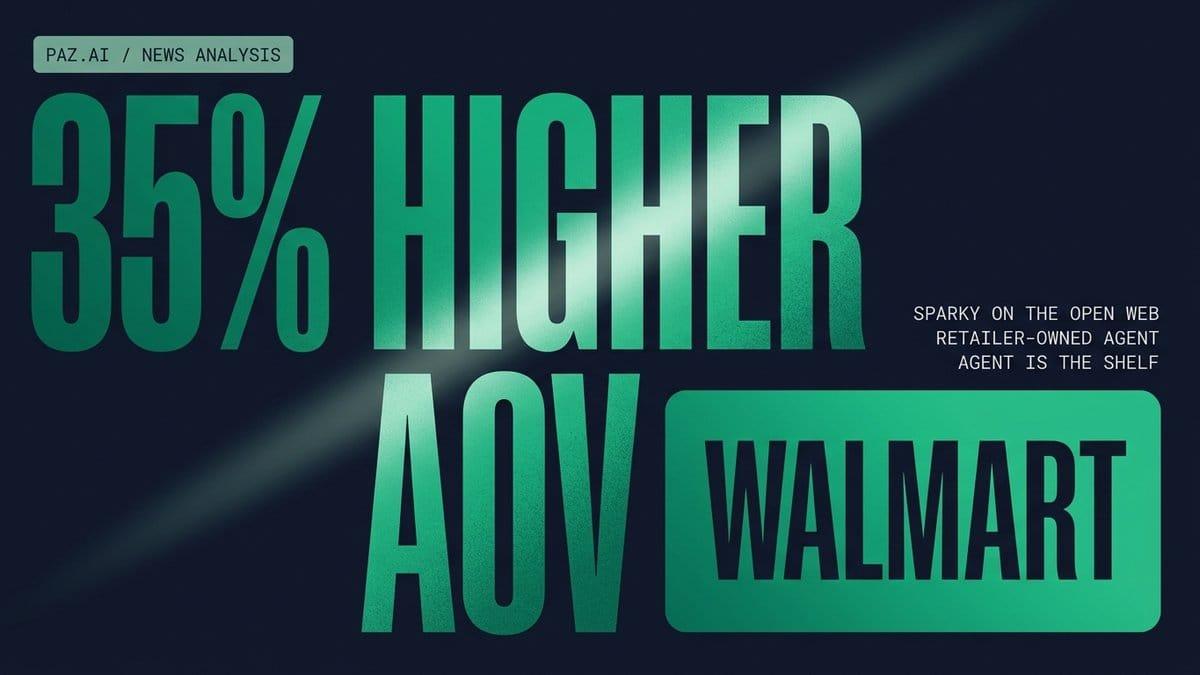
Walmart just took Sparky off the app and put it on the open web. Its shopping agent now greets every visitor, picks what to surface first, and carries a 35% higher average order value than shoppers who skip it. For a brand stocked at Walmart, the category grid is no longer where the sale starts. The agent's first answer is.
TL;DR: Walmart's Sparky shopping agent is now live across its website, app, and stores, with weekly active users up more than 100% in a single quarter and units purchased through it up more than fourfold. When a retailer's own agent becomes the discovery layer, brands compete inside the agent's recommendation, not the search results page. The fix is the same one open-web AI discovery demands: machine-readable product data and a way to measure whether the agent surfaces you at all.
What Changed With Sparky in June 2026?
Walmart expanded Sparky from a logged-in mobile feature to a cross-surface agent running on its website, mobile app, and in-store systems. Walmart first introduced Sparky in June 2025 as a generative AI shopping assistant, framing it as a trusted shopping partner. On the Q1 FY2027 earnings call, CEO John Furner said weekly active users grew more than 100% in a single quarter and that response quality improved 40% this year, per Digital Commerce 360.
Walmart U.S. CEO David Guggina said Sparky now handles personalized replenishment, meal planning, and recommendations tuned to inventory, price, and delivery speed. The agent started as a general-merchandise discovery tool. It has since pulled in everyday essentials like food and consumables, and units purchased through it have more than quadrupled quarter over quarter.
Sparky users carry an average order value about 35% higher than non-users, per Furner's Q1 FY2027 remarks reported by Digital Commerce 360.
Furner tied Walmart's 26% global e-commerce growth in the quarter directly to Sparky and related AI investments. That is the part most brand teams are underreading: this is not a chatbot pilot. It is a production discovery layer driving measurable basket economics at the second-largest online retailer in North America.
Why a Retailer's Own Agent Is Different From ChatGPT
Two models of agentic shopping now run side by side, and they put different demands on your catalog. Open-web agents like ChatGPT, Google AI Mode, and Perplexity recommend across the whole market. A retailer-owned agent like Sparky recommends only from the catalog it already carries, on the retailer's own surface.
That distinction matters for where the competition happens. On ChatGPT, you compete against every brand on the open web for the agent's pick. On Sparky, you compete against the other brands Walmart stocks in your category, inside the retailer's own ai-shopping-assistant. The shelf moved from the category grid to whatever the agent answers first.
| Open-web agents (ChatGPT, Gemini) | Retailer agent (Sparky) | |
|---|---|---|
| Where it runs | The AI platform's surface | Walmart's site, app, stores |
| Catalog scope | The open market | Only Walmart's assortment |
| You compete against | Every brand on the web | Other brands Walmart stocks |
| What decides surfacing | Your product data quality | Your product data quality |
Notice the bottom row. Both models reward the same thing. Whether the agent reads your product clearly enough to recommend it, and to show it as a card with image, price, and specs rather than a passing mention, comes down to how machine-readable your data is. The surface changed. The gating factor did not.
What Sparky's Numbers Tell Brands About AI Discovery
The 35% AOV lift is the signal worth sitting with. It means agent-surfaced shoppers are not just substituting a chat box for a search bar. They are building bigger baskets, which happens when the agent confidently recommends complementary and higher-consideration products. Confidence comes from data the agent can parse.
The quadrupling of units purchased through Sparky, paired with the shift toward replenishment and everyday essentials, shows how a retailer agent compounds. Once a shopper trusts the agent for the weekly meal plan, the same agent gets the benefit of the doubt on the occasional higher-margin purchase. A brand that the agent never surfaces in that weekly habit loses the easy reorder and the downstream consideration.
This is the same dynamic Paz has tracked across open-web surfaces, where being mentioned is common but being shown as a product card is rare. The gap between "the agent mentioned my brand" and "the agent recommended my specific product with a card" is where revenue leaks. On a retailer agent with this kind of AOV lift, that gap is more expensive, not less.
Can You See What the Agent Recommends For Your Category?
Most brands cannot. They have no read on what Walmart's agent surfaces when a shopper asks for products in their category, which competitor it favors, or whether it shows their product as a recommendation or skips it. That blind spot is the core problem, because you cannot fix a placement you cannot see.
Open-web AI discovery has a vocabulary for this. AI share of voice measures how often and how prominently an agent surfaces your products versus competitors across many queries. The same measurement logic applies to a retailer agent: run the queries a real shopper would ask, see whether the agent returns you, and track it over time.
The mechanism underneath both is query decomposition. When a shopper asks Sparky for "an easy weeknight dinner under $20," the agent does not run one keyword search. It breaks the request into sub-questions about meal type, budget, dietary needs, and what is in stock, then assembles an answer. If your product data does not answer those sub-questions in machine-readable form, you are absent from the assembled result. This is the commerce version of the retrieval shift we covered in query fan-out for commerce.
How Retailer Agents Fit the Broader Discovery Shift
Sparky is one instance of a pattern that is widening fast. Merchant-owned agents are appearing across retail, and they sit alongside the cross-brand discovery surfaces. JPMorgan made the case earlier this year that agentic commerce starts on the retailer's own properties before it reaches ChatGPT, an argument we unpacked in why agentic commerce starts on your site.
For a brand, that means the work is not "optimize for ChatGPT" or "optimize for Sparky." It is to get your product data clean enough that any agent, on any surface, can read it, rank it, and show it as a recommendation. That is the core of agentic commerce optimization: one body of well-structured data that performs everywhere agents shop. The retailer agent is simply the newest surface to demand it, and the one with the clearest revenue proof so far.
The retailers winning here are not waiting for brands to catch up. Walmart is building a usage flywheel that gets harder to dislodge each quarter. The brands that read their product data the way an agent reads it, and measure what the agent does with it, are the ones who stay on the shelf as the shelf moves.
What to Do This Week
- Pick five real shopper queries in your category and run them against Walmart's Sparky agent on the web. Note whether it returns your product, a competitor's, or a generic answer. Write down what you see. That is your baseline.
- Audit your product data the way an agent parses it. Count the attributes on your top SKUs. If you have 5 to 8 where agents need 30-plus (title, materials, dimensions, use cases, compatibility, care, dietary flags), that is your card gap.
- Separate "mentioned" from "shown as a card." For each query above, mark whether the agent named your product specifically or only your brand in passing. The card is what drives the purchase.
- Check your structured data feed. Confirm your retailer-facing catalog has clean, complete, machine-readable attributes, not marketing copy. Tools like our AI Readiness Report score this in about 30 seconds.
- Set a cadence to re-measure. Agent recommendations shift with inventory, price, and the agent's own model updates. A one-time check is a snapshot; a weekly read is a signal.
Frequently Asked Questions
What is Walmart Sparky?
Sparky is Walmart's generative AI shopping assistant, first introduced in June 2025 and now live across Walmart's website, mobile app, and physical stores as of mid-2026. It handles product discovery, replenishment, meal planning, and recommendations, and Walmart says its users spend about 35% more per order than non-users.
Does Sparky replace ChatGPT or Google AI Mode for brands?
No. Sparky recommends only from Walmart's own assortment on Walmart's surfaces. Open-web agents like ChatGPT and Google AI Mode recommend across the whole market. Brands need to be readable on both, because the data quality that wins on one surface is what wins on the other.
Why does a 35% higher average order value matter?
It shows agent-surfaced shoppers build bigger baskets, not just swap a search box for a chat box. That makes being surfaced by the agent more valuable, and being skipped more costly, than ordinary search placement.
How do I know if Sparky recommends my products?
Run the queries your shoppers would ask and observe what the agent returns. Track it across many queries to estimate your AI share of voice on that surface. Most brands have no measurement here today, which is the gap to close first.
What kind of product data do AI shopping agents need?
Agents need structured, complete attributes they can parse: clear titles, materials, dimensions, compatibility, use cases, and category-specific fields like dietary flags or ingredients. Marketing copy alone does not give an agent enough to recommend a product confidently or show it as a card.
A retailer's own agent surfacing your product is the clearest, best-paying version yet of the question every AI surface now asks: can the machine read you well enough to recommend you? Walmart just attached a 35% basket premium to the answer. The brands treating their product data as something an agent reads, not just something a human skims, are the ones who stay on the shelf as the shelf keeps moving.
How AI-ready are your products?
Check how ChatGPT, Google AI, and Perplexity evaluate any product page. Free score in 30 seconds.