ChatGPT Got Smarter, Faster, and Cheaper to Advertise On
- Author
- By Dor
- Publication date
- Published
- Last updated
- Updated
- Reading time
- 7 min read
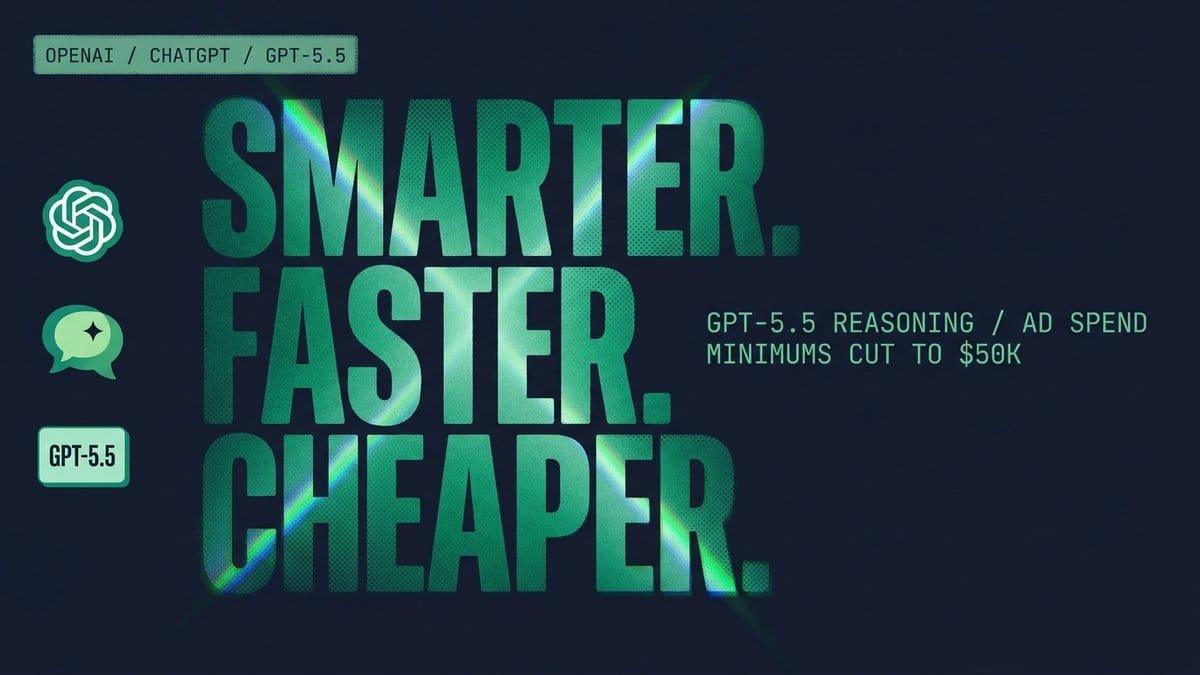
OpenAI shipped three changes this week that look unrelated. They are not. GPT-5.5 reasons harder. Fast Answers returns more common queries before the model thinks. And the ad platform cut its minimum spend from $250K to $50K with CPC bids of $3 to $5. All three push the same direction: brands that want to show up in ChatGPT shopping results without paying need structured, retrievable product data.
TL;DR: ChatGPT's April 2026 updates make the model smarter at filtering merchants (GPT-5.5), faster at answering without deep reasoning (Fast Answers), and cheaper for commerce advertisers to buy paid placement on ($50K minimum, CPC pricing). The organic retrieval layer, fed by product feeds and catalog structure, is the only lever brands have to stay visible without paying. Feed quality, not brand name, decides what ChatGPT surfaces.
What actually changed in ChatGPT this week
Three updates landed April 21-23. Each is a product note on its own. Together they describe a platform moving from "chatbot that shops" to a discovery surface with a working ad business.
GPT-5.5 shipped April 23. OpenAI called it their "smartest and most intuitive" model, with GPT-5.5 Pro heading to Pro, Business, and Enterprise tiers. Greg Brockman, OpenAI's president, framed the release as a step "closer to the creation of OpenAI's super app," per TechCrunch's coverage. Pricing doubled versus the GPT-5 line, now $5 per million input tokens and $30 per million output tokens (see OpenAI's launch post). That pricing tells you who OpenAI thinks is paying: applications where reasoning quality earns the cost, including commerce workflows that compare and recommend.
Fast Answers rolled out globally on April 22. Per the OpenAI ChatGPT release notes, Fast Answers returns quicker, high-confidence responses to common info-seeking queries. It does not reference past chats or memory. It fires before deep reasoning. For shopping prompts that look routine ("what's a good water flosser under $80"), Fast Answers can resolve the query from cached retrieval without the model taking a second pass through context.
The ad platform pivoted to CPC and cut the floor. The Next Web and Stacker reported that OpenAI moved from a $60 CPM model to $3 to $5 CPC bids, and dropped the minimum ad spend from $250K to $50K. That is a five-fold reduction in barrier to entry. Criteo joined the ChatGPT ad pilot in March 2026 with roughly 17,000 commerce advertisers in tow.
Why these three land together
Each update, on its own, is a product tweak. Stacked, they describe a surface where the cost of being invisible is going up faster than the cost of showing up.
Key stat: OpenAI cut the minimum ad spend for ChatGPT from $250K to $50K and moved from CPM to $3-$5 CPC bids, per The Next Web. Criteo brought ~17,000 commerce advertisers into the pilot in March 2026.
GPT-5.5 is a better filter. When ChatGPT reasons harder at each retrieval step, it rejects thin product listings faster and rewards catalogs with enough structured context to support comparison, specification checks, and shopper constraints. The OpenAI product discovery page confirms that 70% of discovery searches include constraints. Constraint-heavy prompts are where GPT-5.5's reasoning lift shows up: more filtering, more merchants quietly dropped from the result set.
Fast Answers is a worse filter but a faster one. For routine shopping queries, Fast Answers can return cached or pre-ranked results without a full reasoning pass. That shifts the decision earlier in the pipeline, to the retrieval layer. There is no "ChatGPT will reason its way to my brand" when the answer fires before reasoning. Whatever is in the index is what gets returned.
The ads pivot is the monetization side of the same coin. A $50K floor with CPC pricing is a Shopify-grade ad product, not an enterprise-only experiment. Brands that could not justify a $250K commitment are now inside the funnel. The catch: paid placements will show up next to organic ACP product results. Brands without clean, structured product data will see competitors show up in both places while they show up in neither.
The retrieval layer is the only organic lever left
In a world where the model is smarter, the cache is faster, and the paid floor is lower, what's the organic lever? Feed quality. Not brand strength, not SEO backlinks, not how long you've been on Shopify.
Here's the stack of inputs that decide what ChatGPT surfaces when a shopper asks about your category:
| Input | Who controls it | What it decides |
|---|---|---|
| ACP product feed | Merchant (via Shopify / Stripe / paz-style distribution) | Whether your product is in the retrieval index at all |
| Google Merchant Center feed | Merchant | Often syndicated into ChatGPT retrieval (see our note below) |
| Product page structured data | Merchant | Fallback when feed is thin |
| Brand authority / reviews | Third parties | Small lift at comparison stage |
| Paid placement | Merchant (now from $50K) | Guaranteed surface if you bid enough |
Three of those five inputs are product data you write and publish. Paz.ai, an agentic commerce optimization platform, sits on the monitoring and distribution side of that stack: we measure how products appear across ChatGPT, Google AI Mode, and Perplexity, then push enriched feeds to Google Merchant Center and the OpenAI commerce product feed. The point is that the retrieval layer is where organic visibility is earned or lost in 2026. If you are invisible there, the only remedy is to pay.
Related context: we wrote up how 83% of ChatGPT shopping results come from Google Shopping on April 16. That dependency has not gone away with GPT-5.5. A smarter model still retrieves from the same feed surface.
What this means for mid-market brands
Enterprise retailers (Target, Sephora, Walmart, Lowe's) have ACP integration teams. Per OpenAI's product partnerships announcement, they are already live. Mid-market brands, the $50M-$500M direct-to-consumer and multi-brand sellers, are the ones this week's updates bite hardest. Three reasons:
First, you can now afford the ads ($50K floor) but you can't afford to only pay for distribution. CPC economics only work if your product converts, which means the landing experience and the product page have to match what the ad promised. That is basic performance marketing, but it is newly relevant in ChatGPT because the click now lands on your site, not on a ChatGPT checkout page. OpenAI discontinued Instant Checkout in March 2026. The shopper buys on the retailer's site.
Second, organic visibility is the multiplier on every dollar you spend on paid. If the model's cold retrieval already surfaces you in 40% of relevant queries, your paid ads compound on a known brand. If it surfaces you in 0% of relevant queries, your paid ads are teaching ChatGPT who you are from scratch, one click at a time. That is expensive learning.
Third, Fast Answers and GPT-5.5 are live for all plans now. By the time you have a feed strategy in Q3, your competitors will have been in the retrieval index for two quarters.
What to Do This Week
- Audit your ChatGPT retrieval coverage. Take 20 real shopper prompts in your category, run them through ChatGPT, and count how often your brand and products appear. Break it down by product card shown, product mentioned, brand mentioned, source cited. Tools like our AI Readiness Report can run this fan-out for you in under a minute.
- Pull your Google Merchant Center feed and check attribute coverage. If your feed has only the required 5-8 attributes, you are invisible to the stricter filtering layer GPT-5.5 just shipped. Aim for 25-plus structured attributes per SKU. See our take on why structured product data is now infrastructure.
- Decide on ACP feed syndication. If you are on Shopify, confirm your agentic storefront is active; if you are not, get on the ACP retrieval index via a syndicator or direct integration. Background in our agentic commerce explainer.
- Model the CPC math before buying ads. At $3-$5 CPC and a 2-4% conversion rate on category-intent traffic, your breakeven requires a product margin of at least 15-20%. If your catalog skews lower margin, organic retrieval is not optional; it's your only viable channel.
- Track AI referral traffic in GA4. Add a custom channel group for known AI user agents (chatgpt.com, gemini.google.com, perplexity.ai, copilot.microsoft.com) so you can see which surfaces are sending traffic.
Frequently Asked Questions
Does GPT-5.5 change how ChatGPT shopping results are ranked?
Not the ranking signal itself, but the filter quality. GPT-5.5 reasons more rigorously at each retrieval step, which means thin listings and catalogs with missing attributes get filtered out earlier. Retrieval still runs on the product feeds and structured data merchants publish.
Will Fast Answers hurt product discovery?
For routine shopping prompts it compresses the reasoning window, favoring merchants already in the retrieval index with strong structured data. Constraint-heavy prompts still route through full reasoning. Net effect: retrieval-layer quality matters more for high-confidence queries.
Is the $50K ChatGPT ad minimum a good deal for mid-market brands?
At $3-$5 CPC with Criteo's commerce inventory, it is a credible performance channel. But it is not a substitute for organic retrieval. Brands without ACP feeds or Merchant Center syndication will pay higher effective CPCs because every click has to re-teach the model who they are.
Can ChatGPT users actually buy inside the chat?
No. OpenAI discontinued Instant Checkout in March 2026 after brands rejected the "anonymous fulfillment center" model. ChatGPT now operates as a discovery and recommendation engine. Users click through to the merchant's own site to complete the purchase. ACP powers product discovery and merchant redirect, not checkout.
How often should brands audit their AI visibility?
Monthly for fast-moving categories (electronics, beauty, apparel), quarterly for durable goods. Feed structure changes, new competitors enter the retrieval index, and surfaces like ChatGPT ship model updates (GPT-5.5 this week) that can shift visibility overnight.
Is this only a ChatGPT problem?
No. Google AI Mode, Gemini, Perplexity, Microsoft Copilot, and Meta's shopping surfaces all run on the same retrieval-layer logic: structured product data fed through their respective protocols (UCP for Google, ACP for OpenAI and Microsoft, MCP for Anthropic). Fixing one feed tends to lift coverage on the others.
The three updates this week are not a story about ChatGPT getting better. They are a story about the economics of being found in ChatGPT tightening: smarter model, faster cache, lower paid floor. Brands that treat their product data as infrastructure, not as a marketing artifact, will keep showing up without having to buy their way in every quarter.
How AI-ready are your products?
Check how ChatGPT, Google AI, and Perplexity evaluate any product page. Free score in 30 seconds.