Ulta Beauty Goes Live on UCP. Beauty Was Always the Test.
- Author
- By Dor
- Publication date
- Published
- Last updated
- Updated
- Reading time
- 7 min read
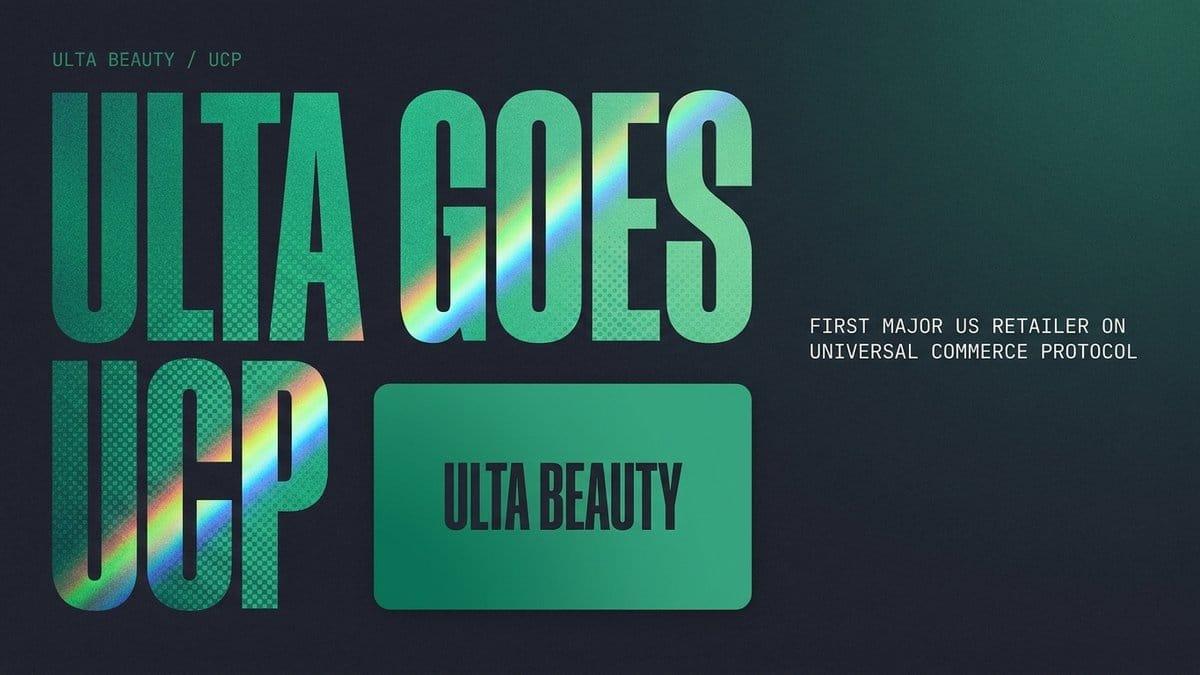
Ulta Beauty is the first major US retailer outside Google's original launch partners to publicly turn on the Universal Commerce Protocol. The pick is not random. Beauty is the most attribute-dense category in retail, which is why Google picked it, and why merchants who can't keep up on product data are about to find out in public.
TL;DR: Ulta Beauty will be shoppable inside Google AI Mode and the Gemini app over the next 30 days, powered by the Universal Commerce Protocol (UCP). It is the first non-launch-partner retailer live on UCP, and it lands in a category where shade, ingredients, skin type, and formulation make product-data completeness the ranking signal. Discovery is moving to protocols. Cards still need the attributes to render.
What did Ulta Beauty actually announce?
On April 22, 2026, Ulta Beauty and Google announced two paired launches. First, Ulta's assortment will become shoppable inside Google AI Mode in Search and the Gemini app, rolling out over the next month and explicitly powered by UCP. Second, Ulta AI, a Gemini-Enterprise-built on-site assistant trained on Ulta's 46 million loyalty members' behavior, goes live on Ulta.com and soon in the Ulta app.
Ashish Gupta, Google's VP and GM for Merchant Shopping, said Ulta's UCP implementation is "a vital step toward that future. By integrating UCP, Ulta Beauty is removing friction and helping their customers purchase right at the moment of discovery in AI Mode in Search and the Gemini app," per the Ulta investor press release. PYMNTS framed it as Ulta becoming the first major beauty retailer live on UCP, and WWD noted Ulta was positioned as an "early collaborator," suggesting Sephora, e.l.f., and Sally Beauty are next.
Why beauty? Because beauty breaks every shortcut
If you want to stress-test a product-data protocol, pick a category where the attributes are non-negotiable. That is beauty.
A foundation needs shade, undertone, finish, coverage, SPF, skin type, formulation, and ingredient flags. A sunscreen needs SPF, mineral-vs-chemical, reef-safe status, age range, water resistance, and face-vs-body use. A shampoo needs hair type, concerns, sulfate-free status, and scent. Miss any of those attributes on a feed, and the AI cannot surface that product for the right sub-query, because the sub-query is about the attribute.
The hard part of agentic commerce is not the protocol handshake. The hard part is that AI surfaces decompose a single shopper query into 8-12 parallel sub-queries, a technique Google itself calls query fan-out. If your product page has 5-8 attributes and the sub-queries probe 20+, you lose the card to a competitor whose feed has the answer.
Key stat: A Surfer SEO study of 173,902 URLs in December 2025 found that 68% of AI-cited pages do not rank in the top 10 organic results. Query fan-out rewards attribute depth, not domain authority. Content matching fan-out sub-queries saw a 161% lift in citations.
Ulta is a public demonstration that when product data is rich enough to answer sub-queries about ingredient sensitivities and shade ranges, retailers earn the product card. Everyone else gets mentioned in text, if that.
The protocol map after today
Ulta's launch tips the scales in the UCP-vs-ACP race that has been playing out since March. Here is where the two stacks sit after today.
| Dimension | ACP (Agentic Commerce Protocol) | UCP (Universal Commerce Protocol) |
|---|---|---|
| Creators | Stripe + OpenAI | Google + Shopify |
| Primary surface | ChatGPT (900M weekly active users, per DemandSage) | Google AI Mode, Gemini app, Microsoft Copilot |
| Current role | Product discovery + merchant redirect (Instant Checkout was discontinued in March 2026) | Catalog + cart + identity linking, live checkout inside AI surfaces |
| Major retailer launches | Target, Walmart, Sephora, Etsy, URBN, Coach | Walmart, Target, Etsy, Wayfair, Ulta (newest) |
| Partner ecosystem | 25+ retailers | 20+ co-signers, Microsoft Copilot adoption (April 20), $750M Google Cloud partner fund |
Two things change with Ulta going live. UCP now has a marquee non-launch-partner deployment in a category where attribute rigor cannot be faked. And Microsoft's April 20 UCP adoption inside Copilot means a merchant's UCP investment now surfaces across Google AI Mode, Gemini, and Copilot from one feed. For mid-market retailers who have been waiting on UCP, that wait is over.
That does not make ACP optional. ChatGPT still drives the biggest slice of AI referral traffic, and OpenAI shipped a major shopping update this week with image-based similar-item search and side-by-side comparisons, running on ACP. The dual-protocol world just got more real.
What Ulta's launch signals for every other retailer
The question merchandising and digital teams should be asking: when a shopper asks AI Mode for "a reef-safe mineral SPF 50 sunscreen for sensitive skin under $30," can your feed answer that prompt, or only half of it?
If it only answers half, the card goes to whoever answered the other half. That is how the product card gap works. You can be mentioned, your brand can be named, the AI can cite your site, and the product card slot still goes to a competitor whose feed has the missing field.
The Ulta launch also validates a pattern we have been tracking. Google is seeding UCP via retailers who carry thousands of third-party SKUs from hundreds of brands. Walmart, Target, Wayfair, and now Ulta. The retailers get distribution inside AI Mode and Gemini. The brands inside those retailers either ship clean, enriched, UCP-compatible product data or they get aggregated generically under the retailer's name, with no brand lift. That is a choice brands need to make consciously, not by default.
The beauty brands that sell into Ulta, think Tarte, Urban Decay, Anastasia Beverly Hills, e.l.f., should read today's news as a timeline. Brands that invest now in ingredient lists, shade libraries, skin-type metadata, and clean image sets will surface cleanly inside Ulta's UCP-backed AI experience. Brands that do not will show up as undifferentiated rows in Ulta's feed.
Mid-market is not enterprise
Ulta has the scale to build Ulta AI on Gemini Enterprise and onboard to UCP with Google's customer engineers in the room. Most retailers do not. UCP is publicly specified, Google's Merchant Center onboarding guide is live, and the incremental work for an already-feed-driven merchant is bounded.
The honest framing: protocol onboarding is the easy half. Product-data enrichment is the hard half. Beauty retailers with 8 attributes per SKU are not going to become competitive on fan-out queries by changing their feed format. They become competitive by actually carrying the attributes the fan-out probes. That is the heart of agentic commerce optimization, and most mid-market product pages score under 50 on the attribute layers of our AI Readiness Report.
Paz.ai, an agentic commerce optimization platform, monitors how products surface across ChatGPT, Google AI Mode, and Perplexity, and enriches catalogs from 5-8 attributes to 30+ for AI-agent discovery. But the playbook below runs with or without a vendor.
What to Do This Week
- Audit your attribute coverage against the sub-queries your category actually gets. Pick your top 10 SKUs and list every attribute a shopper might constrain on. Compare to what you publish in your feed today. If you publish fewer than 20 attributes per SKU, you are losing the fan-out.
- Map your retailer exposure to UCP. If you sell through Walmart, Target, Wayfair, Etsy, or Ulta, your products are about to be recombined inside UCP-powered AI surfaces. Ask those retailers which fields they are pulling from your product data. Fill the gaps before they do it for you.
- Enrich image metadata, not just images. ChatGPT's new image-based similar-item search and Google's visual product results both lean on alt text, structured image metadata, and lifestyle shots. Stock hero images without metadata will not rank.
- Measure AI-referred traffic in GA4 and Shopify analytics. Filter for referrals from chatgpt.com, gemini.google.com, copilot.microsoft.com, and perplexity.ai. If the numbers are near zero, that is data, not noise. It means you are not being shown as a card.
- Pick one protocol to ship first, and schedule the second. If you are Shopify-native, start with UCP via the Google Merchant Center onboarding guide. If most of your AI traffic comes from ChatGPT, start with ACP. Dual-optimize within the quarter.
Frequently Asked Questions
What is the Universal Commerce Protocol?
UCP is an open protocol co-developed by Google and Shopify in March 2026. It specifies how merchants structure catalog, cart, and identity-linking data so AI surfaces like Google AI Mode, Gemini, and Microsoft Copilot can read and rank products. Partners include Shopify, Salesforce, Stripe, and now Ulta Beauty.
Does Ulta's UCP launch make ChatGPT shopping less important?
No. ChatGPT has 900 million weekly active users and shipped a shopping upgrade on April 21, 2026 with image-based search and side-by-side comparisons, running on ACP. UCP and ACP are both required, not either/or. Retailers should dual-optimize.
What happens to beauty brands that sell through Ulta?
Ulta's assortment going live inside Google AI Mode means brand-level product data inside Ulta's catalog will be recombined and surfaced by AI. Brands with rich, structured product data (ingredient lists, shade libraries, skin-type metadata) will earn clean product cards. Brands with sparse data will surface generically under Ulta.
Is UCP only for enterprise retailers?
No. Google published a UCP onboarding guide in Merchant Center in April 2026, and the protocol itself is publicly specified at ucp.dev. Shopify merchants can onboard via Shopify's native UCP integration. Mid-market retailers without engineering teams are the exact audience this wave was designed for.
Why is beauty harder for AI commerce than electronics?
Electronics are specced on a small number of fields (model number, RAM, screen size). Beauty products are specced on dozens of subjective and objective fields (shade, finish, SPF, ingredients, allergens, hair type, skin concerns) and shoppers constrain on those fields heavily. Attribute depth is a first-class ranking signal in beauty fan-out.
Should I worry that my AI-referred traffic is low?
Low AI-referred traffic does not mean you are fine. It usually means you are not being shown as a card. Retailers above you on card rankings capture that traffic. The window to improve visibility is still open but is narrowing as more retailers ship UCP and ACP feeds.
Ulta's launch is the first proof point that beauty, the hardest category for product-data completeness, is where the agentic commerce protocols get their real test. The retailers and brands that pass are the ones whose product data already answers the questions shoppers have not yet typed.
How AI-ready are your products?
Check how ChatGPT, Google AI, and Perplexity evaluate any product page. Free score in 30 seconds.