Microsoft Just Made UCP Mandatory. ACP Isn't Optional Either.
- Author
- By Dor
- Publication date
- Published
- Last updated
- Updated
- Reading time
- 7 min read
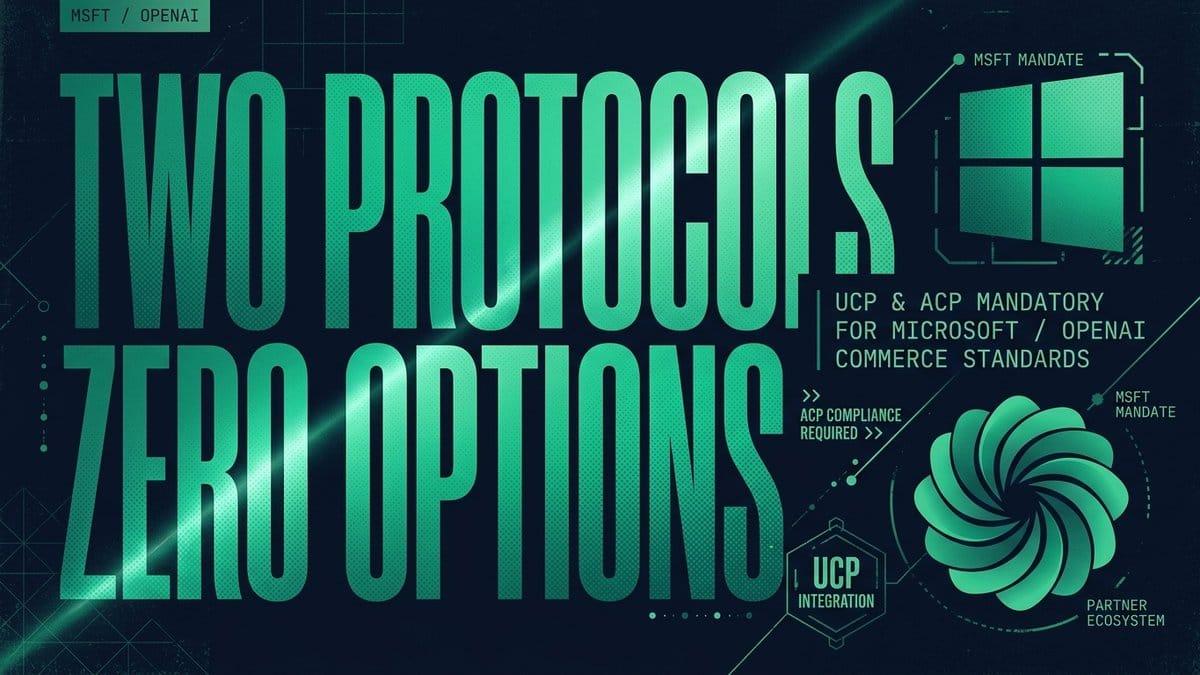
Microsoft rolled out Universal Commerce Protocol feed support in Merchant Center and Copilot this week, turning what looked like a Google and Shopify side project into a multi-platform standard. Same day, OpenAI shipped a major ChatGPT Shopping upgrade running on the Agentic Commerce Protocol. If you were hoping one protocol would win so you could pick a side, that window closed on April 21.
TL;DR: Microsoft adopted UCP in Merchant Center and wired Shopify Catalog into Copilot this week. Combined with ChatGPT running on ACP, merchants now have two distinct protocols to feed, not one. Agentic browser traffic is up roughly 8,000% year over year per Microsoft. Treating either protocol as optional means disappearing from one of the two largest agent surfaces.
What Microsoft Actually Shipped on April 20-21
Microsoft announced four agentic commerce updates in a single April 21 post. Microsoft had been the quiet third player in agentic commerce until now. This is the first time it has taken a public protocol position.
The four pieces:
- Universal Commerce Protocol in Microsoft Merchant Center and Copilot. Merchants who structure product data to UCP now surface in Copilot without a separate integration. Live in the US.
- Shopify Catalog real-time integration into Copilot. Pricing, inventory, and attributes pulled directly through Shopify's commerce API. No custom feed work for Shopify merchants.
- Copilot Checkout on mobile with loyalty program support. Microsoft says the surface now reaches more than 500,000 US merchants. Target is a launch partner, with Target Circle benefits available directly in the Copilot flow. Merchants keep merchant-of-record status.
- Brand Agents extended to WooCommerce. Conversational merchant assistants, previously Shopify-only, now work on WooCommerce stores, with new support for brand and policy materials.
Key Stat: Microsoft reports agentic browser traffic is up roughly 8,000% year over year, automated traffic is growing 8x faster than human traffic, and AI-driven sessions nearly tripled in 2025. These sit alongside Adobe's previously-reported 393% AI referral traffic growth. Independent sources, same directional signal.
Why This Ends the "Pick a Protocol" Debate
The protocol landscape shifted from speculative to operational this week. Here is the state of play as of April 22, 2026:
| Protocol | Creators | Surfaces that consume it | Status |
|---|---|---|---|
| ACP (Agentic Commerce Protocol) | Stripe, OpenAI | ChatGPT Shopping, Microsoft Copilot (via Shopify Catalog path) | Discovery and merchant redirect, live |
| UCP (Universal Commerce Protocol) | Google, Shopify | Google AI Mode, Gemini, Microsoft Copilot and Merchant Center | Live in US as of this week |
| MCP (Model Context Protocol) | Anthropic | Claude, plus broad developer ecosystem including Adobe Commerce as of April 20 | Integration layer, not a product feed spec |
Microsoft did not pick ACP or UCP. It picked both. The UCP feed support in Merchant Center serves UCP-structured catalogs. The Shopify Catalog API integration serves the same Shopify merchants who also appear in ChatGPT via ACP. Microsoft is consuming whatever structured path exists.
The practical consequence is straightforward. A merchant with a UCP-clean catalog now surfaces in Google AI Mode and Microsoft Copilot. A merchant with an ACP-clean catalog surfaces in ChatGPT Shopping and (indirectly, through Shopify) Copilot as well. A merchant with neither surfaces nowhere, regardless of how strong their website is.
The protocol war narrative assumed one winner. The actual outcome is that the winning agent surfaces consume multiple protocols, and merchants carry the integration cost on both sides.
The 500,000-Merchant Mobile Threshold
Copilot Checkout going mobile with 500,000 US merchants and loyalty support is the first serious commercial challenger to ChatGPT's shopping surface.
ChatGPT launched Instant Checkout in September 2025 and discontinued it in March 2026. Only about 30 merchants ever went live. Conversion underperformed. Brands rejected being reduced to anonymous fulfillment centers where they lost traffic, customer data, login and registration, and loyalty engagement. OpenAI pivoted to discovery and merchant redirect, which is the current ACP-powered model. No purchase is completed inside ChatGPT itself. The AI recommends; the shopper buys on the retailer's site.
Microsoft's Copilot Checkout is taking a different shape. Target Circle integration means loyalty program benefits flow through the Copilot checkout experience. Merchants keep merchant-of-record status. Mobile coverage at 500,000 merchants dwarfs the ChatGPT pilot. The model appears designed to address the complaint that killed Instant Checkout: brand relationship preservation.
It is too early to say whether Copilot Checkout will convert where Instant Checkout did not. Forrester has been consistent that this whole category is still experimental with low real-world adoption, and that characterization has not changed in April. What did change this week is the scale of the surface. If even a fraction of 500,000 mobile merchants sees meaningful Copilot-driven sessions, that is a new, non-ChatGPT traffic source to measure.
What Merchants Need to Fix This Week
Concrete steps. Not generic advice.
- Audit the 30-attribute floor on your top SKUs. Export the top 20% of SKUs by revenue. For each, count machine-readable attributes (title, description, price, availability, GTIN, brand, category, color, size, material, image URLs, review count, review rating, shipping info, return policy, warranty, dimensions, weight, specs). If any SKU sits below 15, it will lose comparison-driven ranking against a better-structured competitor in both ACP and UCP surfaces. This is the core of product data enrichment work.
- Confirm you are exposing feeds to both protocol paths. UCP-compliant feed into Google Merchant Center covers Google AI Mode and now Microsoft Copilot via Merchant Center. ACP-compliant product feed into the OpenAI commerce product feed covers ChatGPT. Shopify merchants also get the Shopify Catalog path into Copilot automatically. If your only output is a legacy Google Shopping feed, you are single-path. See our product feed optimization for AI primer for the attribute-level checklist.
- Turn on AI referral tracking now, before Copilot mobile traffic starts landing. Tag
copilot.microsoft.com,chatgpt.com,perplexity.ai,gemini.google.com, andclaude.aias distinct sources in GA4 and your store analytics. Baseline what exists today so you can see the Copilot mobile lift as it happens. This is the foundation of AI visibility in commerce measurement. Tools like our AI Readiness Report can help identify which SKUs are missing the attributes agents actually look for. - Check image metadata for ChatGPT's new image-based similar-item search. OpenAI's April 20-21 ChatGPT Shopping release added photo-upload similar-item search. Products without alt text, structured image URLs, or lifestyle shots will not surface when a shopper uploads a competitor's photo. Low cost, high payoff.
- If you run WooCommerce, evaluate Brand Agents this quarter. Microsoft just opened conversational merchant assistants to WooCommerce with brand and policy materials support. WooCommerce merchants had no Shopify Agents equivalent until now. This is a meaningfully new surface area.
The common thread: one clean catalog, multiple protocol-compliant outputs. Optimizing your catalog once for AI-agent comprehension is the underlying work; syndicating to ACP, UCP, and MCP is the distribution.
Where This Leaves the Competitive Picture
Retailers with dual-protocol coverage are already pulling ahead. Walmart appears in both ChatGPT and Google AI Mode. Target is a Copilot Checkout launch partner and a ChatGPT Shopping merchant. Etsy shows up in ACP partner lists and is UCP-compatible through its catalog structure. These merchants built their product data to be agent-legible before anyone forced them to.
Microsoft's own framing in the April 21 announcement captured the stakes directly:
"Businesses need to be understood, trusted, and eligible inside the AI systems making those decisions, not just visible to the humans browsing them."
Microsoft Advertising, April 21, 2026
Mid-market merchants who have been waiting to see which protocol won are now in a worse position than they were a week ago. The answer is both, and the cost of catching up is higher than the cost of having started in March.
Paz.ai, an agentic commerce optimization platform, monitors how products appear across ChatGPT, Google AI Mode, and Perplexity and publishes catalog data to ACP and UCP-compliant feeds from a single source of truth. The broader point is not tooling. It is that the integration count went from one to two this week, and anyone still treating it as one is behind.
Frequently Asked Questions
What is the Universal Commerce Protocol (UCP)?
UCP is a product data standard co-developed by Google and Shopify, launched in March 2026. It specifies how merchants structure catalog, cart, and identity-linking data so that AI surfaces like Google AI Mode and Gemini can read and rank products. As of April 21, 2026, Microsoft Copilot and Microsoft Merchant Center also consume UCP feeds. Full spec at ucp.dev.
Does Microsoft Copilot use ACP or UCP?
Both. Microsoft Copilot consumes UCP directly through Microsoft Merchant Center. It also consumes Shopify Catalog data in real time via Shopify's commerce API, which overlaps with the same merchants OpenAI reaches through the Agentic Commerce Protocol. Microsoft is multi-protocol by design.
Is Copilot Checkout the same as ChatGPT's old Instant Checkout?
No. OpenAI's Instant Checkout launched in September 2025 and was discontinued in March 2026 after brands rejected losing the direct customer relationship. Copilot Checkout preserves merchant-of-record status, supports loyalty programs (Target Circle is a launch partner), and extends to mobile across 500,000 US merchants. The model is closer to a checkout-assist layer than an in-chat purchase completion.
How big is agentic traffic in 2026?
Microsoft reports agentic browser traffic is up roughly 8,000% year over year, automated traffic is growing 8x faster than human traffic, and AI-driven sessions nearly tripled in 2025. Adobe previously reported 393% AI referral traffic growth, and Digital Commerce 360 reported a 4,700% YoY increase in AI-driven visits to e-commerce sites. Absolute share remains small but growth is consistent across independent sources.
What should mid-market retailers prioritize first?
Structured catalog data before anything else. UCP and ACP both reward completeness of product attributes, image metadata, availability accuracy, and review signals. A merchant with a single, high-quality catalog can fan out to both protocols. A merchant without that foundation will underperform on both regardless of which integration they bolt on first.
Is Microsoft Clarity's AI Visibility useful for merchants right now?
Yes, and Microsoft expanded access to it this week. Clarity's AI Visibility shows which of your pages are cited in AI-driven answers, how often, and where competitors are cited instead. It is a diagnostic, not a fix, but it gives merchants a baseline they did not have in February.
The protocol war question is settled in the boring way. Nobody won, everybody shipped, and the merchants who assumed a single winner are now carrying extra work. The agents keep growing. The catalogs keep getting queried. The only mistake left is waiting.
How AI-ready are your products?
Check how ChatGPT, Google AI, and Perplexity evaluate any product page. Free score in 30 seconds.