A Court Is Deciding If Retailers Can Block AI Agents
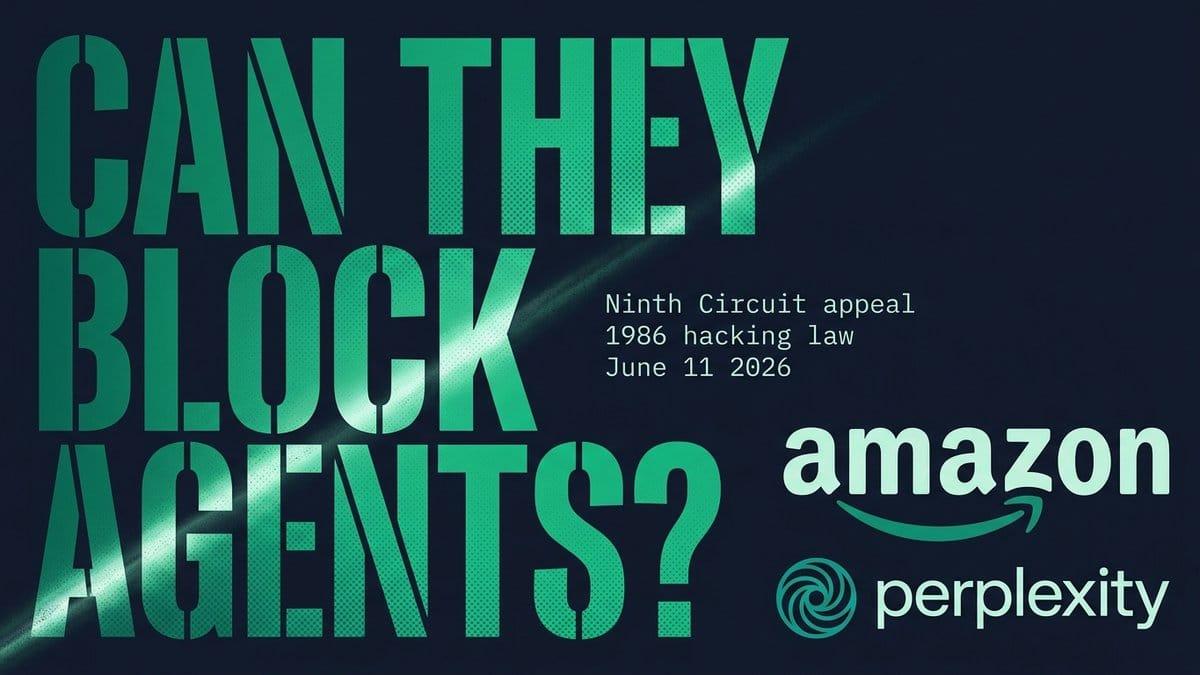
On June 11, a federal appeals court in Seattle heard the case that sets the ground rules for the entire "an agent shops for you" model. The question on the table: when a retailer does not want an AI shopping agent on its site, can it legally lock the agent out? The judges sounded skeptical of the agent's side. No ruling yet, but the stakes for brands are already clear.
TL;DR: A Ninth Circuit panel heard oral arguments on June 11 in Amazon v. Perplexity, the case deciding whether a retailer can use the 1986 Computer Fraud and Abuse Act to block an AI shopping agent from its site. However it lands, brands do not control which surfaces let agents in. The only variable they own is whether they are represented correctly on the surfaces that do.
What happened in the Ninth Circuit on June 11?
A three-judge Ninth Circuit panel in Seattle heard oral arguments over whether Amazon can block Perplexity's Comet shopping agent from operating on Amazon.com. This is the appeal of a March 2026 preliminary injunction. The panel pushed back hard on Perplexity's core argument, and took the case under submission with no ruling.
The dispute started when Senior U.S. District Judge Maxine Chesney ruled in March that Amazon was likely to win its claim that Comet violates the federal Computer Fraud and Abuse Act (CFAA) and California's computer-access law. She granted a preliminary injunction restricting the agent, then stayed it pending appeal. Perplexity appealed, and the June 11 hearing was the result.
At the hearing, Perplexity argued it does not break into Amazon's systems. It built a browser that lets an AI agent reach Amazon on the user's behalf, with the user's own login. "Amazon seeks to stretch criminal statutes that prohibit computer hacking to sue Perplexity simply because Amazon wanted its own customers to access its website its preferred way," its attorney told the panel, per Courthouse News.
Amazon's counter was that an AI shopping agent is not the same as a normal browser. Its attorney pointed out that Brave and Microsoft Edge have the same technical capabilities but decline to drive into Amazon when told to, because they "respect the settled rules." The panel, per Bloomberg Law, gave Perplexity a cool reception.
Why a 1986 hacking law is deciding a 2026 commerce question
The CFAA was written in 1986 to prosecute computer intrusion. It now sits at the center of whether an AI agent acting under a user's login counts as "authorized access" to a retail site. That is a poor fit, and the judges said as much.
The legal core is the phrase "without authorization." Amazon's position is that even when the shopper authorizes the agent, the retailer never did, so the agent's access is unauthorized under the CFAA. Perplexity's position is that the user's permission is the only authorization that matters, the same way it does when you use autofill or a password manager. The Computer Fraud and Abuse Act has drawn criticism for years for being vague and overbroad, as the Electronic Frontier Foundation has documented.
Amazon has the same technical access argument against Brave and Edge. The difference Amazon drew was behavioral, not technical: those browsers decline to act when a retailer signals no. That makes this a question about retailer consent, not about what software can do.
The American Civil Liberties Union filed an amicus brief framing the case as an internet-freedom issue. Legal scholar Eric Goldman, in a guest analysis on his Technology & Marketing Law Blog, laid out why neither side has a clean answer under existing law. The honest read is that the court is being asked to retrofit a statute from the dial-up era onto autonomous shopping agents, and it shows.
Why this matters even if you never sell on Amazon
The case is about Amazon, but the ruling sets a precedent every retailer will reference. If a large retailer can lawfully fence agents out of a logged-in surface, others will copy that playbook. If it cannot, every retail surface becomes agent-routable at once. Either way, brands lose control over where agents are allowed to operate.
Here is the part brands miss. You do not get a vote in this. The legal access rules are being set by courts. The payment rails are being built by Visa, Mastercard, and the platforms. The surfaces that welcome agents (ChatGPT, Google AI Mode, Gemini, Shopify's catalog) make their own rules about what they show. A brand sits downstream of all three.
| Variable | Who controls it | Can a brand change it? |
|---|---|---|
| Legal right of an agent to access a site | Courts (Amazon v. Perplexity) | No |
| Payment rails for agent transactions | Visa, Mastercard, platforms | No |
| Which surfaces let agents shop | OpenAI, Google, Shopify, Amazon | No |
| How well your products read to an agent | The brand | Yes |
That last row is the whole game. JPMorgan's payments leadership has made a similar point about where agentic commerce actually starts, which we covered in our analysis of merchant-owned agents. The legal and infrastructure layers are moving with or without you. Your product data is the one layer you own.
The two outcomes both point the same direction
A skeptical panel does not guarantee a ruling, and oral arguments are not a decision. But it is worth gaming out both endings, because they converge on the same to-do list for brands.
If Perplexity loses and agents can be blocked, discovery fragments. The closed gardens (Amazon being the obvious one) wall agents out, and the open surfaces that welcome agents become the entire battleground. Being readable on Perplexity shopping, ChatGPT shopping, and Google AI Mode stops being optional, because that is where the agents are allowed to look.
If Perplexity wins and agents have authorized access everywhere, every retail surface becomes agent-routable. "Is your product the one the agent picks" applies to all of them at once, and the volume of agent-driven shopping climbs faster. Morgan Stanley already estimates agentic shoppers could reach $385 billion in U.S. e-commerce by 2030. A win for agents pulls that timeline forward.
In both worlds, the brands that win are the ones an agent can read, trust, and represent accurately. The ruling changes where agents operate. It does not change what makes a product winnable once an agent gets there.
What to Do This Week
- Audit how you appear on the open agent surfaces today. Run real shopping queries through ChatGPT, Google AI Mode, and Perplexity for your top categories. Note where you show a product card versus a bare brand mention versus nothing. Tools like our AI Readiness Report score this in about 30 seconds.
- Separate your crawler policy from your access fear. Blocking the wrong bot in robots.txt can erase you from AI search entirely. Review your AI crawler management settings and confirm you are not blocking the retrieval crawlers that feed AI shopping answers.
- Fix your product data for machine reading. Agents rank on structured attributes, not marketing prose. Get the specs, materials, dimensions, and use-cases into structured fields so an agent can compare you accurately.
- Track your share on the surfaces you do not control. Your digital shelf now includes AI answers. Measure your found rate and average position across engines, and watch which competitors the agents pick over you.
- Stop waiting for the legal dust to settle. The ruling could take months. Your representation on the welcoming surfaces is fixable now, independent of how the court rules.
Frequently Asked Questions
What is Amazon v. Perplexity about?
It is a lawsuit over whether Amazon can block Perplexity's Comet AI shopping agent from operating on Amazon.com. Amazon argues the agent accesses its site without authorization under the 1986 Computer Fraud and Abuse Act. Perplexity argues the user's own login is sufficient authorization. A Ninth Circuit panel heard oral arguments June 11, 2026.
Did the court rule that retailers can block AI agents?
No. The June 11 hearing was oral arguments only. The three-judge panel took the case under submission and gave no ruling. A decision could come in weeks or months. The panel sounded skeptical of Perplexity's argument, but skepticism at a hearing does not guarantee the final outcome.
Does this affect retailers who do not sell on Amazon?
Yes. The ruling will set a precedent other retailers reference when deciding their own agent policies. It also clarifies whether the broader "agent shops on your behalf" model is legally durable. Any brand selling through AI shopping surfaces has a stake in the answer, regardless of its Amazon presence.
What can a brand actually control here?
Not the legal rules, the payment rails, or which surfaces admit agents. A brand controls how well its products read to an agent: structured attributes, accurate specs, and consistent data across channels. That is the variable that decides whether an agent recommends you once it is allowed to look.
How fast is agent-driven shopping growing?
Morgan Stanley estimates agentic shoppers could reach $190 billion to $385 billion in U.S. e-commerce spending by 2030, roughly 10% to 20% of online retail. The exact pace depends partly on legal questions like this one, but the direction is set.
The courts will decide where agents are allowed to operate. The platforms will decide which agents get to shop on their surfaces. Neither decision is yours to make. The one thing you own is whether the agent that reaches your products can read them, trust them, and put them in front of a buyer. That work does not wait on a verdict.
How AI-ready are your products?
Check how ChatGPT, Google AI, and Perplexity evaluate any product page. Free score in 30 seconds.