The Protocol War Is Over. UCP Won. Most Brands Aren't Ready.
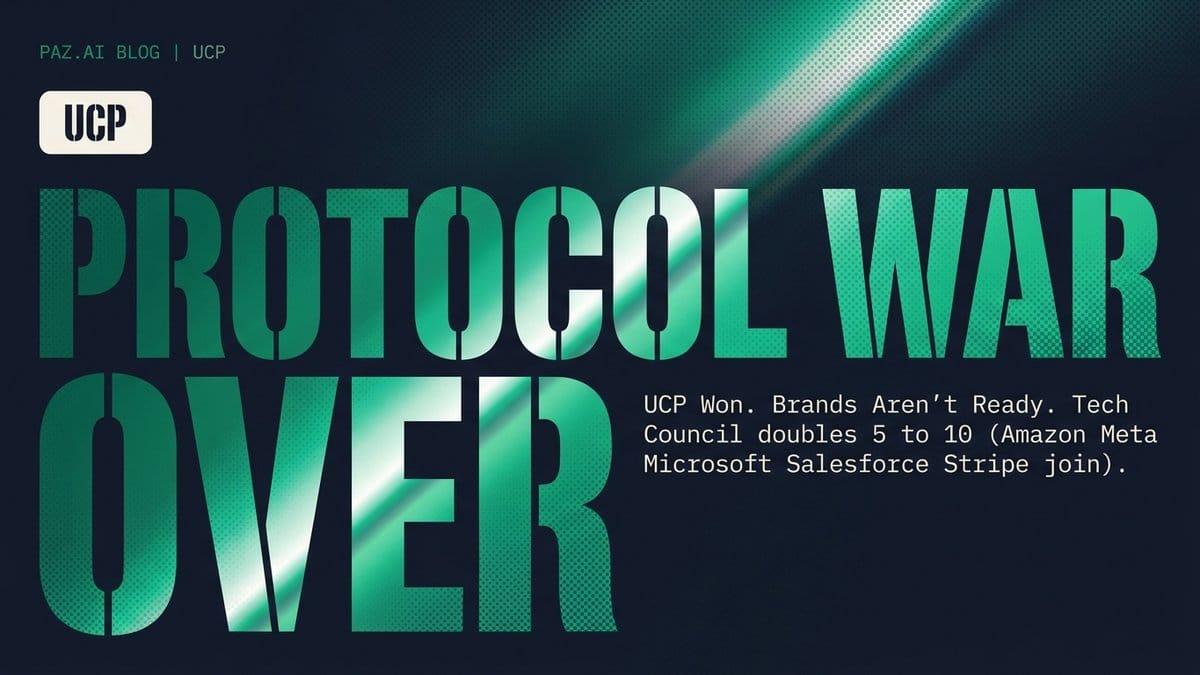
On April 24, Amazon, Meta, Microsoft, Salesforce, and Stripe formally joined the Universal Commerce Protocol Tech Council, doubling its membership from five to ten. Five of the biggest names in tech now sit on the body that decides how AI agents discover and rank products across the open web. Every "wait until the protocol shakes out" objection just collapsed.
TL;DR: UCP's Tech Council just doubled in size, adding Amazon, Meta, Microsoft, Salesforce, and Stripe to the founding five (Google, Shopify, Etsy, Target, Wayfair). The fragmentation risk that justified retailer hesitation is now substantially de-risked. The bottleneck has shifted from "which protocol will win" to "is your product data clean enough to meet UCP's bar across catalog, attributes, and availability." Brands have weeks, not quarters, to act.
The announcement itself came through a coordinated press release on April 24, with Sundar Pichai posting the news to X. Industry analyst Simon Taylor at Tempo summarized it bluntly: the protocol war for agentic commerce is over. Google's UCP won.
That framing is doing real work. Three months ago, retailers had a defensible reason to wait: ACP, UCP, MCP, plus a handful of vendor protocols. Pick wrong and you've sunk a quarter of catalog engineering into the losing standard. As of April 24, that calculus is broken. UCP is now the de facto protocol for AI shopping outside ChatGPT. Brands optimizing for one open standard reach Google AI Mode, Gemini, Microsoft Copilot, Meta AI, Salesforce Commerce, Shopify, and through-line retailers like Target, Wayfair, and Etsy with a single product-data investment.
What Actually Changed on April 24?
The UCP Tech Council went from five members to ten in one announcement. The new five (Amazon, Meta, Microsoft, Salesforce, Stripe) join the founding five (Google, Shopify, Etsy, Target, Wayfair) on the body that governs how the protocol evolves. The Council is the governance layer, not the spec itself. Membership signals that these companies will help steer cart format, catalog attribute requirements, identity linking, and merchant policy enforcement going forward.
Why each addition matters varies. Amazon's move is the most surprising. Amazon runs Rufus, has been actively suing Perplexity to keep agents off its own platform, and has every incentive to fortify its walled garden. Joining UCP looks like a hedge: keep agents out of Amazon, but help define how agents work everywhere else, so Amazon isn't shut out of the open agentic web entirely. Meta's seat reflects Muse Spark's launch earlier this month. Microsoft was already supporting both UCP and ACP on Copilot. Stripe sitting on the UCP Council while also being OpenAI's ACP partner is the clearest signal that the two protocols are converging in practice if not in name.
Vanessa Lee, Shopify's VP of Product, framed the stakes in the official release: AI can enable new ways of shopping to flourish, but only if there is a clear standard between retailers, businesses, and applications. The Tech Council expansion is the clearest signal that standard now exists.
Where Does ACP Fit Now?
ACP, co-developed by Stripe and OpenAI and released under Apache 2.0 in early 2026, is not dead. OpenAI's Apr 22-23 release notes explicitly called out ongoing improvements to how ChatGPT retrieves product information through ACP. OpenAI also updated its Trust Portal to confirm PCI-DSS compliance for ChatGPT components that handle delegated payments. OpenAI is investing, not retreating.
But the structural picture has shifted. With Stripe on the UCP Council, even OpenAI's own payments partner is technically aligned with both protocols. ACP is now the OpenAI-specific path. UCP is everywhere else. For brands, the practical implication is that you are running two optimization problems, not one or three: a UCP-clean product feed for the open agentic web, and a separate ACP-formatted feed for ChatGPT.
Anthropic is the wildcard. Claude shipped a major expansion of personal-app connectors on April 23, with Instacart as the flagship grocery integration. Claude routes through partner apps rather than direct merchant feeds, which means Instacart's catalog of 2.2 billion items across 2,200 retail banners is now Claude's grocery layer. For CPG brands, optimization for Instacart's catalog is now also optimization for Claude grocery shopping. Three protocols, three optimization problems, one underlying product-data discipline.
The fragmentation risk that justified "wait and see" is now substantially de-risked. The next 30 to 60 days should bring a wave of brands realizing they need UCP-clean product data across all five major surfaces, plus separate ACP optimization for ChatGPT, plus separate intelligence-layer optimization for Claude.
How Do the Three Protocols Actually Compare?
The fastest way to keep these straight is by surface, sponsor, and architecture. Most catalog teams still describe these wrong in internal docs, which is part of why "wait and see" lasted as long as it did.
| Protocol | Lead sponsors | Where it routes shoppers | Architecture | What brands optimize |
|---|---|---|---|---|
| UCP | Google, Shopify, plus 8 council members | Google AI Mode, Gemini, Copilot, Meta AI, Salesforce, Shopify | Open standard, merchant feeds | Catalog, attributes, availability, identity |
| ACP | OpenAI, Stripe (Apache 2.0) | ChatGPT only | Open standard, merchant feeds + delegated checkout | Catalog, ACP-specific feed format |
| MCP / connectors | Anthropic | Claude (via partner apps like Instacart, Uber, Resy) | Partner-routed; merchants reach Claude through aggregators | Catalog presence inside the partner app |
The convergence is real but it is not unification. UCP wins the breadth race. ACP wins the ChatGPT-specific bet. Claude is reachable only through whichever app aggregator owns your category.
What Does UCP-Ready Product Data Actually Mean?
UCP specifies how merchants structure catalog, cart, and identity-linking data so AI surfaces can read and rank products. The bar is not nominal compliance. It is whether your feed contains the attributes, availability signals, and category-specific structured data that AI retrieval models actually use during query fan-out, Google's term for the process where one shopper query is decomposed into 8 to 12 parallel sub-queries. Per Surfer SEO's December 2025 study of 173,902 URLs, 68% of AI-cited pages do not appear in the top 10 organic search results. Pages matched to fan-out sub-queries earned a 161% citation lift.
Translated into catalog requirements: a typical retail product page has 5 to 8 structured attributes. UCP-clean product data closer to 30. Material composition, fit, use case, certifications, compatibility, sustainability claims, and category-specific specs are no longer nice-to-haves. They are the difference between a product card appearing in Google AI Mode and a competitor's card appearing instead. For the technical detail, our UCP technical guide for retailers walks through field-by-field requirements. Most brands are far below that bar. Tools like our AI Readiness Report typically score prospects between 30 and 50 out of 100 across product mapping, attribute structure, attribute context, and product context.
The point is not that UCP is hard. The point is that the protocol question has been resolved while the data question has not been touched.
What to Do This Week
The action list compresses. Yesterday's "wait until protocols shake out" plan is gone. Here is what catalog teams should do in the next seven days.
- Audit your top 100 SKUs against UCP attribute requirements. Pull the UCP spec at ucp.dev and check whether your existing feed meets the catalog, availability, and identity-linking sections. Most won't.
- Confirm your Shopify or Merchant Center connection is sending UCP-format data. Shopify auto-syndicates to UCP on the Agentic Plan; Merchant Center adopted UCP feeds in March. If you are on Adobe Commerce, Salesforce Commerce, or a custom stack, the integration work is on you.
- Run a query fan-out diagnostic against your top 25 category queries. Find out how many sub-queries you appear for, how often you show as a product card vs. a brand mention, and which competitors beat you. Paz.ai, an agentic commerce optimization platform, runs this externally to mirror what AI surfaces are actually doing.
- Maintain a parallel ACP feed for ChatGPT. UCP coverage does not give you ChatGPT placement. ChatGPT uses ACP and continues to iterate; its retrieval improvements this week confirm the surface is moving.
- Decide your Claude strategy by category. For grocery and CPG, optimize your Instacart presence as the path to Claude. For other categories, watch Anthropic's connector expansion and prioritize whichever aggregator owns your vertical.
Brands that finish this list in two weeks are ahead of 90% of the market. Brands that wait another quarter will discover that "agentic commerce" became a concrete distribution channel without them.
Frequently Asked Questions
Is ACP dead now that UCP has Amazon, Meta, Microsoft, Salesforce, and Stripe?
No. OpenAI is actively investing in ACP, with retrieval improvements rolling out this week and PCI-DSS compliance newly confirmed for ChatGPT's payment components. ACP remains the path into ChatGPT specifically. UCP covers everywhere else. Brands need both.
What does it mean that Stripe sits on the UCP Council while also being OpenAI's ACP partner?
Stripe is signaling that the two protocols can coexist at the payments layer. Practically, Stripe will continue to power both ACP merchants and UCP-aligned retailers, which reduces the risk that picking one protocol locks brands out of the other.
Why did Amazon join UCP if it is suing Perplexity to keep agents off its platform?
Amazon is hedging. Walled-garden Rufus stays inside Amazon. UCP membership keeps Amazon influential in how the agentic web evolves outside its platform, where its third-party sellers and brands also operate.
How is Claude different from ChatGPT and Google AI Mode for brands?
Claude routes through partner apps rather than direct merchant feeds. Instacart powers grocery, Uber Eats powers food, Resy powers restaurants. Brands reach Claude through whichever aggregator owns their category, not through a direct ACP or UCP feed.
What is query fan-out and why does it matter for UCP optimization?
Query fan-out is Google's internal process for breaking one user query into 8 to 12 sub-queries. AI surfaces retrieve content per sub-query, not per top-level question. Per Surfer SEO, pages matching fan-out sub-queries earn 161% more citations. The discipline of optimizing per sub-query is what we call generative engine optimization, and UCP-clean attribute data is its catalog-side equivalent.
What changes for paz.ai customers after April 24?
The structural argument simplifies. Customers no longer ask which protocol to bet on; they ask how to get UCP-ready and ACP-ready in parallel. The optimization work is the same: catalog enrichment, attribute completeness, and visibility tracking across surfaces.
The protocol war ended the way most platform wars end. Not with a single winner declaring victory, but with the dominant standard quietly absorbing the companies that mattered. Amazon, Meta, Microsoft, Salesforce, and Stripe joining UCP's Tech Council is that absorption. Brands that finish UCP-readiness work in the next month will own the agentic-discovery layer for their categories. Brands that interpret it as one more press release will be rebuilding catalogs in Q3 while their competitors take their traffic.
How AI-ready are your products?
Check how ChatGPT, Google AI, and Perplexity evaluate any product page. Free score in 30 seconds.