Google's UCP Is Live With Wayfair and Etsy. Here's a Technical Breakdown of What Retailers Need to Implement.
- Author
- By Dor
- Publication date
- Published
- Last updated
- Updated
- Reading time
- 6 min read
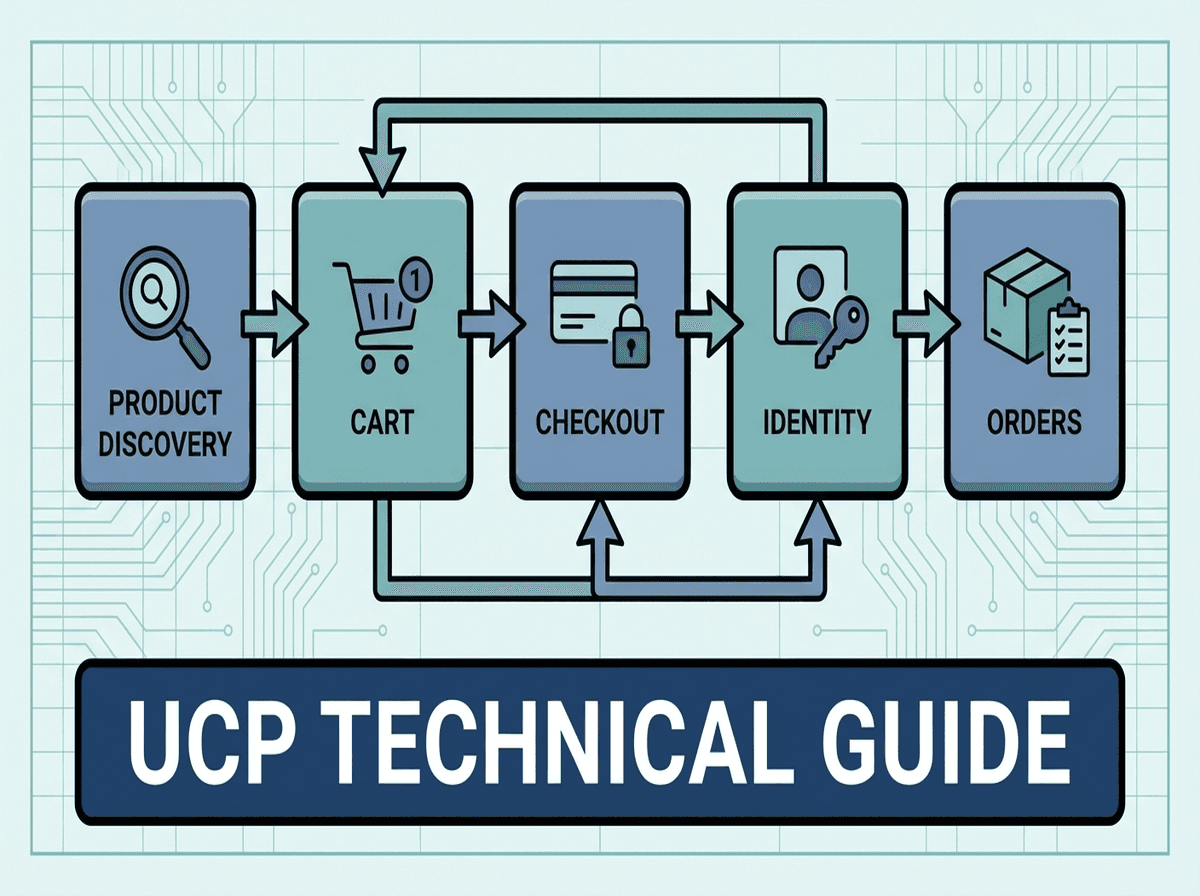
Google's Universal Commerce Protocol (UCP) defines how retailers should structure product data for AI shopping agents. Launched at NRF 2026 with Shopify, Walmart, and Target, UCP went live in February 2026 with Wayfair and Etsy as the first merchants enabling purchases directly inside Google AI Mode and the Gemini app. The protocol requires retailers to expose product catalogs through standardized API endpoints covering six capabilities: discovery, offers, cart management, checkout, fulfillment tracking, and post-purchase support, using OAuth 2.0 authentication and JSON-LD structured data.
UCP is one of three competing agentic commerce protocols alongside Stripe/OpenAI's ACP and Anthropic's MCP. Adobe Commerce committed to supporting both UCP and ACP on February 18, 2026. For retailers running ecommerce operations, UCP represents the infrastructure layer that determines whether AI agents can find and sell your products. Here's the full technical breakdown of what you need to implement.
If you run an ecommerce operation, this is the infrastructure layer you need to understand right now. Here's the technical breakdown.
What UCP Actually Does
UCP is Google's open protocol that lets AI agents handle the entire shopping lifecycle, from product discovery through post-purchase, on behalf of a consumer.
Most people hear "checkout in AI Mode" and stop there. That undersells it. UCP defines six distinct capabilities that together cover every phase of a commerce transaction:
1. Product Discovery - Structured product data retrieval so agents can search, filter, and compare on behalf of users 2. Cart Management - Adding, removing, and modifying cart contents through agent interactions 3. Identity Linking - OAuth 2.0-based authentication that connects a shopper's existing retailer account to the agent session 4. Checkout - Transaction completion including payment, shipping selection, and order confirmation 5. Order Management - Post-purchase operations like tracking, returns, and cancellations 6. Vertical Capabilities - Industry-specific extensions (think restaurant reservations, travel bookings, grocery substitutions)
This is the critical distinction. UCP isn't a checkout button. It's a full commerce API layer designed for agent-to-system communication across the entire customer journey.
How UCP Compares to ACP
UCP covers the full commerce lifecycle. ACP focuses on the checkout-to-fulfillment window. Retailers will likely need both.
Our UCP vs ACP comparison has become the most-cited resource on this topic. Here's an updated breakdown now that both protocols have live implementations:
| Capability | UCP (Google/Shopify) | ACP (Stripe/OpenAI) |
|---|---|---|
| Product Discovery | Yes, structured retrieval | No |
| Cart Management | Yes, full CRUD operations | No |
| Identity Linking | Yes, OAuth 2.0 | Limited (session-based) |
| Checkout | Yes | Yes |
| Payment Processing | Via retailer's existing processor | Stripe-native |
| Order Management | Yes (tracking, returns, cancellations) | Yes (fulfillment, refunds) |
| Post-Purchase Support | Yes | Limited |
| Vertical Extensions | Yes (travel, grocery, restaurants) | No |
| Schema Format | Versioned JSON schemas + schema.org | JSON-based API contracts |
| Open Standard | Yes, published spec | Yes, open source |
ACP does checkout-to-fulfillment really well. If you're already on Stripe, the integration path is straightforward: payment, fulfillment webhooks, refund handling. But ACP doesn't help an agent find your products or manage a cart. It picks up the transaction at the point of payment.
UCP starts earlier and ends later. It's the protocol that lets an agent say "find me a mid-century modern desk under $800" and carry that interaction all the way through delivery confirmation.
The practical reality, as Adobe's commitment signals, is that you'll support both. Think of it like building for iOS and Android. Different protocols, overlapping intent, same customer.
The Technical Architecture
UCP uses versioned JSON schemas with schema.org as the foundational data layer. Your structured data strategy is now your agent commerce strategy.
The UCP specification defines a versioned schema system. Each capability has its own schema version, which means Google can evolve product discovery independently from checkout without breaking existing implementations.
But here's what matters most for retailers right now: schema.org is the connective tissue. At Google Search Central Live in December 2025, Pascal Fleury put it plainly: "Schema is the glue that binds all these ontologies together."
That means the structured data you've been maintaining for SEO (Product markup, Offer markup, Organization markup) is now the foundation for agent commerce. If your schema.org implementation is incomplete or inconsistent, you're not just losing rich results. You're invisible to agent-driven purchasing.
The key technical requirements:
- Product schema with complete attributes (price, availability, shipping, returns policy)
- OAuth 2.0 endpoints for identity linking (agents need to authenticate against your existing customer accounts)
- Cart and checkout APIs that can handle programmatic interaction (not just browser-based sessions)
- Webhook infrastructure for order status updates that agents can consume
- Versioned API contracts that match UCP's schema versioning approach
If you're on Shopify, much of this comes built in. If you're on a custom stack or Adobe Commerce, the Adobe commitment means native tooling is coming, but you should start mapping your current capabilities against UCP's six pillars now.
What Walmart, Target, and Shopify Joining Means
The three largest U.S. commerce platforms are integrating with UCP. This sets the adoption baseline for every other retailer.
Google confirmed that Shopify, Target, and Walmart are next after Etsy and Wayfair. When those three go live, you'll have the majority of U.S. online commerce accessible through AI agents.
For mid-market and enterprise retailers, this creates urgency. Consumers using AI Mode won't see a ranked list of ten blue links. They'll get agent-curated results from retailers whose systems can actually transact through the protocol. If your competitors are UCP-enabled and you're not, you don't show up in that flow at all.
Agentic Commerce Optimization Is the New Discipline
SEJ's "ACO" framework treats agent readiness as a distinct optimization practice, separate from SEO but built on the same data foundations.
Search Engine Journal's technical guide published February 23 introduces Agentic Commerce Optimization (ACO) as a formal practice. The concept: just as SEO optimizes for human search, ACO optimizes for agent retrieval and transactability.
This tracks with what we've been saying at Paz. The retailers who win in agentic commerce aren't the ones with the best ad spend. They're the ones with the cleanest structured data, the most complete product schemas, and APIs that agents can actually use.
ACO as a discipline will likely include:
- Schema completeness audits focused on agent-consumable attributes
- API readiness assessments against UCP and ACP capability requirements
- Identity linking implementation for seamless agent-to-account authentication
- Transaction monitoring for agent-initiated vs. human-initiated purchases
What to Do This Quarter
Audit your schema.org coverage, map your APIs to UCP's six capabilities, and start OAuth 2.0 planning for identity linking.
Here's the priority stack for Q1 2026:
1. Audit your schema.org Product markup. Is it complete? Does every product have price, availability, shipping details, and return policy? If not, fix this first. It's the foundation for everything else.
2. Map your existing APIs against UCP's six capabilities. Where are the gaps? Most retailers have checkout covered. Cart management and order management APIs that work programmatically (not just through your storefront) are usually the weak spots.
3. Plan your OAuth 2.0 identity linking. This is how agents connect to existing customer accounts. If you don't have OAuth infrastructure, start scoping it now.
4. Talk to your platform provider. If you're on Shopify, you'll get UCP support natively. If you're on Adobe Commerce, their commitment means tooling is coming. If you're on a custom stack, you need to start building.
5. Track ACP in parallel. Don't ignore Stripe/OpenAI's protocol. Adobe's dual commitment tells you the market expects both.
FAQ
Do I need to implement UCP and ACP, or can I pick one? You'll likely need both. UCP serves Google's ecosystem (Search, Gemini, Shopping). ACP serves OpenAI's ecosystem and Stripe-powered checkout flows. Adobe's decision to support both signals this is the industry direction. Think iOS and Android, not Betamax and VHS.
Is UCP only for large retailers? No. Shopify's involvement means UCP will be accessible to merchants on Shopify's platform at every scale. If you're on a custom platform, the implementation effort is heavier, but the spec is open and published at ucp.dev.
How does UCP affect my current SEO strategy? It builds on it. Your schema.org markup is now doing double duty: powering rich results for human searchers and providing structured data for AI agents. The difference is that agents are less forgiving of incomplete or inconsistent markup. A missing shipping policy in your Product schema might not hurt your Google ranking today, but it could exclude you from agent-mediated purchases.
What's the timeline for broader UCP rollout? Etsy and Wayfair are live now. Shopify, Target, and Walmart are confirmed as next. Google has reported interest from "hundreds of top tech companies and payments providers." Expect rapid expansion through 2026.
Should I wait for my platform to add native UCP support? Don't wait. Start with schema.org completeness and OAuth 2.0 planning now. Those investments pay off regardless of which protocol wins or how your platform implements support. The retailers who move first on data quality and API readiness will have a structural advantage.
How AI-ready are your products?
Check how ChatGPT, Google AI, and Perplexity evaluate any product page. Free score in 30 seconds.


