Meta Just Turned 3.5B Users Into a Shopping Surface
- Author
- By Dor
- Publication date
- Published
- Reading time
- 6 min read
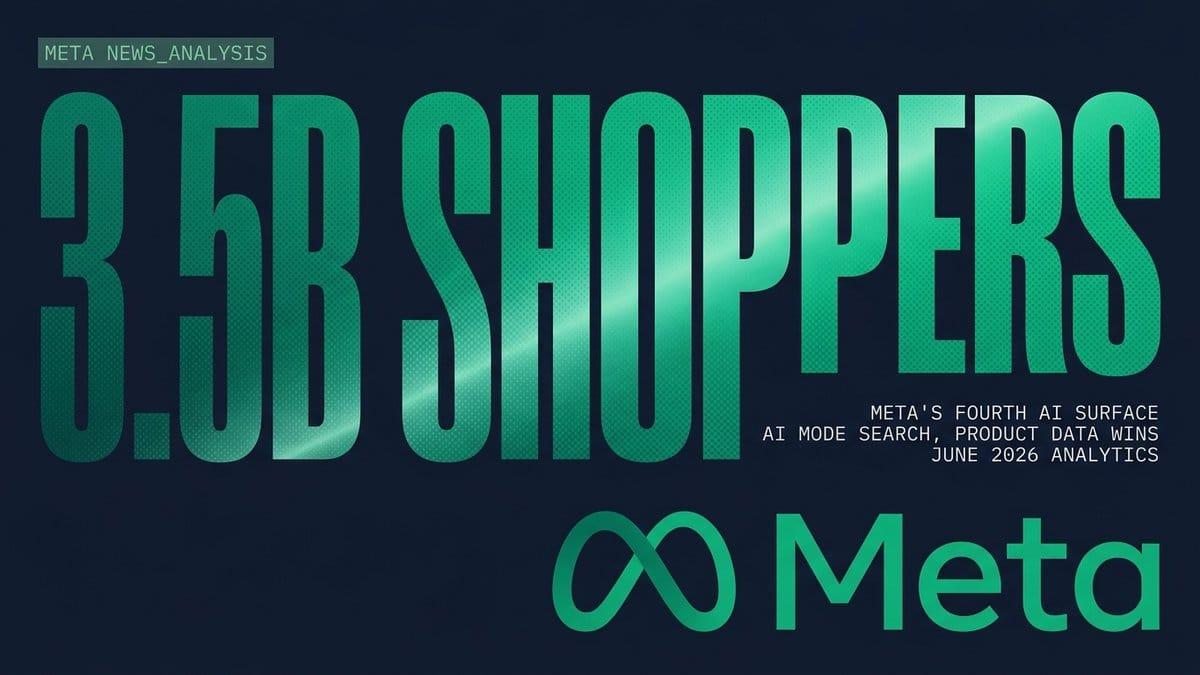
Meta spent the last year testing AI shopping in quiet pilots. This week it stopped testing. On June 15 it put AI-generated search inside Facebook, and a day later at Cannes Lions it shipped a full commerce stack: live shopping ads, virtual-card checkout with Mastercard and Visa, and product data feeding a new AI Shopping mode. The fourth major AI shopping surface just went live, and it reaches 3.5 billion people.
TL;DR: Meta added AI Mode search to Facebook on June 15 and unveiled live shopping ads, virtual-card checkout, and an AI Shopping mode at Cannes on June 16. Product data is now the input that decides whether your brand surfaces. That makes Meta the fourth AI discovery surface alongside ChatGPT, Google AI Mode, and Amazon, and the question of whether your catalog is readable by an AI is no longer about one platform.
We covered Meta's early AI shopping carousels back in March, when it was still a test inside Meta AI. (Meta Joins the AI Shopping Race.) That was a preview. This week is the product.
What Meta actually shipped
Two announcements, one week, one direction.
On June 15, Meta introduced AI Mode in Facebook search. Instead of returning a list of posts, it generates conversational answers pulled from publicly shared content across Facebook, Instagram, Threads, Groups, and Reels, according to TechCrunch. It is the same shape of shift Google made with AI Overviews: the platform answers the question instead of handing you ten links to read.
On June 16, ahead of Cannes Lions, Meta layered commerce on top. The Cannes drop included three pieces that matter for brands:
- Live Video Ads on Instagram and globally on Facebook, with live shopping tools so viewers can browse, check prices, and buy during a livestream, according to Search Engine Land.
- Virtual-card checkout built with Mastercard and Visa, which generates one-time temporary card numbers from a shopper's existing card so they can buy without sharing real card details, per Search Engine Land.
- Product data as a core input. Meta said richer product data will help brands appear across Meta AI Shopping mode in the US, recommendations from its Business Agent, and creator product tagging on Reels.
That last bullet is the one to read twice. Meta is telling brands, in its own words, that the quality of your product data determines whether you show up in its AI shopping experiences.
Why this is a surface, not a feature
A feature lives inside one app and one workflow. A surface is a place where shoppers discover and decide. Meta just crossed that line.
Three things define an AI discovery surface, and Meta now has all three. It generates answers instead of links, so the platform decides what a shopper sees first. It has native commerce tooling, so the discovery moment and the buying moment sit in the same place. And it ranks on product data, so the brands with clean, complete, machine-readable catalogs surface and the ones with thin feeds do not.
3.5 billion people now interact with Meta's AI recommendation engine daily, according to Adgully. That is the audience now sitting on the other side of an AI that answers shopping questions.
This is the same pattern playing out everywhere. The same week Meta shipped its stack, OpenAI updated ChatGPT to improve product data coverage, freshness, and speed and to add side-by-side product comparison for all users, building on the product discovery push it first described in March and framing it as better retrieval of merchant product data inside agentic commerce. Different company, same input: the cleaner your data, the better you place.
Four surfaces, four data formats, one underlying question
A year ago, being recommendable to an AI meant ChatGPT. Now it means four major surfaces with their own retrieval logic and feed expectations.
| Surface | What it answers | What it reads |
|---|---|---|
| ChatGPT | Product comparison and recommendation queries | Merchant feeds via ACP |
| Google AI Mode | Shopping questions inside Search | Merchant Center and the web index |
| Amazon (Rufus / Alexa) | In-marketplace product help | Listing and catalog data |
| Meta AI Shopping mode | Discovery across Facebook and Instagram | Product feeds and creator-tagged catalogs |
The formats differ. The underlying question does not. Each surface decides whether to recommend your product based on how well it can read and understand your catalog. A brand with five product attributes per item is invisible to the parts of these systems that fan a single shopper query into many. A brand with thirty structured attributes answers more of those sub-queries and surfaces more often. This is the mechanic behind AI shopping search: an AI decomposes "best running shoe for flat feet under $120" into separate checks for arch support, price, fit, and use case, and your product has to answer each one.
The math is unforgiving. A Surfer SEO study of 173,902 URLs found that 68% of AI-cited pages are not in the top 10 organic results, and content matching fan-out sub-queries saw a 161% citation lift. Ranking on the old web does not guarantee you surface in the new one. Google's own I/O 2025 announcement described AI Mode breaking a question into subtopics and firing parallel queries. Meta's AI Mode works on the same principle over its own content graph.
What product data quality actually buys you
When a platform says "richer product data helps you appear," it is being literal. Three things change when your catalog is structured for AI reading.
You answer more sub-queries. A product page that names the material, the fit, the use case, the care instructions, and the certifications can be matched against more of the parallel checks an AI runs. A page with a title and a price answers one.
You get shown as a card, not just a name. There is a gap between being mentioned and being shown with an image, price, and specs. The brands that close the product card gap win the click, because a shopper acts on the product they can see. The ones that only get a text mention watch the click go to the competitor with the card.
You stay consistent across four surfaces. Feeding Meta, ChatGPT, Google, and Amazon by hand, in four formats, with four refresh cadences, is how stale data creeps in. And stale data is exactly what OpenAI just said it now penalizes by rewarding freshness. The brands that win multi-channel AI commerce treat the catalog as one source and syndicate it, rather than maintaining four drifting copies.
What to do this week
You do not need to wait for Meta's full rollout to act. The work that makes you visible on Meta is the same work that makes you visible everywhere.
- Audit your product feed depth. Count the attributes on a representative product. If you are under 15, you are answering a fraction of the sub-queries AI surfaces fire. Aim for 30+ structured attributes covering material, use case, fit, compatibility, and certifications.
- Check where you already surface. Run shopping queries in your category on ChatGPT, Google AI Mode, and Meta AI where available. Note whether you appear as a card, a mention, or not at all. That gap is your starting baseline.
- Fix freshness. Confirm price, availability, and inventory in your feeds are syncing in near real time. OpenAI just made freshness a ranking input; assume the others will too.
- Map your creator and Reels product tags. Meta's commerce stack pulls from creator-tagged catalogs. If your products are not tagged correctly in those feeds, you miss the Reels and live-shopping surface entirely.
- Treat the catalog as one source. Stop maintaining separate feeds per platform. Build one enriched catalog and syndicate it, so a fix lands everywhere at once. Tools like our AI Readiness Report show you where your current data falls short before you invest in the fix.
Frequently Asked Questions
Is Meta AI Shopping mode live everywhere?
Not yet. Meta announced AI Mode search on Facebook on June 15 and the commerce tooling, including AI Shopping mode and virtual-card checkout, at Cannes on June 16. Virtual-card checkout is slated to start this summer in the US. The product-data-as-input message applies now regardless of rollout timing.
Does the shopper buy inside Facebook?
Meta's live shopping tools and virtual-card checkout enable buying within its apps for ads. For AI-driven discovery and recommendation more broadly, the model across most surfaces is that the AI recommends and the shopper completes the purchase on the merchant's checkout, the same pattern as ChatGPT after Instant Checkout was rolled back.
How is this different from running Meta ads?
Ads are paid placement you bid for. AI Shopping mode and Business Agent recommendations are organic surfacing decided by how well Meta's AI can read your product data. You can run ads and still be invisible in the AI answer if your catalog is thin.
What does "richer product data" mean in practice?
More structured attributes per product, accurate and fresh inventory and pricing, and clean categorization, formatted so an AI can parse and match it against shopper sub-queries. Five attributes is thin. Thirty structured attributes is readable.
Why does this affect more than Meta?
Because the same input drives ChatGPT, Google AI Mode, and Amazon. Each reads your catalog and decides whether to recommend you. Improving your agentic catalog for Meta improves you everywhere, which is why the surface count growing is good news for brands that do the work once. The discipline here is real commerce AI integration, not a per-platform scramble.
The thing to absorb is not that Meta launched another feature. It is that a fourth platform with 3.5 billion daily AI interactions just told brands, plainly, that product data decides who its AI recommends. The surface list is going to keep growing. The brands that build one clean, deep, fresh catalog now will surface on each new one by default. The brands that wait will discover, surface by surface, that they were never readable in the first place.
How AI-ready are your products?
Check how ChatGPT, Google AI, and Perplexity evaluate any product page. Free score in 30 seconds.