Forrester Confirms the "Organic Era" of AI Shopping. The Ranking Window Is Still Open.
- Author
- By Dor
- Publication date
- Published
- Last updated
- Updated
- Reading time
- 7 min read
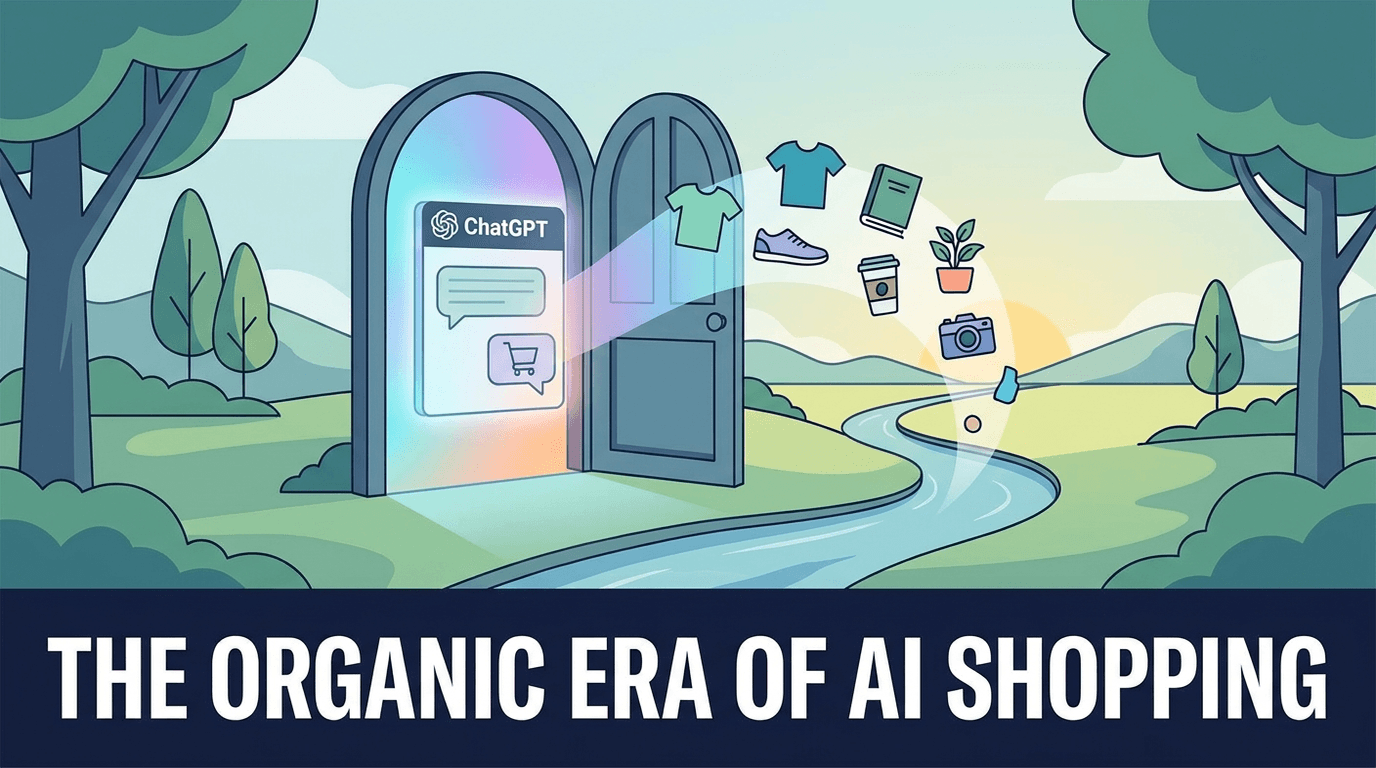
Six months ago, every agentic commerce deck opened with "in-chat checkout is the future." Today, Forrester has confirmed in print that only a handful of merchants ever went live with ChatGPT's Instant Checkout, that it has been pulled back due to "lackluster performance," and that the actual battle is being fought one layer up, at product discovery. If you have been waiting for an analyst firm to validate that discovery matters more than in-chat payments, the validation is here.
TL;DR: Forrester's April 2026 analysis confirms ChatGPT Instant Checkout was scaled back after only a handful of merchants ever went live. With 900 million weekly ChatGPT users and a tiny live merchant base, the ranking window for agentic commerce is wide open. The "organic era" is what comes before paid AI shopping placements arrive, and retailers who optimize product data now will own the recommendations before ads change the economics.
What Forrester Actually Said
In an April 2026 analysis cited by Ecommerce Fastlane and Forbes Business Development Council, Forrester formally characterized ChatGPT's Instant Checkout rollback as a response to "lackluster performance." Only a handful of merchants ever went live. The pullback preserves merchant-owned checkout and, by extension, the customer relationship that brands refused to surrender. [Source: Ecommerce Fastlane, April 16, 2026, Forbes, April 13, 2026].
Forbes's framing went further: killing in-chat checkout was "a gift to retailers." Brands had been told for months that they would need to give up checkout, login, and loyalty integration to participate in AI shopping. They refused. OpenAI listened. The current model, AI recommends and the shopper buys on the retailer's site, is the model merchants actually wanted.
Key Stat: 900 million weekly ChatGPT users. Only a handful of merchants ever went live with Instant Checkout before it was scaled back. That gap is what Forrester means by "organic era."
Why the "Organic Era" Framing Matters
Every new discovery surface goes through the same life cycle. Google search had a decade of organic-only results before AdWords arrived. Amazon had years before sponsored listings dominated the search page. Instagram had years before it became a paid-first platform. Each time, the brands that ranked organically during that window built durable share that survived the transition to paid.
ChatGPT is currently in that window. Forrester's analysis, combined with OpenAI's decision to rebuild around discovery rather than checkout, puts the category back into a familiar pattern: the ranking algorithm is the product, and the brands that feed it the cleanest data win recommendations. Paid placements are coming, OpenAI has been explicit about that, but they are not here yet.
The window closes eventually. It is open now.
What Changed Between September 2025 and April 2026
The honest history: OpenAI launched Instant Checkout in September 2025 as part of the original ACP announcement with Stripe. The pitch was that shoppers could complete purchases inside ChatGPT without leaving the conversation. Partners were announced. A few merchants went live.
Then two things happened. First, brands rejected being reduced to anonymous fulfillment centers. They were losing traffic to their own sites, they lost login and registration data, they could not enroll customers in loyalty programs, and they paid a transaction fee on top. The math stopped working. Second, Walmart publicly disclosed that Instant Checkout conversions were roughly 3x worse than walmart.com checkout [Source: Ivinco, citing Walmart, March 2026]. That is a conversion gap no brand can ignore.
OpenAI pivoted. By March 2026, Instant Checkout was discontinued. The ACP protocol still exists as open source at agenticcommerce.dev, but it now powers product discovery and merchant redirect, not checkout. The shopper sees products inside ChatGPT, then clicks through to the retailer's own site to buy. Merchants keep the customer, the data, and the relationship.
| Phase | Timeline | What Happened |
|---|---|---|
| Launch | September 2025 | OpenAI + Stripe announce ACP with Instant Checkout. Partners named. |
| Early live | Q4 2025 | A handful of merchants go live. Conversion lags walmart.com by ~3x. |
| Pullback | March 2026 | OpenAI scales back Instant Checkout. ACP repositions around discovery. |
| Organic era | April 2026 - present | 900M weekly users, tiny live merchant set, ranking wide open. |
| Paid placements | Future | OpenAI has said ads are coming. Timing unconfirmed. |
The Competitive Reality: Winners Are Already Locking In Position
While the analyst community finalizes the "organic era" framing, a small group of retailers has quietly been capturing the traffic. ChatGPT now drives roughly 20% of Walmart's referral traffic and 15% of Target's [Source: BeautyMatter, citing Accenture, April 6, 2026]. Shopify reported 15x AI-driven order growth in Q4 2025. Adobe's Q1 2026 data shows AI traffic grew 393% year-over-year across US retailers, with AI-referred shoppers now converting 42% better than typical human-driven visitors [Source: Adobe via TechCrunch, April 16, 2026].
Meanwhile, Aido Lighthouse benchmarked 345+ retailers in April 2026 and found that only 2% can complete an end-to-end autonomous AI transaction. Thirty percent score zero on transactability. The average AI readiness score was 48.1 out of 100.
Two groups are forming. The first group is being recommended by AI every day and is pulling higher-quality traffic than they can get from paid search. The second group is invisible and does not yet know it. The "organic era" is kind to the first group and brutal to the second.
What the Organic Era Requires
Winning during an organic window is never glamorous. It is structured work. Based on what is actually driving recommendations in ChatGPT, Google AI Mode, and Perplexity today, the playbook is:
- Feed quality over feed quantity. The OpenAI product feed spec (version 2026-01-30), Google's Merchant Center, and the Amazon Rufus index all reward 25 to 40 structured attributes per SKU. Most catalogs have 5 to 8. The delta is the work.
- Protocol coverage across ACP and UCP. ACP handles ChatGPT and Microsoft Copilot discovery. UCP handles Google AI Mode and Gemini. Running both, not picking one, is what enterprise brands need for full surface coverage.
- Category depth in attribute schema. "Running shoes" is not enough. "Neutral support, 10mm heel drop, breathable mesh upper, for flat-foot overpronators" is what AI agents match against conversational queries.
- Merchant info and policy transparency. Returns, shipping, warranty, in-stock status. Agents now surface these details inside the recommendation. Missing or outdated fields lose the sale.
- Weekly monitoring of actual placement. The rankings change weekly. The retailers capturing share are running continuous checks on which queries return their products as a full card (image, price, link), versus a brand mention, versus nothing at all.
"It isn't mainstream yet, and it's pretty risky right now, because there aren't enough guardrails in the system for people to feel comfortable with agents autonomously buying things for them."
- Matt Kropp, BCG AI expert, quoted in CBS News, April 17, 2026
Kropp's caution is the right caveat. Consumer trust is still catching up. But that is exactly why the organic era exists. When consumer trust catches up and ads arrive, the brands already ranked will keep most of the share. The brands trying to catch up will pay for placement.
What To Do This Quarter
Three concrete actions for the next 90 days:
- Audit your top 20% of SKUs by revenue. Count the structured attributes each has. Anything under 15 is a gap. Anything under 8 is invisible. (Our walkthrough of how retailers structure their data for AI agents lives on paz.ai/agentic-commerce.)
- Run a weekly "ghost query" test. Pick the five queries that matter most in your category and ask ChatGPT, Google AI Mode, and Perplexity each week. Track whether you show up, whether the competitor shows up, and whether the answer includes a product card or a text mention.
- Decide the owner of AI visibility before Q3 planning. This is neither SEO nor paid search nor the PIM team alone. It sits across all three. Someone owns the number or nobody does.
The Honest Counterpoint
Forrester has not pronounced agentic commerce ready for prime time. Their position remains that the category is "experimental" and that consumer adoption for actual purchasing remains low. Only 35% of Gen Z and 23% of Gen X say they currently use ChatGPT for product search. Those numbers will grow, but they are not yet the majority.
That tension, a market moving fast with conversion quality that already exceeds human-driven traffic, but an overall consumer base that is still early, is the exact shape of every organic window that came before it. Retailers who wait for full consumer adoption will miss the window to lock in position for free. That is the price of certainty.
Frequently Asked Questions
What does Forrester mean by "organic era"?
Forrester's framing, and similar commentary from Ecommerce Fastlane, describes the current period in AI shopping: 900M weekly ChatGPT users but only a small set of live merchants, no paid placements yet, and ranking driven by product data quality. Retailers who optimize now capture free share that paid placements will be more expensive to buy later.
Is ChatGPT Instant Checkout coming back?
No. OpenAI discontinued Instant Checkout in March 2026. The ACP protocol still exists but now powers product discovery and merchant redirect. The shopper buys on the retailer's own site, not inside ChatGPT. Forrester has confirmed the scaleback.
When will paid placements in ChatGPT arrive?
OpenAI has publicly stated that advertising is coming but has not given a specific timeline. The organic era is open until they roll out paid inventory. Analysts differ on when that will be; most estimates fall in 2026-2027.
How is this different from traditional SEO?
Traditional SEO optimizes page content for ranking algorithms that serve human readers. AI visibility optimizes structured product data for agents that read feeds, not pages. Different inputs (attributes, feeds, schemas), different outputs (product cards, recommendations), different protocols (ACP, UCP, MCP).
What happens to retailers who wait?
They lose share to the retailers ranking now. Adobe Q1 2026 data shows AI referral traffic converts 42% better than typical traffic. Walmart and Target are already capturing 20% and 15% of ChatGPT referral volume in their segments. When ads arrive, late movers will pay to reach the same shoppers that optimized retailers reach for free.
Conclusion
The analyst validation is here. The data is here. The protocols are stable enough to optimize against. The only thing missing from most retailers' AI commerce strategy is the decision to make one.
See where your brand shows up today. Run a free AI Readiness Report at paz.ai and get your Found Rate, Visibility Score, and competitor comparison in under a minute.
Paz.ai, an agentic commerce optimization platform, helps retailers monitor how their products appear across ChatGPT, Google AI Mode, and Perplexity, enrich catalog data for AI comprehension, and distribute protocol-compliant feeds to every major AI shopping surface.
How AI-ready are your products?
Check how ChatGPT, Google AI, and Perplexity evaluate any product page. Free score in 30 seconds.