Amazon Is Buying ChatGPT Ads. That's Not a Strategy.
- Author
- By Dor
- Publication date
- Published
- Reading time
- 6 min read
Amazon just placed sponsored slots inside ChatGPT for searches like "Top-Rated Kitchen Gear," reported by Business Insider on June 22, 2026. It is the largest US retailer's first-ever ChatGPT ad buy. If Amazon now treats paid ChatGPT placement as a budgeted line item, every mid-market brand needs to pay attention.
But paying for the slot is not the same as winning the query.
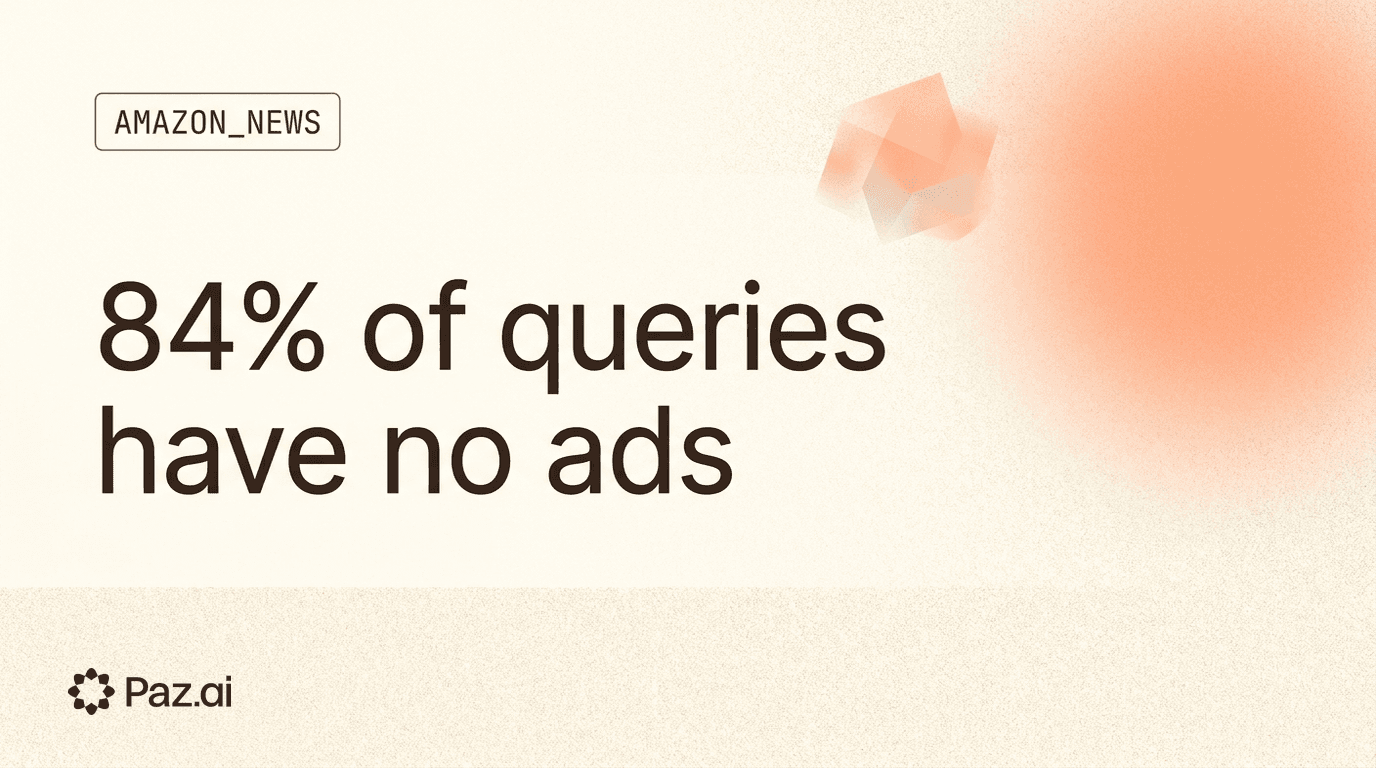
TL;DR: Amazon now buys paid slots inside ChatGPT (Business Insider, June 22, 2026) while walling off its own product data from AI agents. Research from Floodlight (June 2026) found 84% of ChatGPT queries return no ads, and where ads do appear, unrelated brands often fill those slots instead of the organically recommended ones. Paid ChatGPT visibility is thin and query-limited. Organic AI retrieval wins most queries. Fix both, but the organic layer is not optional.
What Amazon Actually Did (and Why It's Telling)
Amazon's ChatGPT ad buy is a revealing data point, not a blueprint to copy blindly.
According to Business Insider (Eugene Kim, June 22, 2026), Amazon purchased sponsored placement under queries including "coffee maker" and "Top-Rated Kitchen Gear." The ads funnel users back to amazon.com, where Amazon controls the checkout, the data, and the relationship. Amazon is not trying to become AI-native. It is trying to keep its existing funnel alive as AI search intercepts more discovery queries.
That context matters. Amazon also stopped feeding product data to Google Shopping last year, blocks OpenAI's crawler from its catalog, and won a court order against Perplexity's shopping agent. Its strategy is to monetize AI surfaces for traffic while keeping its own data locked. That is a playbook only Amazon can run, because Amazon owns the destination. Most brands do not.
The Ad Coverage Problem Nobody Is Talking About
The structural issue with chasing paid ChatGPT placement: most queries do not serve ads.
Research from Floodlight (June 2026) found that 84% of ChatGPT queries returned no sponsored results at all. Where ads did appear, unrelated brands frequently filled the slots rather than the brands organically surfaced in the answer. You can pay for a slot and still lose the recommendation.
84% of ChatGPT shopping queries return zero ads (Floodlight, June 2026). In queries where ads do appear, organic retrieval still determines which brands dominate the answer.
This reflects how ChatGPT's retrieval architecture works. The model composes answers via passage-level retrieval across a vast corpus, then ads are overlaid on a small slice of queries. The answer layer and the ad layer are separate systems.
A brand with weak organic AI representation gets a thin ad slot but a bad answer when no ads appear, which is most of the time.
Why Organic AI Discovery Still Wins Most Queries
Paid slots are overlaid on ChatGPT answers after retrieval is complete. The underlying retrieval, which determines whether your brand appears in the answer at all, is driven entirely by product data quality. That is the layer most brands have not addressed.
ChatGPT uses query fan-out, breaking a single user query into multiple sub-queries to retrieve the most relevant product information. A search for "best running shoes for flat feet" fans out into sub-queries about arch support, durability, price range, and return policy. Each sub-query retrieves passages independently.
A study by Surfer SEO (December 2025, 173,902 URLs analyzed) found that 68% of AI-cited pages are not in the top 10 organic search results. Your Google rankings do not map to your AI visibility. Brands with structured product data, complete attributes, accurate pricing, and answer-ready descriptions get surfaced repeatedly across fan-out sub-queries. Brands without that structure get skipped, even if they paid for an adjacent ad slot.
As of June 2026, ChatGPT handles an estimated 50 to 80 million shopping queries per day based on OpenAI's disclosed usage patterns. The overwhelming majority resolve without any sponsored result. That is the market organic AI visibility competes for.
The Walled Garden Trap for Everyone Else
Amazon restricts AI agent access to its own catalog while paying to appear in ChatGPT results. For brands that sell exclusively on Amazon, that strategy partially covers them. For any brand with its own direct channel, the lesson runs the other direction: your data needs to be accessible, structured, and retrievable.
Amazon's Rufus and walled-garden agent strategy shows what catalog lock-in looks like from the inside. Rufus is trained on Amazon data and optimized to keep users on Amazon. Brands relying solely on that ecosystem have no direct influence over how their products are described or compared by AI systems outside it.
The brands capturing organic AI discovery over the next 18 months are investing now in AI visibility as a separate discipline from SEO: structured product data, answer-ready descriptions, and systematic monitoring of ChatGPT query coverage.
Paid vs. Organic: Two Levers, Very Different Coverage
| Dimension | Paid ChatGPT Ads | Organic AI Discovery |
|---|---|---|
| Query coverage | Minority of queries (~16%, Floodlight June 2026) | All queries |
| What determines presence | Bid, relevance score, ad budget | Product data quality, structured attributes, passage retrievability |
| Cost model | CPC / CPM (ongoing) | Up-front content/data investment |
| Brand control | Limited (slot, not answer copy) | Higher (your data shapes the answer) |
| Answer influence | Ad appears alongside or below AI answer | You are in the AI answer itself |
| Who benefits most | High-reach brands with broad catalog | Any brand with well-structured product data |
| Amazon's approach | Buying both simultaneously | Walling off data to protect own funnel |
The right answer for most brands is not choosing one over the other. It is recognizing that paid placement covers a narrow query slice, and that organic ChatGPT product visibility is the foundation that makes any paid spend more effective.
Branded and non-branded AI query visibility also behave differently. Brand-name queries ("Nike running shoes") may favor established brands regardless of data quality. Non-branded queries ("best running shoes for flat feet under $150") are decided entirely by retrieval quality. Most high-intent shopping queries are non-branded.
What to Do This Week
-
Audit your organic ChatGPT representation before buying ads. Search your category queries in ChatGPT and note which brands appear in the answer body, not just the sponsored rail. If your brand is absent from the answer, an ad slot alone will not fix that.
-
Structure your product data for passage retrieval. Each product description should independently answer the sub-queries a shopper might have: materials, sizing, use cases, price-to-value context, and return policy. Thin, SEO-keyword-stuffed descriptions get skipped by query fan-out. Complete, attribute-rich descriptions get surfaced.
-
Track AI visibility separately from organic search rank. Your Google page-one position does not predict your ChatGPT appearance. Use agentic commerce monitoring to track category query coverage separately. Paz.ai, an agentic commerce optimization platform, tracks how products appear across ChatGPT, Google AI Mode, and Perplexity so you can spot gaps before a competitor fills them.
-
Do not assume Amazon's playbook transfers. Amazon is protecting its own funnel. If you sell direct-to-consumer, your product data on your own site is the lever. Optimize it for AI retrieval, not just for human browsing.
-
Map your non-branded category queries. List the 10 to 20 queries a first-time buyer would use to find your category. Run them in ChatGPT today. Note who appears and how their products are described. That is your competitive benchmark for the organic territory where most AI shopping decisions get made.
Frequently Asked Questions
Does Amazon's ChatGPT ad buy mean other brands should follow?
Not without fixing the organic layer first. Amazon's ads drive users to amazon.com, where it controls everything downstream. Organic AI discovery determines whether you appear on the majority of queries where no ads are served. Paid placement without strong organic representation means invisible on 84% of ChatGPT queries (Floodlight, June 2026).
How does ChatGPT decide which brands appear organically in shopping answers?
ChatGPT uses passage-level retrieval across training data and connected product feeds. Brands that appear consistently have complete product data: detailed attributes, accurate pricing, and contextual descriptions that answer likely sub-queries. Structural completeness matters more than keyword density.
Why is Amazon buying ChatGPT ads while blocking AI agents from its catalog?
Amazon uses paid placement to capture traffic while keeping its catalog inaccessible to AI agents that could direct buyers elsewhere. The ChatGPT product feed ad channel works differently: brands submit product feeds that OpenAI uses for both ads and organic surfacing. Amazon buys the slot without opening its full catalog to third-party AI retrieval.
Is paying for ChatGPT ads worth it for mid-market brands?
It depends on query coverage for your category. Because 84% of ChatGPT queries return no ads (Floodlight, June 2026), paid placement only helps on the subset that serve sponsored results. For most mid-market brands, the stronger investment is optimizing product data for organic retrieval first, then adding paid placement where sponsored slots are consistently available.
What is the difference between ChatGPT's ad system and traditional paid search?
Traditional paid search serves ads on nearly every commercial query. ChatGPT's ad coverage is much thinner, available on a minority of shopping queries and still rolling out. ChatGPT's ad unit also appears alongside an AI-generated answer built independently from product data. You can win the ad slot and still lose the answer if your organic product data is weak.
How does Amazon's walled-garden approach affect brands that sell primarily on Amazon?
It is a compounding risk. Your AI discoverability is controlled by Amazon's choices about data exposure and how Rufus describes your products. You have no direct influence over your AI representation. Brands with a direct catalog have a lever Amazon-only sellers do not.
Amazon buying ChatGPT ads is a signal, not a strategy to copy wholesale. The largest US retailer is using paid placement to protect a funnel it built over decades. Most brands do not have that funnel. What they can build, right now, is the organic AI visibility layer that determines outcomes on the vast majority of queries that never serve a sponsored result. That is the game in play, and it runs on product data quality, not ad budgets.
How AI-ready are your products?
Check how ChatGPT, Google AI, and Perplexity evaluate any product page. Free score in 30 seconds.