Your Brand Shows Up in AI for Its Name. Why It Vanishes for Everything Else
- Author
- By Dor
- Publication date
- Published
- Last updated
- Updated
- Reading time
- 6 min read
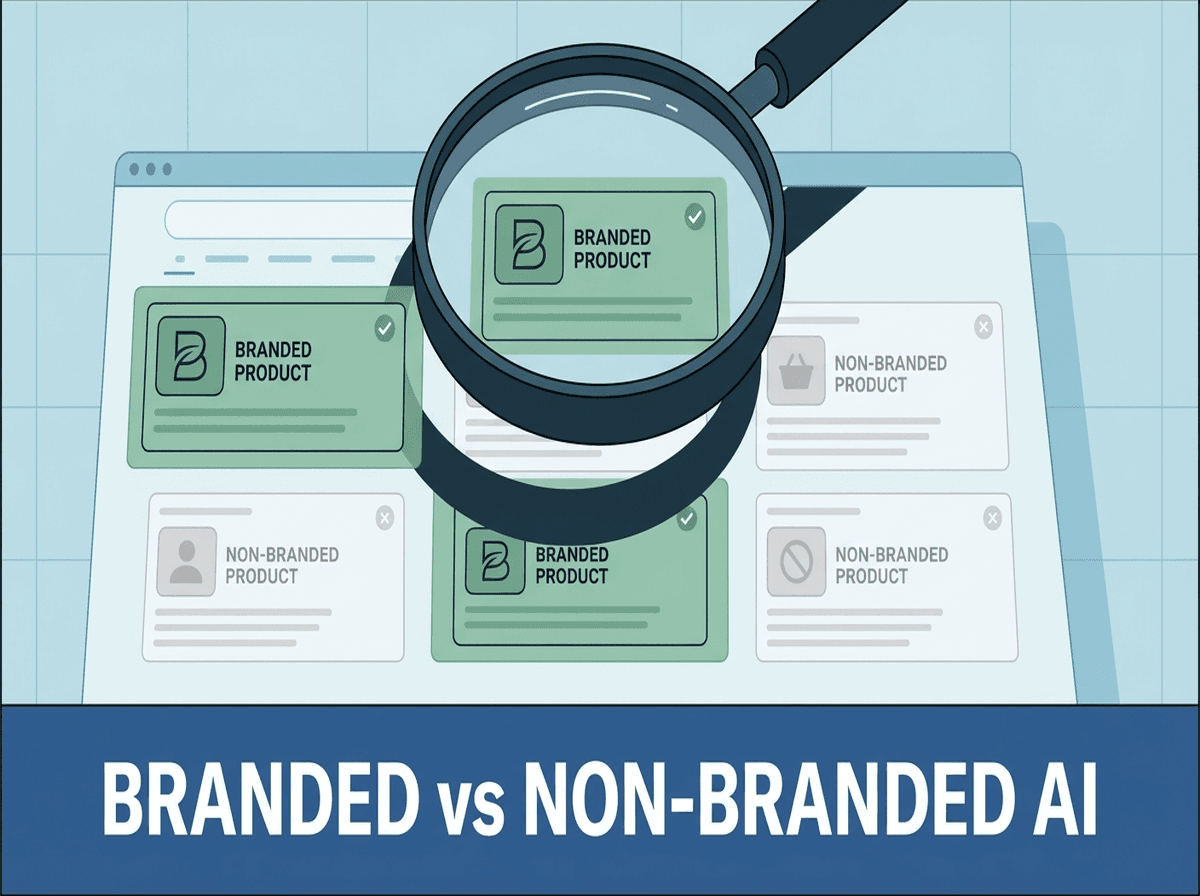
"I don't even know if we show up." That is how most Heads of Ecommerce describe their AI visibility, and the first test they run is the same one every time. They type their brand name into ChatGPT, see their products, and relax. Then someone asks the assistant for "the best running shoes for flat feet under $150" and the brand is nowhere in the answer.
That is the branded versus non-branded gap. Branded prompts find you. Category prompts, the ones a shopper types before they have a brand in mind, are where the purchase intent lives and where most product information falls short. This post explains why the gap opens and what to fix first.
What branded and non-branded mean when the search box is a chat window
A branded prompt names you: "show me Nike running shoes." The assistant can pattern-match on a known entity, and there is enough public information about Nike running shoes to fill a warehouse. We looked at how that plays out in how Nike wins when you ask AI for sneakers.
A non-branded prompt describes a need: "best running shoes for flat feet under $150." The shopper has intent, a specific requirement and a budget, but no brand yet. To answer, the assistant has to reason about product attributes, in this case arch support, cushioning, foot shape and price. It has to match a described situation to specific products, and it can only do that with the product information it can find and read.
That is where brands drop out. The branded test tells you the assistant knows you exist. It says nothing about whether you are recommended when a shopper describes a problem instead of naming you.
Why non-branded prompts are where the money is
Think about how people actually shop. "A good gift for my husband who skateboards." "Best moisturizer for dry skin under $50." "A lightweight stroller that fits in an overhead bin." None of these name a brand, and each one is a buying decision in progress.
The shift to this kind of shopping is measurable. PYMNTS Intelligence found that, as of January 2026, 41% of US consumers had used dedicated AI platforms for product discovery, and 43% of them said they had fully replaced their previous search methods. A shopper study from XCCommerce and SmartBrief, surveying NRF SmartBrief readers in December 2025, found that more than 70% were using or exploring AI tools to find better deals. These shoppers are describing problems, not typing brand names.
The traffic that comes back is also worth having. Adobe Analytics reported that during the 2025 holiday season traffic to US retail sites from generative AI tools rose 693% year over year, AI referrals converted 31% better than other traffic sources, and revenue per visit was up 254%. These are shoppers who already described what they want to an assistant, got a recommendation, and clicked through to buy.
In classic search, a brand could bridge the non-branded gap with paid ads. Bid on "best running shoes" and you appear whether or not your product page mentions arch support. Paid placement now exists in ChatGPT too, and our ChatGPT Ads service covers it, but it complements being recommended organically rather than replacing it. The assistant still reads your product information to decide which products fit the question.
What the assistant reads when there is no brand name
When a shopper asks for "a warm winter jacket for hiking in the Pacific Northwest under $200," the assistant has to evaluate warmth, water resistance, weight, the activity, the climate and the price. If your listing says "Men's Winter Jacket, Black, $189" and little else, there is nothing to match. The jacket might be the perfect answer, but the information does not say so.
The attributes shopper questions test are the ones a good salesperson would volunteer: who the product is for, what it is made of, what it is compatible with, how it fits, what climate or activity it suits, what is in the box, and what it costs. If those facts live only in a PDF or a support article, the assistant is unlikely to find them. If they are stated plainly on the product page and in the feed, it can.
The feed matters as much as the page. Assistants that draw on Google's shopping data inherit whatever is in your Merchant Center feed, including the categories Google guessed for you and any attributes left blank.
A frequent question we hear is which Merchant Center fields AI surfaces read. The practical answer is to treat title, description, product type, Google product category, GTIN, price, availability and the category-specific attributes as the fields that decide whether a product can be matched at all. Our product feeds service works on exactly those fields.
As Loni Stark, Vice President of Strategy and Product at Adobe, put it: "Brands face a dual imperative: optimizing for AI agent discoverability while deepening direct customer relationships through superior experiences."
Why the same prompt returns you once and not the next time
Teams often report that a category prompt returned them on Monday and a competitor on Tuesday, or that ChatGPT recommends them while Google AI Mode does not. Assistants assemble each answer from a fresh retrieval, so small differences in wording, the shopper's location, stock status and which sources were fetched change the result. One query is a sample, not a verdict.
That is why a before-and-after view has to be built on a fixed set of shopper questions, run repeatedly across assistants, with appearances counted as a share rather than a yes or no. We described one way to do that in our note on Google's AI performance insights and share of voice. It is also why zero-click behavior matters. When the assistant answers inside the chat, as we explored in zero-click AI shopping, being named in the answer is the visit.
What to fix first
Closing the non-branded gap is product information work, and it can be done in a sensible order by a lean team.
- Write the category prompts a real shopper would ask. Pick around twenty for your highest-revenue categories. Write them as personas, not keywords: "a stroller for a parent who flies monthly," not "lightweight stroller." If the questions do not sound like a customer, the results will not tell you anything.
- Run them across ChatGPT and Google AI Mode and record what comes back. Note whether you appear as a product card, a text mention, or not at all, and which competitors appear instead. This is the baseline.
- Fix the product information the prompts expose. For each product that should have appeared, add the missing facts to the page and the feed from your own sources: specifications, supplier data, support tickets and reviews. Resolve conflicting sources with the product owner before publishing.
- Re-run the same prompts and compare. Appearances in answers, AI-referred sessions and orders are three different numbers. Report them separately.
Structured data belongs on that list too. Schema.org product markup and a complete, current feed make the same facts machine-readable, so the assistant does not have to guess from marketing copy. The AI visibility service runs this cycle with you, and a free AI readiness report shows how a single product page reads to the assistants before you start.
Frequently asked questions
How is AI search different from Google for product discovery?
Google ranks pages using keywords, links and other signals. An assistant interprets the meaning of the question and matches it against the product facts it can retrieve, then composes an answer that names specific products. A product needs complete, plainly stated information on the page and in the feed to be matched, not only keyword-optimized copy.
Can brands buy visibility in AI search the way they do with Google Ads?
Paid placement in ChatGPT exists, and we run it for brands. It is a complement to organic recommendation, not a substitute. The assistant still decides which products fit the shopper's question from the product information it reads, so thin product data limits paid and organic results alike.
How quickly is AI shopping adoption growing?
Fast, from a small base. Adobe reported 693% year-over-year growth in AI referral traffic to US retail sites during the 2025 holiday season, and PYMNTS Intelligence found that 41% of consumers had used AI platforms for product discovery as of January 2026. For most stores AI-referred sessions remain a small share of traffic, which is why the conversion and share-of-answer numbers matter more than the growth rate.
This is the work Paz does for lean ecommerce teams. A Paz expert runs your category prompts across the assistants, finds the gaps in your product pages and feed, and proposes the fixes with the evidence behind each one. You approve, and the platform publishes the changes and tracks whether you start appearing for the questions that used to skip you. Talk to us.
How AI-ready are your products?
Check how ChatGPT, Google AI, and Perplexity evaluate any product page. Free score in 30 seconds.


