AI Visibility: The New SEO
- Author
- By Dor
- Publication date
- Published
- Last updated
- Updated
- Reading time
- 8 min read
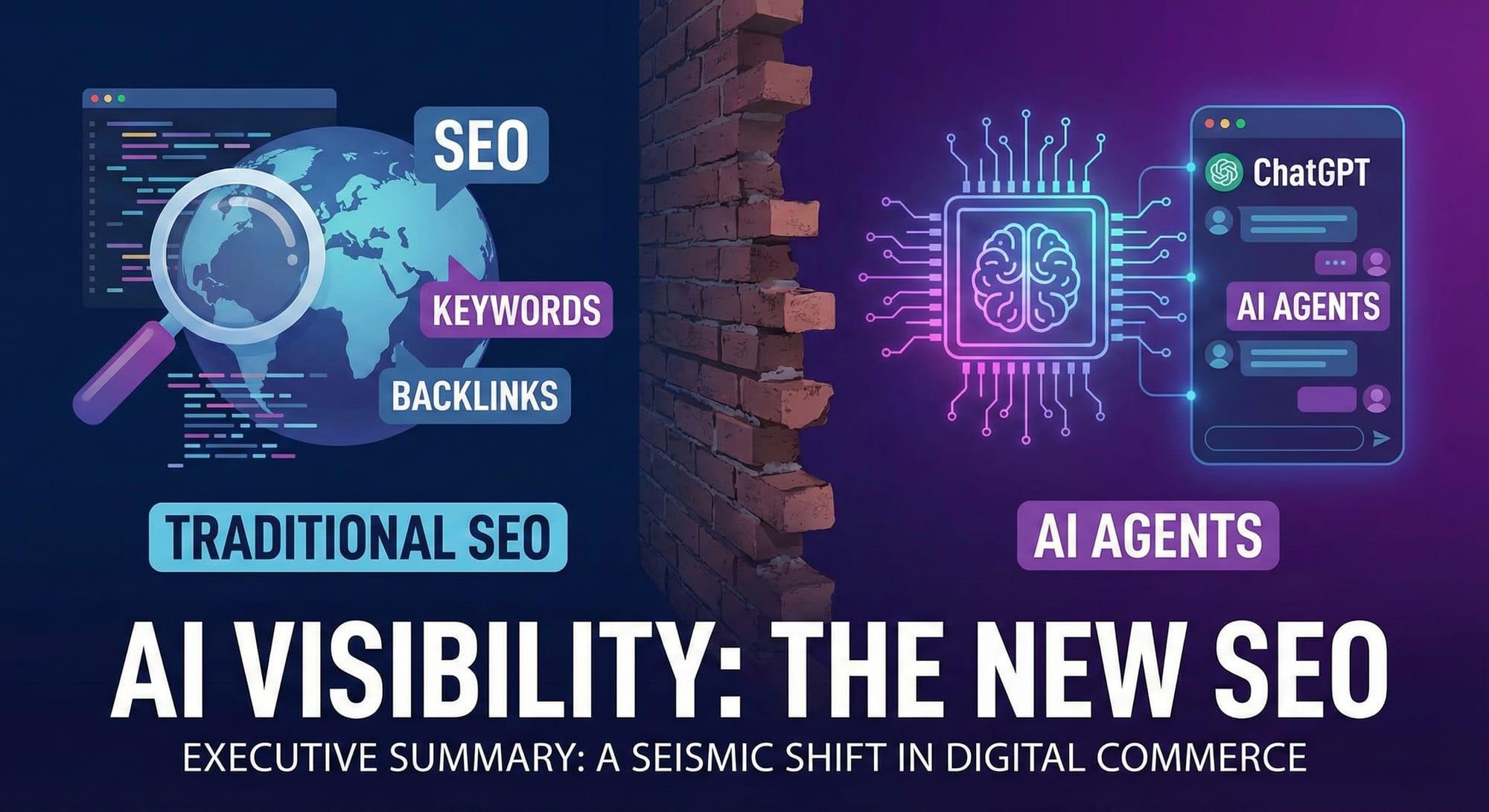
Executive Summary
For two decades, retailers have invested heavily in search engine optimization. Rankings, keywords, backlinks-these concepts shaped digital commerce strategy. But a seismic shift is underway.
When 50 million people ask ChatGPT for product recommendations every day, traditional SEO is irrelevant. AI agents don't crawl websites or follow PageRank algorithms. They make recommendations based on entirely different criteria-criteria most retailers don't understand and can't currently measure.
This whitepaper introduces AI Visibility: the new discipline of ensuring your products are discoverable, recommended, and purchasable through AI shopping agents.
The Core Problem:
- 90-95% of organic traffic for major retailers comes from branded searches
- AI agents source recommendations from unbranded, intent-based queries
- Most retailers have zero visibility into how AI perceives their products
- Without measurement, optimization is impossible
The Opportunity:
- AI-referred visitors convert 38% better than traditional traffic
- AI users spend 32% more time on site
- Early optimizers are achieving 7x better sales growth
- The window for competitive advantage is now
Part 1: The Visibility Crisis
The Discovery Gap
Consider this data point from a large global fashion retailer (December 2025):
- 0.5% of organic traffic comes from AI engines
- +8,000% YoY growth in AI engine sessions
- 90-95% of organic traffic is branded queries
This reveals a critical problem: consumers who already know your brand find you through traditional search. But consumers discovering through AI-the fastest-growing channel-aren't finding this retailer at all.
This is the AI discovery gap, and it affects nearly every retailer.
Why Traditional SEO Fails
SEO was designed for a specific system: search engine crawlers that index pages, analyze keywords, and rank based on signals like backlinks and domain authority.
AI agents work differently:
| Factor | Traditional Search | AI Agents |
|---|---|---|
| Query Type | Keywords | Natural language |
| Results | Links to pages | Direct recommendations |
| Selection | Algorithm ranking | Contextual reasoning |
| Data Source | Crawled web pages | Structured data feeds |
| User Action | Click to visit | Purchase in-chat |
| Optimization | PageRank signals | Semantic understanding |
Your SEO investment-the metadata, backlinks, and technical optimization-doesn't translate to AI visibility. These systems operate on fundamentally different principles.
The Invisible Majority
Based on our analysis of retailer data, the vast majority of product catalogs are effectively invisible to AI agents:
Common Visibility Failures:
- Incomplete Attributes: Products lack the detailed attributes AI needs to match user intent
- Non-Semantic Descriptions: Marketing copy that humans understand but AI can't parse
- No Protocol Integration: Products aren't accessible via ACP, MCP, or AP2
- Stale Data: Inventory and pricing don't update in real-time
- No Checkout Path: AI can recommend but can't complete the sale
The result: when a consumer asks ChatGPT "What's the best running shoe for marathon training under $150?"-your product isn't in the consideration set.
Part 2: Understanding AI Decision-Making
How AI Agents Recommend
AI shopping agents don't search-they reason. When a user asks for a product recommendation, the agent:
- Parses Intent: Understands what the user actually needs
- Queries Sources: Accesses product databases via protocols
- Evaluates Options: Compares products against user criteria
- Applies Reasoning: Selects the best match with explanation
- Presents Recommendation: Offers specific product(s) with rationale
The Selection Criteria
AI agents consider factors traditional SEO doesn't capture:
Explicit Criteria (User-Stated):
- Price range
- Brand preferences
- Specific features
- Use case requirements
Implicit Criteria (AI-Inferred):
- Product quality signals
- User profile matching
- Contextual appropriateness
- Availability and fulfillment
System Criteria (Platform-Driven):
- Data completeness
- Real-time accuracy
- Checkout capability
- Historical performance
The Trust Loop
AI agents develop preferences based on outcomes:
Recommendation → User Feedback → Adjusted Weighting → Future Recommendations
Products that lead to:
- Completed purchases (not abandoned carts)
- Positive user feedback
- No returns or complaints
- Repeat purchases
...get recommended more frequently. This creates a flywheel effect where early visibility compounds over time.
Part 3: Measuring AI Visibility
The Measurement Problem
You can't optimize what you can't measure. Most retailers face a fundamental challenge: they have no idea how AI agents perceive their products.
What You Can Currently Measure:
- AI referral traffic (limited)
- AI-attributed conversions (if tracked)
- Some platform-specific metrics
What You Can't Currently Measure:
- How often your products are recommended
- Why competitors are chosen instead
- Which queries trigger your products
- What attributes AI values most
- Your relative visibility score
This measurement gap is where competitive advantage is won or lost.
Introducing the AI Visibility Score
An effective AI Visibility Score should capture:
1. Discoverability (40%)
- Are your products in the AI's accessible data?
- Can AI agents find your products for relevant queries?
- How complete are your product attributes?
2. Recommendability (30%)
- How often are your products selected?
- What's your share of recommendations vs. competitors?
- Are you winning on your target queries?
3. Convertibility (30%)
- Can users purchase without leaving the AI interface?
- How smooth is the checkout experience?
- What's your AI-attributed conversion rate?
Competitive Benchmarking
Visibility is relative. Your score matters in context:
| Score Range | Interpretation |
|---|---|
| 90-100 | Market leader-you're the default recommendation |
| 70-89 | Strong presence-competitive on most queries |
| 50-69 | Moderate visibility-appearing for some queries |
| 30-49 | Limited visibility-significant blind spots |
| 0-29 | Effectively invisible-urgent action needed |
Most retailers today score below 30. The ones optimizing are approaching 70+.
Part 4: The AI Visibility Framework
Pillar 1: Data Completeness
AI agents can only recommend what they can understand. Data completeness is table stakes.
Essential Attributes:
- Product title (natural language optimized)
- Description (semantic, use-case focused)
- Price (current, with promotions)
- Availability (real-time inventory)
- Images (multiple angles, high quality)
- Category (standardized taxonomy)
- Brand (verified, consistent)
- SKU/identifiers (unique, accurate)
Enhanced Attributes:
- Materials and composition
- Size/fit information
- Compatibility (works with X)
- Use cases (ideal for Y)
- Comparison points (vs. alternative Z)
- Social proof (ratings, reviews)
- Sustainability/certifications
- Care instructions
The Completeness Gap:
| Attribute Category | Typical Retailer | AI-Optimized Retailer |
|---|---|---|
| Basic attributes | 95% complete | 100% complete |
| Enhanced attributes | 30% complete | 90% complete |
| Semantic descriptions | 10% optimized | 80% optimized |
| Real-time accuracy | Daily updates | Real-time sync |
Pillar 2: Semantic Optimization
AI understands language differently than search engines. Optimization requires semantic thinking.
Traditional SEO:
"Men's Running Shoe - Lightweight Marathon Training Shoe - Black/Red"
AI-Optimized:
"A lightweight racing shoe designed for marathon training and race day.
Weighs just 7.2oz with responsive foam cushioning that maintains energy
return through mile 26. Best for neutral runners seeking speed without
sacrificing comfort on long runs. The breathable mesh upper keeps feet
cool, while the rubber outsole provides grip in wet conditions."
The AI-optimized description:
- Addresses specific use case (marathon training)
- Provides concrete details (7.2oz, 26 miles)
- Specifies ideal user (neutral runners)
- Anticipates follow-up questions (breathability, wet grip)
Pillar 3: Protocol Integration
Visibility requires accessibility. Your products must be available through the protocols AI agents use.
Priority Protocol Stack:
- ACP (Agentic Commerce Protocol)
- Required for ChatGPT shopping
- Enables in-chat checkout
- Live with major retailers
- MCP (Model Context Protocol)
- Enterprise AI standard
- Broad agent support
- Growing to 90% adoption
- AP2 (Agent-to-Agent Protocol)
- Google ecosystem
- Payment network integration
- Building momentum
Integration Checklist:
- [ ] Product catalog exposed via protocol APIs
- [ ] Real-time inventory sync configured
- [ ] Pricing rules applied dynamically
- [ ] Checkout flow integrated
- [ ] Order management connected
- [ ] Analytics tracking enabled
Pillar 4: Checkout Enablement
Visibility without convertibility is incomplete. AI-referred traffic converts 38% better-but only if purchase is frictionless.
Checkout Requirements:
| Capability | Basic | Optimal |
|---|---|---|
| Add to cart | In-chat | In-chat |
| View cart | In-chat | In-chat |
| Payment | Redirect | In-chat express |
| Confirmation | In-chat + email | |
| Tracking | Separate login | In-chat query |
| Returns | Website | In-chat initiation |
The Conversion Formula:
AI Visibility × Checkout Friction = Conversion Rate
Maximum visibility with high friction = abandoned carts
Lower visibility with zero friction = still converts
The optimal position: high visibility AND frictionless checkout.
Part 5: Competitive Intelligence
Know Your Position
AI visibility is a zero-sum game for specific queries. When a user asks for "the best wireless earbuds for running," one or two products get recommended-everyone else is invisible.
Competitive Questions to Answer:
- Which competitors appear for your target queries?
- What attributes make them more recommendable?
- Where do you win? Where do you lose?
- What's the gap to close?
Query Mapping
Map your products to the queries you should win:
Example: Wireless Earbuds
| Query | Your Visibility | Top Competitor | Gap |
|---|---|---|---|
| "Best wireless earbuds for running" | 2nd | Sony WF | Sweat resistance spec |
| "Budget earbuds under $50" | Not visible | JBL | Price positioning |
| "Earbuds with longest battery life" | 1st | - | Leading |
| "Noise canceling for flights" | 3rd | Bose | ANC detail missing |
This analysis reveals specific actions: add sweat resistance specs, adjust price positioning, maintain battery leadership, enhance ANC descriptions.
Trend Monitoring
AI recommendation patterns shift. Monitor for:
- New competitors entering your queries
- Changes in AI selection criteria
- Seasonal query variations
- Emerging query patterns
- Protocol updates affecting visibility
Part 6: Implementation Playbook
Week 1: Audit
Data Completeness Audit
- Export product catalog
- Score attribute completeness
- Identify critical gaps
- Prioritize by revenue impact
Protocol Integration Audit
- Map current integrations
- Identify missing protocols
- Assess checkout capabilities
- Document technical requirements
Competitive Position Audit
- Define target queries
- Test against AI platforms
- Document current visibility
- Benchmark against competitors
Week 2: Optimize
Data Enhancement
- Fill critical attribute gaps
- Rewrite descriptions for AI
- Add semantic attributes
- Verify pricing accuracy
Integration Setup
- Initiate protocol connections
- Configure data feeds
- Test sync accuracy
- Enable checkout flows
Week 3: Launch
Go-Live Checklist
- [ ] All critical attributes complete
- [ ] Descriptions AI-optimized
- [ ] Protocol integrations live
- [ ] Real-time sync verified
- [ ] Checkout tested end-to-end
- [ ] Analytics tracking confirmed
Monitoring Setup
- Configure AI traffic tracking
- Set up conversion attribution
- Establish baseline metrics
- Create competitive alerts
Week 4+: Iterate
Continuous Optimization Loop:
- Measure: Track visibility score, traffic, conversions
- Analyze: Identify winning and losing queries
- Hypothesize: Determine optimization opportunities
- Test: Implement changes to product data
- Measure: Assess impact on visibility
- Repeat: Continuous improvement
Part 7: The Future of AI Visibility
Near-Term Evolution (2026)
Visibility will become table stakes. Just as every retailer eventually had to do SEO, every retailer will need AI visibility. Early movers have 12-18 months of competitive advantage.
Measurement will mature. Platforms will provide better analytics. Third-party tools will emerge. Visibility scoring will become standardized.
Personalization will intensify. AI agents will learn user preferences, making visibility more nuanced-different users see different recommendations for the same query.
Medium-Term Shifts (2027-2030)
AI agents will negotiate. Beyond recommendations, agents will negotiate prices, terms, and bundles on behalf of consumers. Visibility will include willingness to engage.
Multi-agent environments. Users will have multiple AI agents-shopping, financial, health-that coordinate. Visibility will need to span agent ecosystems.
Real-time optimization. Static product data will give way to dynamic, AI-generated descriptions optimized in real-time for specific queries and users.
The Visibility Arms Race
As more retailers optimize, visibility becomes competitive:
- Today: Optimization = visibility (low competition)
- 2026: Optimization = parity (medium competition)
- 2030: Superior optimization = visibility (high competition)
The implication: start now, build capabilities, accumulate advantages while competition is low.
Conclusion: The Visibility Imperative
Twenty years ago, retailers who ignored SEO became invisible on Google. Today, retailers ignoring AI visibility are becoming invisible to 50 million daily shopping queries-and the number grows every month.
The mathematics are straightforward:
- 805% YoY growth in AI shopping traffic
- 7x sales advantage for visible retailers
- 38% conversion premium for AI-referred traffic
- $300-500 billion projected AI commerce by 2030
You cannot afford to be invisible.
Your Next Steps:
- Audit your current AI visibility (or lack thereof)
- Measure your competitive position on key queries
- Optimize your product data for AI understanding
- Integrate with protocols AI agents use
- Track your visibility score over time
The retailers who master AI visibility will capture the defining commerce channel of the next decade. The ones who don't will wonder where their customers went.
About Paz.ai
Paz.ai solves the AI visibility problem. Our platform:
- Measures your AI Visibility Score across platforms
- Identifies blind spots and optimization opportunities
- Optimizes product data for AI recommendation
- Integrates with all major protocols (ACP, MCP, AP2)
- Tracks competitive position and trends
Stop guessing. Start knowing.
Sources
Market Research & Statistics
- Bain & Company - How Customers Are Using AI Search
- McKinsey - Agentic Commerce $5 Trillion Forecast
- Morgan Stanley - Agentic Commerce Market Impact Outlook
- Adobe Analytics - Cyber Week 2025 Report
- Salesforce - Holiday Shopping Insights 2025
Consumer Behavior
- Capital One Shopping - AI Shopping Statistics 2025
- Digiday - How Consumers Are Using AI to Shop in 2025
- Yotpo - How AI Is Changing Product Discovery in 2025
- a16z - State of Consumer AI 2025
Industry Analysis
- CB Insights - The Agentic Commerce Market Map
- Digital Commerce 360 - How AI Shopping Agents Are Rewiring Retail
- eMarketer - AI Shopping Referrals Retail Trends 2025
- Business of Fashion - AI's Transformation of Online Shopping
- GeekWire - How Agentic Commerce Could Disrupt Online Retail
Protocol Documentation
Glossary
AI Visibility: The degree to which your products are discoverable and recommendable by AI shopping agents.
Agentic Commerce Protocol (ACP): The protocol developed by Stripe and OpenAI for commerce transactions within AI interfaces.
AI Discovery Gap: The difference between your brand search visibility (traditional SEO) and your unbranded query visibility (AI).
Model Context Protocol (MCP): Anthropic's protocol for connecting AI systems to external data sources and services.
Semantic Optimization: Structuring product data for AI understanding rather than keyword matching.
Visibility Score: A composite metric measuring discoverability, recommendability, and convertibility across AI platforms.
Related: branded vs. non-branded AI visibility
This report was prepared by Paz.ai as part of our commitment to advancing retailer understanding of AI commerce. Data sourced from public company reports, industry research, and Paz.ai analysis.
How AI-ready are your products?
Check how ChatGPT, Google AI, and Perplexity evaluate any product page. Free score in 30 seconds.