Amazon Just Renamed Rufus to Alexa for Shopping. Open-Web Brands, You Need Two Stacks Now.
- Author
- By Dor
- Publication date
- Published
- Reading time
- 7 min read
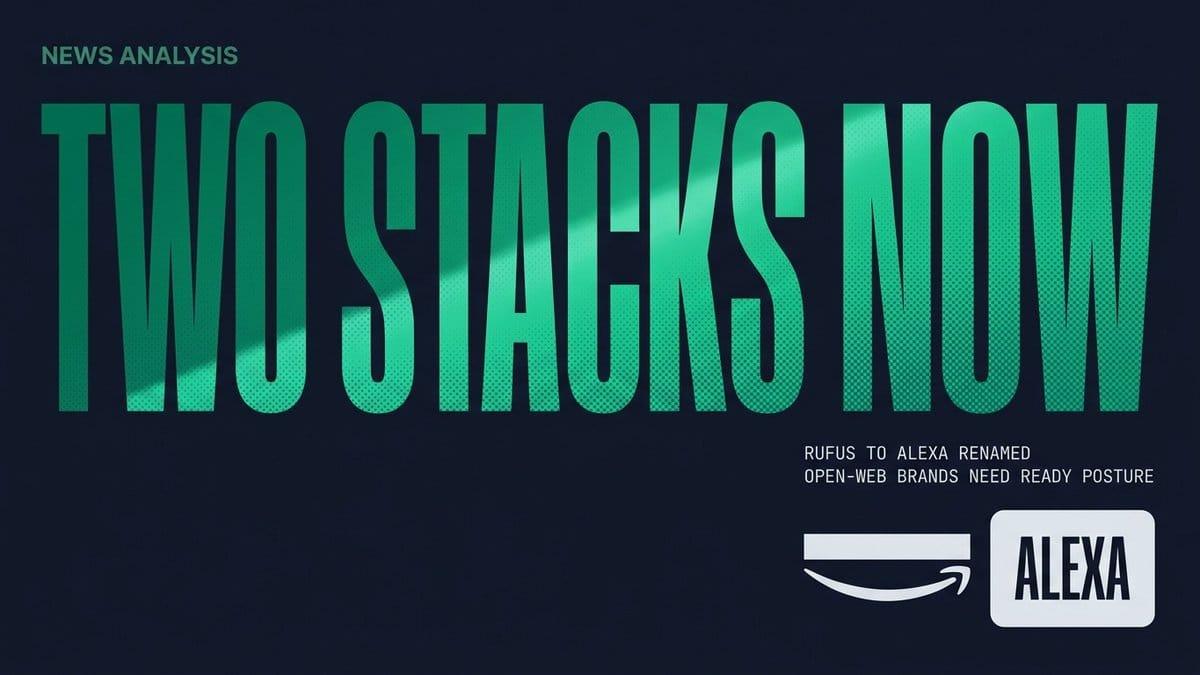
Amazon retired the Rufus brand on May 13, 2026 and folded its shopping agent into Alexa. The new name is Alexa for Shopping, it lives in the main Amazon search bar, and it ships free to every U.S. shopper with no Echo, no Prime, and no Alexa app required (Amazon). The agent that used to live in a chat window now lives behind every search box Amazon owns.
TL;DR: Amazon merged Rufus into Alexa and put the agent inside the main search bar, exposing it to roughly 300 million U.S. shoppers and tying it to the 600 million-plus active Alexa endpoints (Andy Jassy 2025 shareholder letter). The Amazon walled garden just doubled down on its own agent surface. Brands that sell on Amazon AND off Amazon now need two distinct readiness postures: one inside the walled garden, one for the open-web agents (ChatGPT, Google AI Mode, Gemini, Perplexity, Claude). The two stacks are additive, not interchangeable.
What actually changed on May 13?
Three things changed at once. The Rufus brand is gone from the consumer-facing UI. The agent is now called Alexa for Shopping and it answers questions directly inside the main Amazon search bar, instead of inside a separate chat panel (GeekWire). And the agent picked up new autonomous capabilities: Scheduled Actions (recurring restocks, auto-buy at a target price), Custom Shopping Guides, side-by-side multi-product comparison, and a full year of price history (Amazon).
The naming move is the part to read carefully. Rufus was a Beta-flavored product line buried inside the Amazon app. Alexa is the brand Amazon spent a decade putting in living rooms, kitchens, and cars. By choosing Alexa as the consumer-facing name, Amazon is telling its installed base that the shopping agent is a first-class Amazon surface, not a chatbot experiment. Every Echo, every Fire TV, and every Amazon search bar is now an entry point to the same agent.
Why this widens the walled-garden gap
Amazon controls the entire stack from query to checkout. Alexa for Shopping reads Amazon's product graph directly. It can rank, compare, schedule, and transact without ever leaving the Amazon environment. Open-web AI agents cannot do that. They cannot ingest Amazon's catalog the way they ingest a brand's own site, and they redirect the shopper out to the merchant's checkout instead of completing the purchase themselves. OpenAI discontinued Instant Checkout in March 2026 for exactly that reason: brands refused to be reduced to anonymous fulfillment centers and demanded the shopper land on the merchant's own site (retailer pushback overview).
That gap is the strategic shape of agentic commerce right now. Two surfaces, two physics:
| Surface | Owns the agent | Owns the catalog | Owns the checkout | Visible to brands? |
|---|---|---|---|---|
| Amazon (Alexa for Shopping) | Amazon | Amazon | Amazon | Indirectly, via listing optimization |
| ChatGPT, Gemini, Google AI Mode, Perplexity, Claude | The AI platform | The brand's own site or feed | The merchant's site | Directly, via catalog and feed quality |
Amazon's announcement is a clean signal that the walled-garden side is industrializing fast. The open-web side is industrializing too, just on a different timeline and through a different set of commerce protocols. Brands that sell across both sides need to run both plays.
What "two readiness stacks" actually means
Walled-garden readiness for Alexa for Shopping looks a lot like classic Amazon listing optimization, but the bar moved. The agent reads structured product fields, ranks across them, and pulls answers into the search bar before the shopper sees a single product card. The same fields a human shopper might skim are now what the agent reasons over.
Key stat: Amazon's announcement explicitly states the agent answers questions in the main search bar and can take you into an Alexa for Shopping conversation if it decides your query is best answered by the agent rather than by a product page (Amazon). The product detail page is no longer the default destination.
Open-web readiness is a different job entirely. It is not about Amazon listing fields. It is about whether your catalog can be parsed by retrieval systems that decompose a shopper question into eight to twelve sub-queries and pull passages from across the web (Google's own framing, and our passage-level retrieval explainer). It is about whether your product feed is syndicated to Google Merchant Center, the OpenAI product feed, and the open-web shopping surfaces beyond Amazon. It is about whether conversational commerce agents like Perplexity Shopping and Gemini can render your product as a card with price, image, and availability, or whether you only show up as a brand mention.
Brands that already have a strong Amazon listing program tend to assume that work covers them for the open-web agents. It does not. Amazon-internal data does not leave the Amazon walled garden. Your open-web visibility is determined by the structured data on your own site and in your own feeds.
The numbers that make this urgent
Amazon's own data points show what the walled-garden side looks like at scale. Andy Jassy disclosed in his 2025 shareholder letter that Rufus had hundreds of millions of customers and that Amazon expects it to drive tens of billions of dollars in incremental annualized sales (letter). Black Friday 2025 saw AI chatbots drive $14.2 billion in global sales and $3 billion in U.S. sales according to Salesforce's holiday data (Salesforce holiday recap). Amazon is consolidating that demand under one named consumer brand.
On the open-web side, the numbers tell a parallel story. AI Mode is now Google's default search experience for shopping queries in the U.S. Morgan Stanley pegs U.S. agentic commerce at $190 to $385 billion by 2030 (Digital Commerce 360 coverage of the Morgan Stanley note). At NRF 2026, nearly 75% of Stripe session attendees were implementing or actively planning agentic commerce initiatives (Stripe NRF 2026 trends recap). Neither side is small. Neither side is optional.
What to Do This Week
-
Audit your Amazon listing program for agent-readability. Walk a small set of high-priority ASINs and confirm structured fields (title, key features, A+ content modules, variants, dimensions, certifications) are complete and consistent. Alexa for Shopping ranks across those fields before it ever shows a product card. Gaps here cost you ranking inside the walled garden.
-
Confirm your off-Amazon catalog is feeding the open-web agents. Check that your Google Merchant Center feed is current, your structured product schema (Product, Offer, AggregateRating, Brand) validates on Google's Rich Results Test, and your feed is syndicated to OpenAI's product feed spec if applicable. The product feed management stack is the entry point.
-
Measure your open-web Found Rate by category. Run a sample of category-level shopping queries against ChatGPT, Google AI Mode, Perplexity, and Gemini and record whether your products appear as a product card, a product mention, a brand mention, or not at all. An AI shopping assistant decides which products surface based on how cleanly your catalog parses, and tools like our AI Readiness Report automate the fan-out and the scoring.
-
Brief your CMO and ecom lead on the two-stack model. Most teams have one budget line for Amazon and one budget line for direct-site SEO. Neither budget covers open-web agent readiness as a distinct workstream. Make it explicit. If the open-web side has no owner, the budget will keep flowing to Amazon and to Google PLA, and the discovery surface that is growing fastest will go unmonitored.
-
Update the agentic commerce slide in your next leadership review. The walled-garden vs open-web split is now visible to consumers, not just to retail strategists. Senior leadership should see both columns of the table above and which side currently has a clear owner inside your org.
Frequently Asked Questions
Is Rufus actually gone or is it just renamed?
The Rufus brand is gone from the consumer-facing Amazon UI as of May 13, 2026. The underlying agent capabilities (recommendations, comparisons, Scheduled Actions, autonomous price-tracking purchases) are unified under the Alexa for Shopping name and surfaced through the main Amazon search bar, the Amazon Shopping app, amazon.com, and Echo Show devices.
Does this change anything for brands that only sell on Amazon?
The strategic posture stays the same: optimize structured Amazon listing fields, A+ content, and reviews. What changes is the consequence of getting it wrong. The agent now answers many product questions directly in the search bar before the shopper scrolls to a product detail page, so weak listing data may cost you the answer slot before it costs you the click.
How is this different from optimizing for ChatGPT or Google AI Mode?
The Amazon walled garden uses Amazon's own product graph and ranking signals. Open-web agents read public structured data on your site and your feeds. The Google AI Overviews surface in particular treats your data very differently than Amazon does. Treat the two as parallel workstreams.
Will Alexa for Shopping share data with open-web AI agents?
No public commitment suggests it will. Alexa for Shopping reads Amazon's product graph and personalization signals from the Amazon account. Open-web agents do not have access to that data. Brand visibility on each side has to be earned with the data that side can actually see.
What signal should brands track first?
Track Found Rate by category across the open-web AI agents, then track product card share separately. Amazon walled-garden performance is already measured through standard Amazon analytics. The blind spot is the open-web side, where most brands have no measurement yet.
Does this affect Shopify merchants directly?
Indirectly. Most Shopify merchants do not sell on Amazon, so Alexa for Shopping is not the primary surface for them. But the strategic signal still applies: the open-web agents (ChatGPT, Gemini, Google AI Mode, Perplexity) are the parallel surface, and Shopify catalogs syndicate into many of them already. The question is whether your catalog data is rich enough to rank when those agents fan a query out into sub-queries.
Amazon naming its consolidated shopping agent after Alexa is the cleanest signal yet that the walled-garden side of agentic commerce is going to behave like a full-stack consumer product, not a feature. The open-web side is going to behave like an open ecosystem with protocols, feeds, and measurable visibility. Brands that pretend the two surfaces are one surface will end up measuring the wrong thing on the wrong cadence. Brands that run both stacks in parallel will be the ones the agent picks when the shopper asks.
How AI-ready are your products?
Check how ChatGPT, Google AI, and Perplexity evaluate any product page. Free score in 30 seconds.