Thrive Capital Just Bet $100M on Shopify's AI Commerce Future
- Author
- By Dor
- Publication date
- Published
- Reading time
- 7 min read
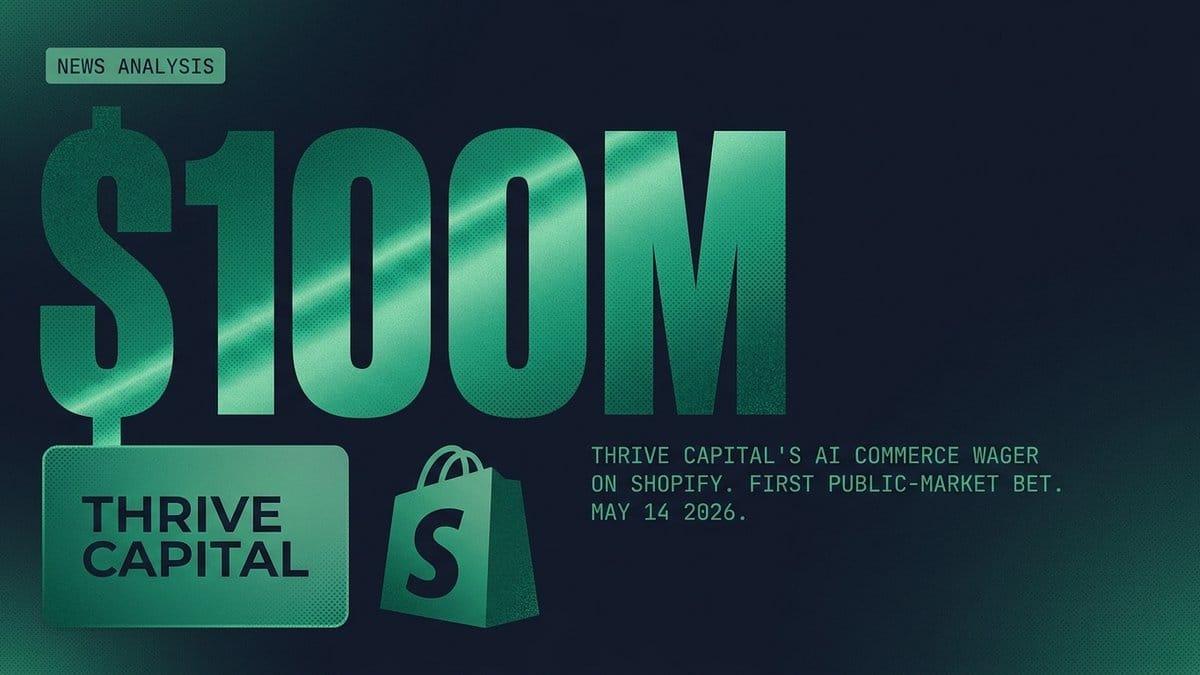
Thrive Capital, the firm behind OpenAI, Stripe, and Instacart, just put roughly $100 million into Shopify shares on the open market. It is the first material public-equity bet Joshua Kushner's fund has made in its history, and it was framed explicitly as a wager on AI commerce. The numbers Shopify shared alongside the news are the most credible merchant-side validation of agentic shopping we have seen all year.
TL;DR: Thrive Capital made its first ever public-market bet on May 14, 2026, putting ~$100M into Shopify and citing AI commerce as the thesis. Shopify President Harley Finkelstein disclosed three numbers in that announcement: AI-driven order volume up 15x year over year, new-buyer orders from AI sources converting at roughly 2x organic search, and AI-driven traffic up 8x. The rails work. The catalogs feeding those rails mostly don't.
Agentic commerce has been a category in search of merchant-side proof. Plenty of platform announcements, plenty of protocol launches, not many honest conversion numbers from the merchants doing the selling. That changed this week.
What Thrive Actually Bought
Thrive Capital is not a typical retail-tech investor. Its portfolio includes OpenAI, Stripe, SpaceX, and Instacart, and it has been a private-markets shop almost exclusively. According to PYMNTS, the firm raised a $10 billion fund in February 2026, and the Shopify position is the first material public-equity commitment that fund has made.
The framing was unusual for a public-markets purchase. Kushner's team did not pitch Shopify as a value play on a beaten-down stock, even though Shopify was down roughly 40% YTD before the news. They pitched it as the merchant-infrastructure winner in the AI-commerce shift. The portfolio logic is legible: they own the model layer through OpenAI, the payments layer through Stripe, and now the merchant-rails layer through Shopify.
Key takeaway: When the firm that owns OpenAI and Stripe spends its first material public-market check on Shopify and tells the world the thesis is AI commerce, that is the closest thing this category has to a buy signal from the smartest capital in the room.
The Finkelstein Numbers, Decoded
Shopify President Harley Finkelstein used the Thrive announcement to disclose three operating metrics the company had previously held back. They are worth unpacking.
| Metric | Value | What it actually means |
|---|---|---|
| AI-driven order growth | +15x year over year (2025) | Volume of orders attributable to AI surfaces (ChatGPT, Gemini, Copilot, Perplexity) grew ~15x on the Shopify base in 2025. Base is small but no longer rounding error. |
| New-buyer conversion from AI | ~2x organic search | A first-time visitor arriving from an AI source converts at roughly twice the rate of one arriving from classic organic search. |
| AI-driven traffic growth | +8x year over year | Sessions originating from AI surfaces grew 8x year over year. |
Two things stand out. Traffic grew 8x but orders grew 15x, meaning conversion rate on AI-sourced sessions is rising faster than the traffic itself. That is the opposite of what happens in a typical channel-saturation curve, where new-buyer conversion drops as the channel scales. The 2x conversion premium on new buyers is also the metric most directly visible to a CFO. AI-sourced visitors are not just curious; they are intent-loaded by the time they land.
This is consistent with Adobe's 2025 holiday data showing AI-driven traffic converts materially better than non-AI traffic across categories. The pattern is durable across data sources, not just one platform's marketing.
Why The Smart Money Picked The Rails Layer
Agentic commerce has roughly five layers to bet on: model, discovery, rails (merchant infrastructure), trust (payments and identity), and catalog. Thrive already owns the model layer through OpenAI and a slice of the trust layer through Stripe. The Shopify position is a deliberate move on the rails. Whichever model wins and whichever payment network wins, the merchant infrastructure beneath them will clear an outsized share of agentic transactions because it is where products, inventory, and fulfillment live.
That logic is showing up elsewhere this week. Mastercard and PhotonPay completed the first live production agentic transaction in APAC on May 14, with an AI agent autonomously booking and paying for a ride. SAP put autonomous supply chain at the center of Sapphire 2026. Stellagent shipped a cross-protocol sandbox covering ACP, UCP, AP2, Visa Trusted Agent Protocol, and Mastercard Agent Pay. Every adjacent layer is shipping production infrastructure on roughly the same week.
Thrive's bet pulls all of that into one thesis: AI commerce is real, it is monetized through merchant rails, and the rails are concentrating around a small number of platforms.
The Catch: Rails Are Necessary, Not Sufficient
Here is the part the Thrive release did not say. Owning the rails is the necessary condition for AI-driven order growth, not the sufficient one. The sufficient condition is that the product data flowing through those rails is actually agent-readable.
This is where the 15x stat hides a long tail. Merchants pulling 15x AI order growth on Shopify are not a uniform distribution. They are the ones whose catalogs have been cleaned up, enriched with the attributes agents actually retrieve against, and structured so the model layer can use them. Most catalogs on Shopify, Salesforce, Adobe, and Magento were built for human-readable PDP rendering, not for an LLM doing passage-level retrieval against a 70-word natural-language query.
The pattern Surfer SEO surfaced in late 2025 still applies: 68% of AI-cited pages are not in the top 10 organic results for the surfaced query. Agents choose what to recommend on different signals than Google ranks on. The shift from keyword matching to entity-level retrieval is the structural reason. If your catalog only optimizes for the old LLM SEO signals, your 15x is somebody else's 15x.
The Thrive bet is a bet on the rails. It is not yet a bet on any individual merchant's catalog. That is a separate decision and a separate set of work.
This is also why the Pipe17.ai launch this week matters more than its press release suggested. Pipe17 is productizing order operations for AI agents through 40+ MCP-exposed tools. The full stack is now plumbed end-to-end: discovery agents on top, order-ops agents on the back, the merchant catalog sitting between them as the bottleneck. Catalog quality and AI merchandising are the work still owed by the brand, regardless of which platform clears the transaction.
What Mid-Market Retailers Should Do This Week
The Thrive headline is going to land on every retail-leadership Slack channel by Monday. Useful responses to have ready.
- Pull your own AI-source conversion rate before someone asks. In GA4, isolate sessions referred from chat.openai.com, gemini.google.com, perplexity.ai, copilot.microsoft.com, or ChatGPT app referrals. Compare new-buyer conversion to organic search baseline. If you cannot isolate the source, that itself is the problem to fix first.
- Audit one product category for agent-readability. Pick the category where you most want AI-sourced traffic. Run 8-10 natural-language queries against ChatGPT and Gemini that a buyer in that category would actually use. The gap between "we sell this" and "AI knows we sell this" is the work.
- Ask the operating question, not the platform question. The Thrive bet does not mean "we should move to Shopify." It means the AI-traffic channel is measurable enough that someone can be held accountable for growing it. Name the owner internally before the metric becomes board-level.
- Get a baseline on AI visibility this quarter. Tools like our AI Readiness Report exist for this reason. The retailers who compound the 15x are the ones who knew their starting score in May, not the ones who waited until Q4.
- Map your catalog data to the protocols, not the marketing. ACP, UCP, AP2, Visa Trusted Agent Protocol, and Mastercard Agent Pay are all moving from announcement to production this quarter. The mapping between your PIM fields and what each protocol consumes is more useful than another vendor slide deck.
The Frame Going Forward
Thrive's bet is not the end of the AI commerce debate. It is the moment the debate stopped being about whether the category is real and started being about which brands inside the category compound. The merchant rails are converging on Shopify and a handful of peers. The model layer is converging on OpenAI, Google, Anthropic, and Microsoft. The payments layer is converging on Visa and Mastercard. The brand-side catalog layer has not converged on anything yet, which is exactly why it is the layer where individual decisions still matter. The 15x number is the number every brand wants on its own dashboard by next year. None of them get there by accident.
Frequently Asked Questions
Why is Thrive Capital's bet specifically a signal for AI commerce, not just for Shopify?
Because Thrive's portfolio is structured around AI infrastructure across layers. The fund owns OpenAI on the model side and Stripe on the payments side. A position in Shopify, framed as the merchant-rails layer, completes a three-layer thesis. The Shopify-specific drivers (Q1 GMV, take-rate, international growth) are not what Thrive pitched. AI commerce is.
What counts as an "AI-driven order" for Shopify?
An order where the inbound session traces to an AI surface: ChatGPT, Gemini, Copilot, Perplexity, or one of Shopify's native ChatGPT and Claude apps. Shopify uses referrer-based attribution plus its own ChatGPT app and connector telemetry. Methodology is closer to last-click than to multi-touch, so the 15x understates true AI influence on sessions that converted later through email or direct.
Is Shopify the only merchant platform with AI commerce momentum?
No. Salesforce, Adobe Commerce, commercetools, and BigCommerce have all shipped ChatGPT or Gemini syndication paths in 2026. Shopify has the largest installed base and the most aggressive AI-specific product cadence, which is why Thrive picked it. The catalog-readiness gap is real on every platform.
What is the realistic timeline for AI-driven orders to be a material channel for a mid-market retailer?
For most mid-market retailers, the realistic answer is 12-18 months from "started measuring" to "AI is a top-five channel by new-buyer revenue." Faster for verticals where natural-language buying is intuitive (beauty, home, gift, supplements). Slower for verticals with deep configurator flows. Teams already measuring in May 2026 will be the teams reporting a material channel by Q3 2027.
Should we wait for Google Marketing Live on May 20 before making any moves?
No. GML will almost certainly include UCP, Business Agent, AP2, and Direct Offers updates. Those will affect tactics but not strategy. The strategic move (measure AI-sourced traffic, fix catalog data, name an internal owner) is identical regardless of what Google announces. Start the work this week and absorb the GML news inside it.
How AI-ready are your products?
Check how ChatGPT, Google AI, and Perplexity evaluate any product page. Free score in 30 seconds.