60% Will Ditch an AI Shopping Agent After One Bad Pick
- Author
- By Dor
- Publication date
- Published
- Reading time
- 6 min read
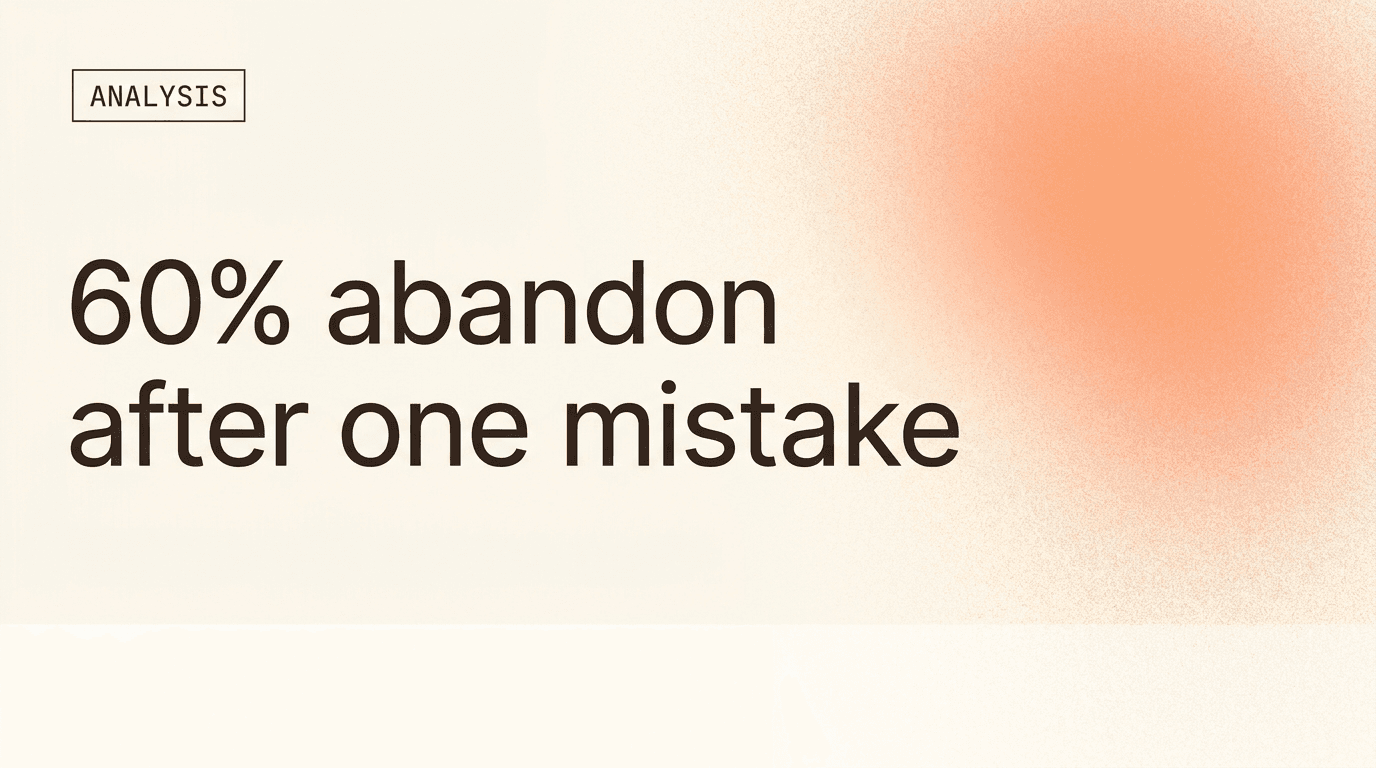
Sixty percent of UK shoppers say they would stop using an AI shopping agent after a single mistake, per new ACI Worldwide research published June 29, 2026 (ACI Worldwide / YouGov). One wrong recommendation and the shopper is gone. That changes what "winning" in AI shopping actually means.
TL;DR: Getting mentioned by ChatGPT or Google AI Mode is the entry ticket, not the prize. With 60% of consumers ready to abandon an agent after one error and only 19% trusting AI for everyday purchases (ACI Worldwide / YouGov), the brands that survive are the ones the AI represents accurately and completely. Stale prices and thin attributes are no longer a ranking problem. They are a trust problem for the entire channel.
For two years the agentic commerce conversation has been about presence. Are you findable? Do you show up when a shopper asks an assistant for the best running shoe or the right water flosser? That question still matters. But the new ACI data reframes the stakes. Presence without accuracy is worse than absence, because a wrong answer doesn't just lose one sale. It teaches the shopper to distrust the agent, and the agent learns to route around the source that caused the error.
What did the ACI Worldwide research actually find?
ACI Worldwide commissioned YouGov to survey more than 2,000 UK adults, and the headline numbers describe a trust gap, not a capability gap. Just 19% of consumers trust AI assistants to handle everyday purchasing decisions, compared with 55% who trust a human expert or adviser. Seven in ten (69%) say they do not trust AI even when it follows rules they set themselves (ACI Worldwide / YouGov).
The most operationally important finding is the fragility. Sixty percent would abandon an agent after one mistake (ACI Worldwide / YouGov). That is a single-strike threshold for a behavior most people have only recently started trying. And 54% believe the AI company, not the shopper, should be on the hook for refunds when something goes wrong, which tells you how much agency consumers expect to hand over and how unforgiving they will be when it fails.
Consumers are nearly three times more likely to trust a human expert than an AI assistant for everyday purchases (ACI Worldwide / YouGov). What closes that gap is not better models. It is being the source the agent gets right every time.
This sits on top of a market that was already cautious. Forrester's December 2025 survey found that 35% of Gen Z and just 23% of Gen X had used ChatGPT for product search (Forrester), and Forrester continues to describe the category as experimental. The adoption curve is real but early, which means every early experience carries outsized weight. A shopper who gets burned in month one does not come back in month two.
Why a wrong answer costs more than a missing one
When an AI agent omits your product, you lose a chance. When it recommends your product with the wrong price, a missing size, or an attribute that turns out to be false, you lose the shopper and you damage the agent's confidence in your data. Those are different failure modes with very different costs.
Here is the mechanism. AI shopping engines decompose a single shopper question into eight to twelve parallel sub-queries, a process Google calls query fan-out (Google I/O 2025). A query like "best sunscreen for sensitive skin under $20" fans out into sub-queries about mineral versus chemical formulas, fragrance-free options, SPF ratings, price, and reef safety. The engine assembles an answer by retrieving the passages and product attributes that best match each sub-query. If your product data answers eight of those sub-queries correctly and gets one wrong, the agent may still surface you, and then the shopper discovers the error at the worst possible moment.
| Failure mode | What the shopper sees | Cost to you |
|---|---|---|
| Omission | Your product never appears | One lost opportunity, recoverable |
| Stale price | Cart shows a price that no longer exists | Lost sale plus a trust hit on the agent |
| Wrong attribute | "Fragrance-free" product that isn't | Abandonment, return, possible churn from the channel |
| Thin data | Generic match, no differentiation | Crowded out by the brand with richer attributes |
The ACI finding makes the bottom three rows existential rather than annoying. In a market where 60% leave after one mistake (ACI Worldwide / YouGov), an inaccurate recommendation sourced from your catalog is a liability you handed to the platform.
Accuracy is now a discovery strategy, not a back-office task
Most brands treat catalog accuracy as an operations problem owned by a merchandising or data team, separate from the marketing question of visibility. That split no longer holds. The data an AI agent reads to decide whether to recommend you is the same data it reads to describe you, and the shopper experiences both as one moment.
Consider how thin the typical product record is. Many ecommerce product pages carry five to eight structured attributes, while AI agents evaluating a query fan-out can check for thirty or more. The brand with richer, correct attributes does not just rank higher. It gives the agent fewer chances to guess, and guessing is where wrong answers come from. A complete record on structured product data reduces the surface area for error.
There is a competitive edge hiding in the trust gap. If consumers will punish agents for mistakes, the agents will learn to favor sources that rarely cause them. Over time the platforms route demand toward catalogs they can trust, the same way search engines learned to favor pages that satisfied users. Being the low-error source is a durable position. It is also one almost no brand is actively managing today, because the tooling to monitor how you actually appear across ChatGPT, Google AI Mode, and Perplexity has only recently caught up to the problem.
What to Do This Week
- Audit your live AI representation, not just your feed. Ask ChatGPT and Google AI Mode the top five buying questions in your category and read what they say about your products. Note every wrong price, missing variant, or false attribute. Your feed can be technically valid and still produce wrong answers downstream.
- Fix the highest-traffic SKUs first. Pull your top 20 products by revenue and verify that price, availability, and the five attributes shoppers actually filter on are current and complete. These are the records most likely to generate a public mistake.
- Close the attribute gap. Compare your structured attributes against the sub-queries a shopper would fan out in your category. If you have eight attributes and the category needs thirty, you are leaving the agent to infer the rest. Build out the missing fields.
- Set a sync cadence that matches your price velocity. If you reprice daily, a weekly feed sync guarantees stale data in AI answers. Match the refresh rate to how fast your catalog actually changes.
- Track the gap between mentioned and accurate. Being named is step one. Being named correctly, with a buyable price and true specs, is the metric that protects the channel. Tools like our AI Readiness Report surface where your representation diverges from reality.
Frequently Asked Questions
Does this research apply outside the UK?
The ACI Worldwide survey covered UK adults specifically (ACI Worldwide / YouGov), so treat the exact percentages as UK figures. The underlying pattern, low tolerance for AI purchasing errors, lines up with US data showing early and cautious adoption, including Forrester's finding that only 23% of Gen X had used ChatGPT for product search by late 2025.
Is visibility in AI shopping still worth pursuing?
Yes, and more than ever. You cannot win a recommendation you never appear in. The point is that visibility is necessary but not sufficient. Once you are present, the accuracy and completeness of how you are represented determines whether the shopper converts or churns from the channel entirely.
What counts as a "mistake" that loses a shopper?
A wrong price, an out-of-stock item presented as available, a false or missing attribute, or a product that does not match the stated need. Any of these can sour a shopper on the agent, and the agent on your data. The ACI study suggests a single instance is enough for many people.
How is AI shopping different from traditional SEO here?
Traditional SEO rewarded ranking. AI shopping rewards being the correct, retrievable answer to many sub-queries at once through passage-level retrieval. A page can rank well and still feed an agent the wrong attribute. The unit of trust shifted from the page to the product record.
Does the purchase happen inside the AI assistant?
No. AI assistants recommend products and direct shoppers to the merchant's own site to complete the purchase. OpenAI discontinued in-chat Instant Checkout in March 2026, so the current model across agentic commerce surfaces is discovery and redirect. Your product data drives the recommendation; your site closes the sale.
The agentic commerce race spent its first chapter on a simple question: can the AI find you? The ACI data opens the next one. When it finds you, does it get you right? Sixty percent of shoppers have already told us how little margin for error they will give. The brands that treat catalog accuracy as a discovery strategy, not a chore, are the ones the agents will keep recommending after everyone else has used up their one mistake.
How AI-ready are your products?
Check how ChatGPT, Google AI, and Perplexity evaluate any product page. Free score in 30 seconds.