AI Compares Products on Attributes Your Page Never Mentions
- Author
- By Dor
- Publication date
- Published
- Last updated
- Updated
- Reading time
- 5 min read
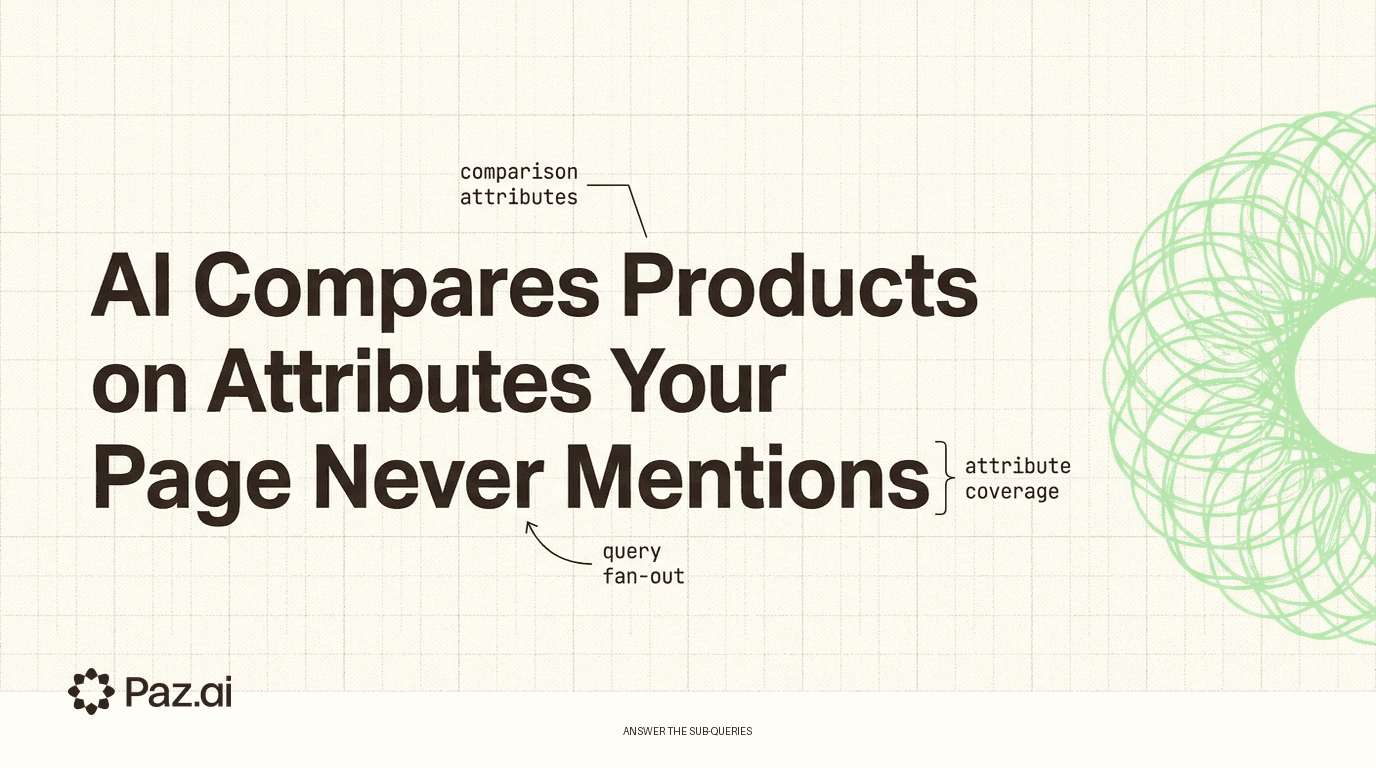
When a shopper asks ChatGPT for "the best running shoe for flat feet in a mid-price range," the assistant does not read your product page the way a human does. It decomposes that one request into a fan of smaller questions, gathers candidates, and then ranks them on a specific set of comparison dimensions. If your data does not answer those dimensions, you lose the recommendation before the shopper ever sees a price.
TL;DR: AI shopping assistants compare products on dimensions they extract from the query, not the attributes you chose to highlight. Most catalogs answer the headline question and miss the eight to twelve sub-questions the engine actually weighs. Closing that gap is the single most valuable move for AI discovery in 2026.
The market spent the last year arguing about feeds, protocols, and checkout. The quieter, more important story is what happens in the half-second between a shopping question and an answer. That is a comparison step, and it runs on attributes most product pages were never built to expose.
What Are Comparison Attributes in AI Shopping?
Comparison attributes are the specific dimensions an AI assistant weighs when it ranks one product against another for a given query. For "best running shoe for flat feet in a mid-price range," those dimensions include arch support type, stability rating, drop height, weight, and price band. The assistant scores each candidate on each dimension, then surfaces the product whose data answers the most of them.
This is a different exercise from keyword matching. Classic search asks whether a page contains "running shoe." AI shopping search asks whether a product is actually a good answer to a richly specified need, and it can only judge that against data it can read. The dimensions come from the query, not from your merchandising priorities.
Google described the underlying mechanism at I/O in 2025: "AI Mode uses our query fan-out technique, breaking down your question into subtopics and issuing a multitude of queries simultaneously on your behalf" (Google). Deep Search pushes that further, issuing "hundreds of searches" before composing an answer. Each sub-query is a comparison dimension waiting for an answer.
Why Your Best Attributes Are Often the Wrong Ones
Most catalogs are optimized for the attributes a category manager cares about: brand line, color, material, a marketing tagline. Those fields win on the brand's own site, where a human browses with context. They underperform in query fan-out, where a machine is matching structured need to structured data.
Consider a coffee maker listing. The page leads with "sleek matte finish" and "barista-grade." A shopper asks an assistant for "a programmable drip coffee maker that keeps coffee hot for 4 hours and fits under a cabinet." The engine now needs carafe type, programmability, thermal-hold duration, and physical height. None of those are on the page. A competitor that lists all four wins the slot, even with a duller product description.
The product mentioned most is not the product that answers the most sub-questions. AI ranks on coverage of the comparison dimensions, and coverage is a data problem, not a copywriting one.
This is why being mentioned is a weak signal. AI search now plans, retrieves, grades its own answer, and retrieves again, a loop we broke down in why AI search grades your product twice. Surviving that loop means having an answer for each dimension the grader checks, not just appearing once in the first pass.
How Much Coverage Actually Matters
The clearest evidence comes from a Surfer SEO study of 173,902 URLs, which found that pages ranking for the main query plus its fan-out sub-queries were 161% more likely to be cited in AI answers than pages ranking for the main query alone (Surfer SEO). The same study found that 67.82% of cited pages did not rank in the top 10 organic results for the headline query at all.
Read that twice. Two-thirds of what AI cites is invisible to traditional rank tracking. The pages winning are the ones that answer the sub-questions, regardless of where they sit on the classic results page. For commerce, the sub-questions are comparison attributes, and the page that supplies them gets surfaced.
| Layer | Classic search optimizes for | AI shopping search rewards |
|---|---|---|
| Query | One keyword phrase | 8-12 fan-out sub-queries |
| Matching | Page contains the keyword | Data answers each dimension |
| Unit retrieved | The whole page | A passage or attribute |
| Winner | Highest-ranked page | Product with broadest attribute coverage |
That bottom row is the shift. Passage-level retrieval means an assistant can pull a single specification from deep in your catalog and use it in a comparison, or skip you entirely if the specification is missing.
The 393% Channel You Cannot Afford to Lose
This is not a niche optimization. AI-sourced traffic to US retail sites grew 393% year over year in Q1 2026 and converts roughly 42% better than non-AI traffic, the data point we unpacked in AI shoppers now convert 42% better than humans. ChatGPT alone processes an estimated 50 million shopping-intent queries per day (Forbes).
A channel that converts better and grows that fast is worth getting the data right for. The brands treating their catalog as static product copy are quietly ceding higher-intent shoppers to competitors whose data simply answers more of the question. This is the core of modern AI merchandising: the merchandising decision now happens inside a retrieval system, against attributes, before a human sees anything.
The good news is that comparison-attribute coverage is fixable. It is structured data work, not a rebrand. The brands that close the gap first lock in an advantage that compounds, because retrieval systems keep choosing the product that answers the question.
What to Do This Week
- Pull your top 20 category queries and list the comparison dimensions for each. For "best X under $Y," write out every attribute a reasonable buyer would weigh. This is your target schema.
- Audit one flagship product against that schema. Mark each dimension present, partial, or missing in your live product data. Most brands find that a large share of the dimensions are simply absent.
- Add the missing structured attributes first, not the prose. Engines read structured fields more reliably than marketing copy. See how to structure product data for AI agents.
- Check how AI currently retrieves you. Retrieval is grounded in what the system can fetch and reuse, the principle behind retrieval-augmented generation for commerce. Run a few real category queries through ChatGPT and Google AI Mode and note which dimensions decide the recommendation.
- Re-test after enrichment. Coverage gains should show up as more product cards and better positions in AI product recommendations within a few weeks.
Frequently Asked Questions
What is the difference between keywords and comparison attributes?
Keywords are terms a page contains. Comparison attributes are the dimensions an AI assistant weighs to rank products against a specific need, such as drop height or thermal-hold duration. Classic search matches keywords; AI shopping search scores products on attribute coverage extracted from the query.
How does query fan-out create comparison attributes?
Query fan-out decomposes one shopping question into 8 to 12 sub-queries, each probing a different facet of the need. Those facets become the comparison dimensions the engine scores candidates against. A product that answers more facets is more likely to be recommended.
Why does my product get mentioned but not shown as a card?
Mentions require the engine to recognize your brand. Product cards require structured data the engine can display and compare: price, image, key specs. If your catalog answers fewer comparison dimensions than a competitor, the engine often mentions you while showing the competitor's card.
Is this only a Google problem?
No. ChatGPT, Perplexity, and Google AI Mode all use retrieval-and-rank pipelines that score products against query-derived dimensions. Coverage gaps cost you across every AI shopping surface, not just one.
How fast can comparison-attribute coverage improve results?
Because retrieval systems re-fetch product data continuously, enriching missing attributes can change which products surface within days to a few weeks, far faster than the months a traditional SEO change can take to compound.
The conversation about agentic commerce keeps circling payments and protocols, but the decision that determines whether you sell happens earlier and quieter. An assistant breaks a shopper's request into a dozen questions and chooses the product whose data answers the most of them. The attributes you never thought to publish are the ones deciding the recommendation. Map the questions, fill the gaps, and you stop losing slots you never knew you were competing for.
How AI-ready are your products?
Check how ChatGPT, Google AI, and Perplexity evaluate any product page. Free score in 30 seconds.