Agentic Commerce Hits 1.3B Users by 2031. Are You Findable?
- Author
- By Dor
- Publication date
- Published
- Reading time
- 6 min read
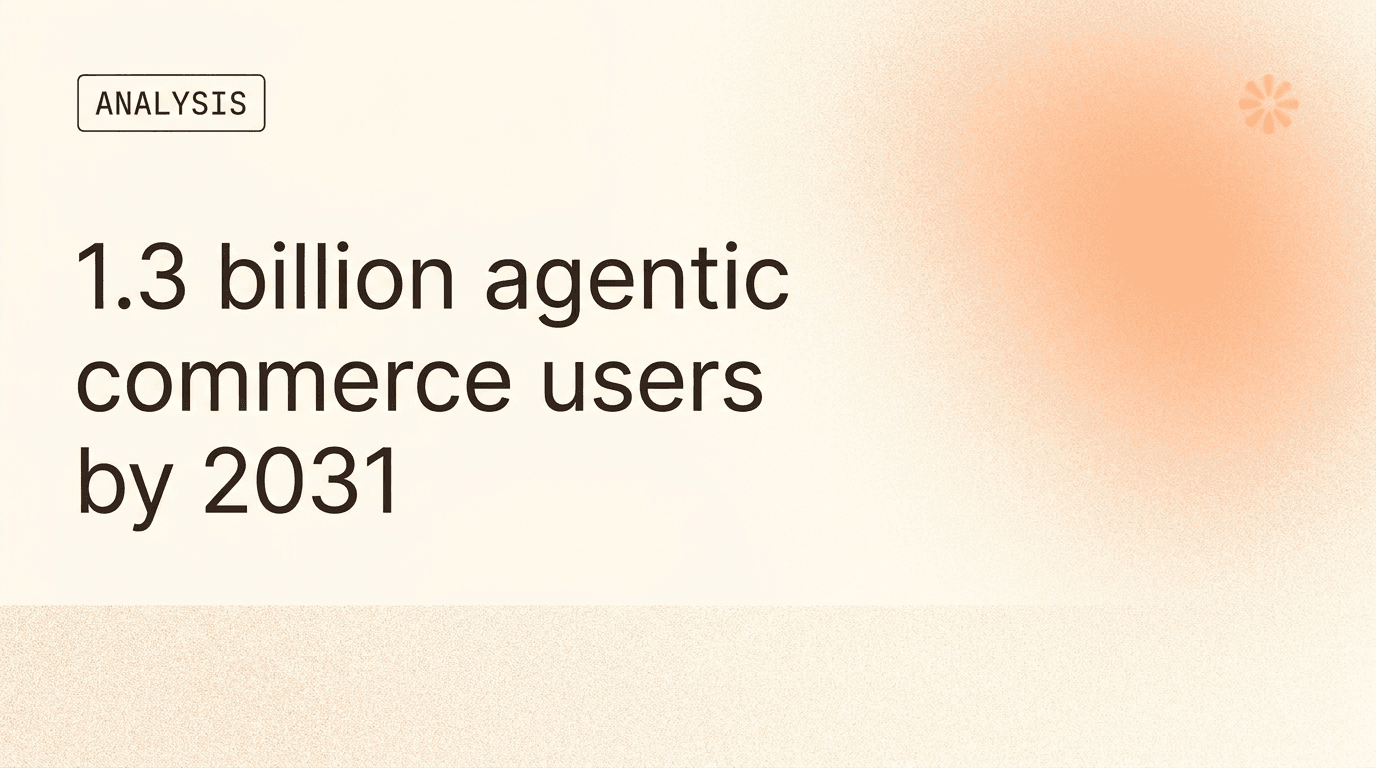
The agentic commerce user base will grow nearly 350% in five years, from fewer than 300 million people this year to 1.3 billion by 2031, per a new Juniper Research forecast published on June 29, 2026. The number that matters for your store is not the size of the wave. It is whether an AI agent can find and trust your products when those shoppers arrive.
TL;DR: Juniper Research now projects 1.3 billion agentic commerce users by 2031, up from under 300 million in 2026, with global spend reaching $1.5 trillion by 2030. The single biggest brake on that growth, per Juniper, is low user trust. For mid-market brands, the takeaway is concrete: the brands an AI agent surfaces with confidence are the ones with structured, complete, trustworthy product data. That work pays off now, not in 2031.
The headline is easy to skim and forget. A bigger market is coming, everyone knows the drill. The detail underneath is where the strategy hides. Juniper's analysts pinned the current ceiling on a specific problem, and that problem maps directly onto a decision you can make this quarter.
How big is agentic commerce going to get?
Agentic commerce will reach 1.3 billion users globally by 2031, up from fewer than 300 million in 2026, a rise of roughly 350% over five years, according to Juniper Research's June 29 study (Juniper Research). It attributes the growth to three forces: direct support from major retailers, rising consumer comfort with AI, and broader availability of agentic payment infrastructure.
That user forecast sits alongside a separate Juniper projection that agentic commerce spend will hit $1.5 trillion globally by 2030 (Juniper Research, June 29, 2026). Put together, you get a picture of a category moving from pilot to mainstream inside a single planning horizon.
It helps to triangulate. Morgan Stanley estimates US agentic commerce alone will reach $385 billion by 2030, and Gartner predicts $202 billion in agentic AI spending in 2026, figures collected in our agentic commerce statistics hub. A separate NRF and Stripe survey found 75% of retailers implementing or planning agentic commerce. The estimates differ in scope and method, but they point the same direction, and they are no longer coming only from consulting decks. A specialist research firm sizing 38,000 datapoints across five years is now mapping the same curve.
What is actually holding the market back?
Trust. Juniper's report is blunt about the brake: user familiarity and trust with agentic commerce is low right now, and that is the gating factor on adoption. The analysts expect it to fade as AI becomes a normal part of daily life, but for now, hesitation is the bottleneck, not technology or payment rails. Juniper's VP of Research, Nick Maynard, framed the payment side this way: "Cards increasingly support agent payments through tokenisation, but card domination within agentic commerce is not in the market's best interests, given how important payment preferences are within eCommerce" (Juniper Research, June 29, 2026).
Juniper's finding, in plain terms: the technology and the payment rails are arriving faster than consumer trust. Adoption is gated by whether shoppers believe an agent will make the right call on their behalf.
Read that as a brand, not as a futurist. When a shopper finally lets an agent buy on their behalf, the agent will not gamble on an ambiguous product. It will recommend the option it can describe accurately, match to the request precisely, and present with confidence. Trust at the consumer level becomes a representation problem at the product level. The brands with clean, complete, machine-readable data are the ones an agent will stand behind.
This is the part most market-size articles miss. The forecast is not a reason to wait until 2031. It is a reason to fix your product data while the field is still thin and the cost of being early is low.
Why findability is the real metric, not market size
Findability is whether an AI shopping engine can locate, understand, and recommend your specific product for a real shopper query. Market size tells you the prize. Findability tells you whether you collect any of it. A growing market with you invisible inside it is worse than a small market where you win.
Here is the mechanism that decides it. AI shopping surfaces like Google AI Mode and ChatGPT do not match a single query against your page. They run query fan-out, decomposing one shopper question into 8 to 12 parallel sub-queries, then assemble an answer from whatever passages they can retrieve. A Surfer SEO study of 173,902 URLs found that 68% of AI-cited pages were not in the top 10 organic results (Surfer SEO, December 2025). Ranking on Google is no longer the same thing as being found by an agent.
A product page with five attributes answers maybe one of those sub-queries. A page enriched to 30-plus attributes answers most of them. That difference is the gap between a product mention and a product card, between being named in passing and being shown with image, price, and a buy link the shopper can act on, the difference structured product data makes.
| Signal | Low-readiness brand | High-readiness brand |
|---|---|---|
| Product attributes | 5 to 8 fields | 30-plus enriched fields |
| Sub-queries answered | 1 of 10 | 7 of 10 |
| Typical AI result | Brand mention, no card | Product card with price and link |
| Agent confidence | Low, skips to a rival | High, recommends you |
What does this mean for mid-market brands specifically?
Enterprise retailers already have teams pointed at AI visibility. Mid-market brands are the ones most exposed, because the user wave is real but their referral traffic from AI is still near zero. They have not submitted feeds, structured their attributes, or checked how they appear when an agent decomposes a category query.
The advantage is timing. As of June 2026, agentic commerce is still early enough that a well-prepared catalog stands out. The brands that structure their data now will compound visibility while competitors wait for the forecast to feel urgent. By the time 1.3 billion users is the present tense and not a projection, the leaderboard for each category query will already be set.
What to Do This Week
- Run a findability baseline. Pick five real shopper queries in your category and ask ChatGPT, Google AI Mode, and Perplexity each one. Note whether you appear as a product card, a mention, or not at all. That is your starting line. Tools like our AI Readiness Report can score this systematically.
- Audit your product attributes against fan-out. For your top 20 products, list every sub-question a shopper might ask (material, use case, sizing, compatibility, care). Count how many your current product data actually answers.
- Enrich the gaps. Expand thin product pages from a handful of fields toward 30-plus structured attributes, written for machine comprehension, not just human skim. See our guide to AI readiness basics.
- Submit your feed to the surfaces that matter. Get a clean product feed into Google Merchant Center and the ChatGPT commerce ecosystem so agents have something accurate to retrieve.
- Track competitors, not just yourself. Findability is relative. Check who currently wins your category queries and by how much, then close the specific gaps that cost you the card.
Frequently Asked Questions
How many people will use agentic commerce by 2031?
Juniper Research projects 1.3 billion agentic commerce users globally by 2031, up from fewer than 300 million in 2026. That is roughly 350% growth over five years, driven by retailer support, rising consumer comfort with AI, and more agentic payment infrastructure (Juniper Research, June 2026).
What is the biggest barrier to agentic commerce adoption?
Per Juniper Research, the main brake is low user familiarity and trust. Consumers are still hesitant to let AI agents transact for them. Juniper expects that to fade as AI normalizes, but for now trust, not technology, is the gating factor on growth.
Does a bigger agentic commerce market automatically help my store?
No. Market size measures the opportunity, not your share of it. If AI shopping engines cannot find, understand, or confidently recommend your products, a larger market simply means more sales going to rivals with better product data.
How do AI shopping agents decide which products to recommend?
They use query fan-out, breaking one shopper question into 8 to 12 sub-queries, then build an answer from retrievable passages. Products with rich, structured attributes answer more sub-queries and are recommended more often. Thin product data answers few and gets skipped.
Should mid-market brands wait until the market is bigger?
No. Early is the advantage. As of mid-2026, the field is still thin, so a well-structured catalog stands out cheaply. Waiting means entering after category leaderboards have hardened, which makes visibility far harder to win back.
A market headed toward more than a billion users is a strong reason to care about agentic commerce. It is a weak reason to relax. The forecast that should change your roadmap is not the size of the audience in 2031, it is Juniper's finding that trust is what unlocks it. Trust, at the shelf an agent builds, is just accurate and complete product data. The brands that fix that now will be the ones agents recommend when the wave actually lands.
How AI-ready are your products?
Check how ChatGPT, Google AI, and Perplexity evaluate any product page. Free score in 30 seconds.