Visa Just Wired Payments Into ChatGPT. Now Discovery Is the Game.
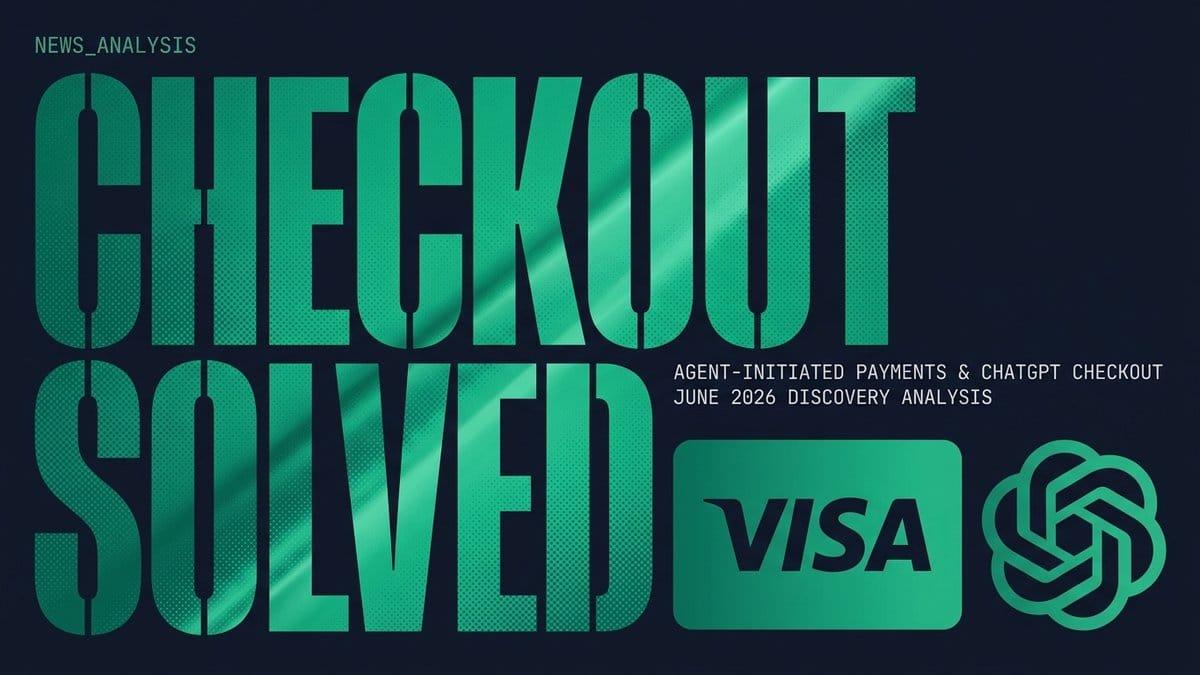
Visa and OpenAI announced on June 10 that Visa Intelligent Commerce now plugs directly into ChatGPT, letting AI agents complete purchases on a user's Visa card. The checkout problem on the largest consumer AI surface just got solved. That moves the entire competitive question one step upstream: did the agent find and pick your product in the first place?
TL;DR: Visa wired agent-initiated payments into ChatGPT on June 10, 2026, using tokenized Visa credentials. With checkout handled automatically, the only thing standing between a brand and a sale is whether the AI surfaced it during product discovery. The bottleneck moved from the buy button to the recommendation, and the recommendation runs on your product data.
For two years, the debate about AI shopping fixated on the buy button. Could an agent actually complete a transaction? Who carried the payment risk? Which protocol would win? Those were real questions, and as of last week they have a real answer on ChatGPT. The transaction layer is no longer the hard part. The hard part is everything that happens before it.
What did Visa and OpenAI actually announce?
Visa and OpenAI announced a strategic collaboration to integrate Visa Intelligent Commerce into OpenAI experiences, starting with ChatGPT. A user can tell ChatGPT to "find wireless headphones under $150," and the agent identifies an eligible product and completes the purchase using a tokenized Visa credential, with real-time authorization and user-defined controls like spending limits and required approvals.
This matters because of what it replaces. Multiple outlets, including The Next Web and the Associated Press, note that OpenAI retired its original in-chat checkout in March 2026 because it was error-prone and merchants resisted the fee model. The Visa deal is a reset of the payment layer, not a continuation of the old one. Users link their own Visa cards, and the design makes it easier for merchants to accept agent-initiated transactions.
Visa's Jack Forestell framed the deal as building the trusted-transaction infrastructure for AI agents "as active participants in the economy." Source: Visa investor newsroom.
One detail worth holding onto: the purchase still completes on the merchant's terms, on tokenized rails, not inside an opaque OpenAI checkout. The discovery-and-redirect model that defines today's AI shopping agent behavior did not go away. Visa just removed the friction on the payment leg of it.
Why does solving payments make discovery the whole game?
When an agent can complete the purchase automatically, the buy button stops being a differentiator. Every brand that accepts Visa is on equal footing at checkout. The only variable left is whether the agent recommended you before it ever got to payment.
Think about the headphones example. The agent does not survey the entire market. It decomposes the request into sub-queries (under $150, wireless, well-reviewed, in stock) and assembles a short list from the products whose data it can actually read and trust. If your product is missing structured attributes, the agent cannot confirm it fits the request, so it picks a competitor it can verify. The payment then runs flawlessly, for the other brand.
Here is the uncomfortable part. Most merchants have no idea what an agent says about their products, because the recommendation happens in a layer they never see. AI visibility is the measurement of exactly that: how often, and how prominently, your products surface when shoppers ask AI for something you sell.
The cleaner the checkout rails get, the more the differentiator becomes whether you are in the model's consideration set, represented correctly.
This is not a ChatGPT-only dynamic. Google AI Mode runs its own decomposition through query fan-out, firing 8 to 12 sub-queries per shopper request, per Google's I/O 2025 documentation. The pattern is the same across surfaces: the agent retrieves passages, not pages, and ranks the products it can parse.
How is the discovery layer different from old SEO?
Classic SEO optimized a page to rank for a keyword a human typed. Agentic discovery optimizes structured product data to be retrievable when a model decomposes a request into parts. The unit of competition shifted from the page to the passage.
The data backs this up. A Surfer SEO study of 173,902 URLs published in December 2025 found that 68% of AI-cited pages do not rank in the top 10 organic results. Ranking on Google is no longer a proxy for being recommended by an AI agent. They are separate games with separate rules.
| Dimension | Classic SEO | Agentic discovery |
|---|---|---|
| Who is searching | A human typing a keyword | An agent decomposing a request |
| Unit retrieved | The page | The passage / structured attribute |
| What wins | Keyword match, backlinks, page rank | Attribute completeness, machine readability |
| Where it shows | Blue links | A recommendation or product card |
| Proxy for success | Top-10 organic ranking | Found rate across AI surfaces |
This is why passage-level retrieval is the frame that matters now. An agent does not read your homepage and form an impression. It pulls the specific fields that answer the specific sub-query, and if those fields are thin, you lose the slot before the conversation about price or checkout even starts.
What does a brand actually control here?
A brand controls its product data, and that is the entire lever. Payment rails are set by Visa and OpenAI. The decomposition logic is set by the model. The one input you own is whether your catalog is legible enough for an agent to confirm your product fits the request. This is the digital shelf, rebuilt for machines that read instead of browse.
The card networks made this concrete the same week. The day Visa announced its ChatGPT integration, Mastercard launched its own agent-payment protocol with 30-plus partners, per reporting on the rollout. Both networks are racing to industrialize the payment layer. Neither one touches the question of which product gets recommended. That question lives entirely in your product data, and how well its machine-readable structure maps to the requests agents fire.
Paz.ai, an agentic commerce optimization platform, monitors how products appear across ChatGPT, Google AI Mode, and Perplexity, then handles product data enrichment so agents can read and rank your catalog. The point is not the tooling. The point is that the discovery layer is now measurable, and what gets measured gets fixed.
What to Do This Week
The payment rails are out of your hands. The discovery layer is not. Five concrete moves while the ranking window is still open:
- Run an AI Readiness Report on your top five products. Score the attribute gaps an agent would hit before it ever recommends you, and see where you sit on AI share of voice against rivals.
- Ask ChatGPT and Google AI Mode three buying questions in your category. Note whether your product appears, and which competitor takes the slot when it does not.
- Audit your structured attributes against the request types agents fire. Size, material, price band, compatibility, availability. If a field is missing, an agent cannot confirm fit.
- Check how often you surface across multiple surfaces, not just one. A product can appear on Google AI Mode and vanish on ChatGPT depending on feed coverage.
- Fix the highest-traffic category first. Enrich the catalog where the buying intent is strongest, then expand outward.
None of these require buying anything. They require knowing what the agent sees, which most brands have never checked.
Frequently Asked Questions
Does the Visa deal mean people buy inside ChatGPT now?
Not in the old sense. OpenAI retired its native in-chat checkout in March 2026. The Visa integration lets an agent initiate a purchase on the user's Visa card, but the model is still discovery and agent-assisted purchase on tokenized rails, not a closed in-app store. The merchant relationship stays intact.
How is this different from the March 2026 Instant Checkout that was killed?
The original Instant Checkout was an OpenAI-run flow with a merchant fee that few retailers adopted. The Visa version uses the user's own linked Visa card with tokenized credentials, real-time authorization, and user-set controls. It is designed for merchants to accept agent payments rather than cede checkout to OpenAI.
If checkout is solved, why does product data still matter?
Because the agent has to choose your product before any payment happens. It decomposes the request into sub-queries and assembles a short list from products it can verify against those sub-queries. If your attributes are thin, the agent cannot confirm fit and recommends a competitor it can read. Payment never enters the picture for you.
Does this only affect ChatGPT?
No. The same retrieval pattern drives Google AI Mode and Perplexity. Each surface decomposes shopper requests and ranks products by how readable their data is. A brand strong on one surface can be invisible on another, which is why cross-surface AI visibility tracking matters.
What is the single highest-leverage fix?
Attribute completeness. Agents reward products whose structured data answers the specific sub-queries they fire. Most catalogs ship with 5 to 8 attributes; agents need closer to 30 to confirm fit across the requests a category generates.
Is this a near-term concern or years out?
Near-term. ChatGPT sits at roughly 900 million weekly users as the largest consumer AI surface, as covered in the Visa deal reporting, and the payment friction just dropped on it. The brands that fix discovery while the field is still uneven get a head start that closes as catalogs catch up.
When the buy button works for everyone, the buy button stops mattering. The competition moves to the moment before it, the moment the agent decides which product to name. That moment is not luck and it is not branding. It is whether your product data is complete enough for a model to trust it over the alternative. Visa just made that the only question left that you can actually do something about.
How AI-ready are your products?
Check how ChatGPT, Google AI, and Perplexity evaluate any product page. Free score in 30 seconds.