The Week AI Shopping Went Mainstream
- Author
- By Dor
- Publication date
- Published
- Last updated
- Updated
- Reading time
- 4 min read
Related: evolution from catalog to conversation
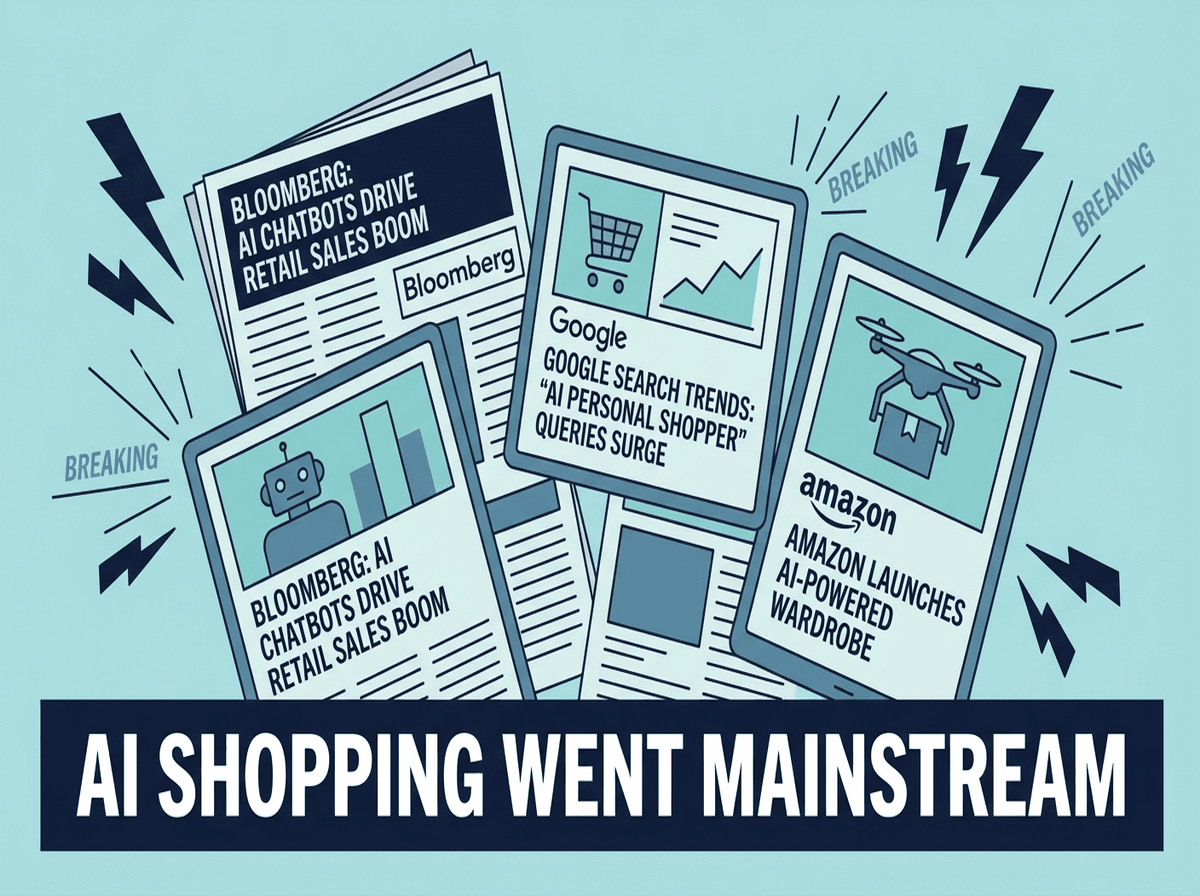
Key finding: The week of February 17, 2026 marked agentic commerce going mainstream: Bloomberg declared the "age of agentic commerce," Harvard Business Review published an AI shopping strategy guide, Reddit launched AI product carousels, and Loblaw deployed AI checkout across 600+ Canadian stores.
Last updated: February 26, 2026
The Week AI Shopping Went Mainstream
There are weeks where nothing happens in retail, and then there are weeks where the entire industry lurches forward at once. The week of February 17, 2026 was the second kind.
Within five days, Bloomberg declared "the age of agentic commerce". Harvard Business Review published a strategy guide for brands adapting to AI shopping agents. Reddit started testing AI-powered product carousels built from community discussions. And Loblaw, Canada's largest grocery chain, announced a deal with Google to put its products inside AI Mode — just a week after integrating its PC Express grocery service into ChatGPT.
Any one of these stories would be worth a write-up. All of them in the same week tells you something bigger is happening.
Bloomberg and HBR don't chase hype
On February 18, Bloomberg Opinion ran a piece titled "Retail Could Be the Next Industry Disrupted By AI." The language was blunt: "autonomous AI chatbots will be the ones selecting and buying goods." That's not a tech blog speculating about what might happen in 2030 — that's the financial press telling investors the shift is underway now.
The next day, HBR published "How Brands Can Adapt When AI Agents Do the Shopping" — a full strategy piece laying out five steps brands need to take, from structuring content for machines to preserving customer trust when an AI is doing the buying. HBR doesn't write strategy guides for theoretical trends. When they publish one, it means their readers (the C-suite) are already asking about it.
What's notable about both pieces is the framing. This isn't about chatbots helping people find products faster. It's about AI agents that compare, select, and purchase autonomously. The consumer doesn't browse. The agent does. That's a different model than anything retail has operated under before.
Google and Reddit are rebuilding the front door
While Bloomberg and HBR were naming the trend, the platforms were already building for it.
Google had announced earlier in February that it's testing a new shopping ad format inside AI Mode — product listings embedded directly in AI-generated responses. If you've spent the last 20 years optimizing for search result pages, think about what this means. The page is becoming a conversation. And Google is figuring out how to put ads inside that conversation.
They're not keeping this domestic, either. On February 19, Reuters reported that Google partnered with Sea Group (Shopee's parent company) to build an "AI agentic shopping prototype" for e-commerce across Southeast Asia. This isn't an experiment — it's global infrastructure.
Then there's Reddit. On February 19, TechCrunch reported that Reddit started testing AI-powered shopping results: product carousels with pricing, images, and "where to buy" links, generated from community discussions. Reddit has quietly become one of the most trusted product research sources on the internet (how many of your own searches end with "reddit" appended to the query?). Now they're cutting out the search engine middleman and turning that trust into a transactional layer.
Both moves point the same direction: product discovery is migrating out of search boxes and category pages and into AI-mediated conversations.
Loblaw's two-platform bet is the real tell
Startups experimenting with AI shopping is expected. A $60B+ revenue grocer restructuring its digital strategy around it — that's a signal.
On February 12, Loblaw announced it was integrating PC Express into ChatGPT, letting consumers explore recipes in the chatbot and buy ingredients through Loblaw's grocery delivery app. A week later, on February 19, they announced a Google partnership to surface health, beauty, and apparel products inside AI Mode, with Gemini powering personalized recommendations.
Two AI platforms. Two different product categories. Same retailer. Two announcements in seven days.
Loblaw's Chief Digital Officer Lauren Steinberg framed it as "a natural evolution of how our customers want to shop." Not "an experiment." Not "a pilot." An evolution.
The platform layer is retooling, too
It's not just consumer-facing companies making moves. Digital Commerce 360 reported on February 19 that Salesforce, VTEX, and Kibo are all shipping agentic commerce features — agents that handle customer service, field product questions, automate merchandising, and manage orders.
Commerce.com CEO Travis Hess described the shift to PYMNTS: "Product discovery begins with a prompt, not a homepage. It is the quality of data that determines whether you get seen."
That line is worth sitting with. In a world where AI agents do the shopping, your product data is your storefront. Not your website design, not your ad budget — your structured data, your descriptions, your availability feeds. That's what the agent reads. That's what determines whether your products show up in its recommendation or get skipped for a competitor with cleaner data.
When a human browses, they forgive bad data. They'll click around, squint at a blurry photo, figure out that "azure" probably means blue. An AI agent won't. It'll just pick the competitor whose data makes sense.
What it adds up to
One week doesn't make a trend. But when Bloomberg names it, HBR writes the strategy guide, Google puts ads in it, Reddit builds for it, Loblaw bets on it from both sides, and the entire platform layer starts shipping features for it — all within days of each other — that's not a trend. That's an inflection point.
Agentic commerce isn't something that might matter in 2028. It's being built and deployed right now, by the biggest names in media, technology, and retail simultaneously. The brands that will do well are the ones getting their product data ready for this world today — not the ones waiting for a clearer signal.
The signal doesn't get much clearer than the last week of February 2026.
How AI-ready are your products?
Check how ChatGPT, Google AI, and Perplexity evaluate any product page. Free score in 30 seconds.