The Payments Stack Is Done. 80% of Catalogs Aren't.
- Author
- By Dor
- Publication date
- Published
- Last updated
- Updated
- Reading time
- 7 min read
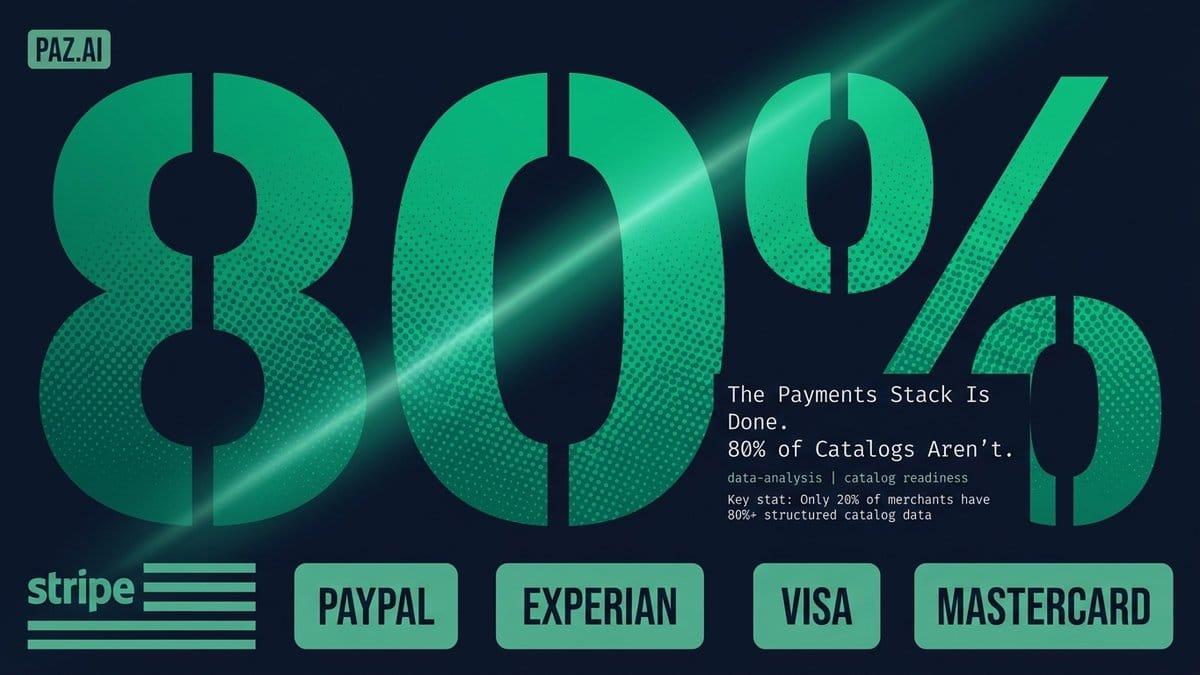
Stripe shipped 288 launches at Sessions 2026 this week. Experian, Visa, Mastercard, Cloudflare and Skyfire stacked the identity layer on top. The payments side of agentic commerce is functionally complete. Then PayPal's own merchant survey landed: only one in five merchants has a catalog AI agents can actually read. The bottleneck just moved.
TL;DR: At Stripe Sessions 2026, Stripe announced Link Wallet for agents, expanded its Agentic Commerce Suite to Google AI Mode and Gemini, and shipped a CLI for the Machine Payments Protocol. Experian launched Agent Trust the next morning. Yet PayPal's Agentic Commerce Pulse Report (498 US merchants, Q1 2026) shows only 20% have 80%+ of their catalog as structured machine-readable data. Discovery and product data are now the binding constraint, not payments.
The narrative for six months was that AI-native checkout flows would eat the world. Two independent signals this week say otherwise. Jefferies' Shopify Q1 preview flagged "OpenAI's pullback" on agentic checkout. eMarketer's coverage of Stripe Sessions confirmed Stripe rolled back its own Instant Checkout product because consumer behavior didn't match the press releases. The infrastructure got built. Shoppers didn't show up to the new flow.
What did show up: AI-mediated discovery. Amazon's Q1 reported Rufus engagement up 400% year over year. Alphabet's Q1 reported all-time-high search queries driven by AI Overviews and AI Mode, with Sephora and Macy's added as UCP partners. The shift isn't where money changes hands. It's where the product gets chosen.
What did Stripe actually finish at Sessions 2026?
Stripe Sessions on April 29 produced 288 launches. Three matter for agentic commerce, and together they close the last open questions on the payments side.
Stripe + Google. Stripe expanded its Agentic Commerce Suite to Google AI Mode and the Gemini app. Launch merchants: Quince, Fanatics, JD Sports. Stripe checkout now lives inside all four major Western AI surfaces: ChatGPT (since September 2025), Meta, Microsoft Copilot, and Google. One processor, four front doors. (Stripe newsroom)
Link wallet for agents. A new product that lets users grant agents programmatic access to Link, generating either a one-time-use card or a Shared Payment Token. Anchor merchants: Kate Spade, Best Buy, Coach. Stripe also published link-cli on GitHub for agents spending on a user's behalf via the Machine Payments Protocol. (TechCrunch)
Instant Checkout rollback. Buried in eMarketer's coverage: Stripe quietly rolled back its own Instant Checkout because consumer behavior wasn't there. Patrick Collison framed Q1 2026 as "the beginning of an AI-driven singularity." The singularity is happening in discovery, not checkout.
Then add the identity layer Experian announced on April 30. Agent Trust binds a verified human, their device, and their AI agent through a real-time trust token, validated against Visa's Trusted Agent Protocol and enforced by Cloudflare. Pair that with Mastercard's Verifiable Intent (donated to FIDO Alliance last week) and Google AP2, and the agentic transaction has trust scaffolding from intent capture through fraud monitoring.
Key stat callout: Stripe shipped 288 launches at Sessions 2026. Zero of them solved "your product catalog isn't structured for agent retrieval." (Stripe blog)
What did PayPal find about merchant readiness?
PayPal commissioned the Agentic Commerce Pulse Report, a Q1 2026 study of 498 US merchants across small business, mid-market, and enterprise. Five findings stood out, but one was sharper: only one in five merchants has 80% or more of their product catalog available as structured, machine-readable data.
That is the data AI agents need to surface products for relevant shopper queries. Without it, the merchant is invisible. Compare that to the rest of the report:
| Finding | Small Business | Mid-Market | Large Enterprise |
|---|---|---|---|
| Familiar with agentic commerce | 91% | 97% | 99% |
| Believe delay risks losing customers | 78% | 76% | 86% |
| Expect positive impact in 12-24 months | high | high | 94% |
| Trust AI to accurately represent their brand | 71% | 82% | 88% |
| 80%+ catalog as structured machine-readable data | ~20% (across all segments) | ~20% | ~20% |
Almost everyone is paying attention. Most expect positive impact within two years. Four out of five lack the catalog infrastructure to capture it. Nearly half of merchants track AI agent visits and 95% report at least partial visibility into AI-referred traffic. Awareness is closing. Capability is not.
PayPal also surfaced a quote that maps neatly onto where the work happens:
"We're implementing things on our site to make us more discoverable by AI. We've had a big focus on implementing as much schema as possible so that AI can read and interact with our PDP pages." - Large Enterprise, Outdoor Clothing
That is product-page-level work. Schema, attributes, machine-readable specs. Not checkout integration, not a payment partnership. The retailers who are further along are doing the unglamorous catalog work first.
Why does the bottleneck shift to catalog now?
Two reasons. The first is mechanical. AI agents do not browse like humans. They retrieve. Google AI Mode, ChatGPT, and Perplexity all use query fan-out: a single shopper question gets decomposed into 8 to 12 parallel sub-queries, each run against a structured catalog or web index. A product page with five attributes fails the fan-out. A page with 30 covers more sub-queries and gets cited more often. The gating function reads structured data.
The second is competitive. With payments solved, the marginal dollar of effort moves to whatever still differentiates. Stripe's 288 launches mean every merchant on Stripe gets the same payment infrastructure on the same day. The catalog is the part that doesn't get commoditized by a press release. It is where mid-market and enterprise retailers can still build a real edge in AI visibility.
This is why the Stripe rollback signal matters more than it sounds. If consumers were adopting AI-native checkout flows, payments would still be the bigger near-term opportunity. They are not. They are using AI to discover, comparing options, and clicking through to the merchant's site to buy. That puts product discovery, passage-level retrieval, and structured product data squarely in the path of revenue today.
What about the new identity and trust layer?
Experian's Agent Trust, Visa's Trusted Agent Protocol, Mastercard's Verifiable Intent, Google AP2, and the FIDO Alliance together solve the question "is this agent allowed to transact." That removes a real objection from enterprise procurement. Agentic transactions can no longer be dismissed as too risky to support. (Experian PLC)
The flip side: once trust is solved, the next question retailers face on internal calls is harder. "The agent is allowed to transact, why isn't it choosing us?" The answer is almost always catalog quality. Wrong attributes, missing variants, no schema, weak passages. The trust layer raises the floor and exposes the catalog problem.
What does the PacSun hybrid stack tell us?
At Commerce Live 2026 on April 29, PacSun was named as the first publicly visible hybrid agentic stack: Salesforce Commerce Cloud as the platform, Feedonomics for catalog syndication, BigCommerce headless checkout, and PayPal Store Sync as the connector. The point is not which vendor wins. PacSun built a portable agentic stack on its existing platform without replatforming. Other retailers will copy the pattern, because catalog data and discovery surfaces are the work that needs doing now.
What to Do This Week
- Run a catalog completeness audit. Pick your top 50 SKUs by revenue. Count attributes per product. If the average is under 15 to 20, you are in the bottom 80%. Tools like our AI Readiness Report score this in 30 seconds against a public URL.
- Add schema and structured data to your product detail pages. Start with Product, Offer, AggregateRating, and Brand schema. Validate in Google's Rich Results test. This is the highest-impact change PayPal's enterprise respondents named.
- Test query fan-out coverage on your category. Pick five real shopper queries. Ask ChatGPT, Google AI Mode, and Perplexity. Track which sub-queries you appear for and which competitor wins each one.
- Enroll in UCP and ACP feeds. Google's UCP onboarding is now production-grade and OpenAI's product feed spec is documented. Both are free to enroll.
- Reprioritize away from AI-native checkout sprints. If your roadmap allocates engineering to building purchase flows inside AI surfaces before catalog work is done, reorder. Stripe's own rollback says the consumer adoption isn't there. Catalog is the higher-ROI work for Q2.
Frequently Asked Questions
What is the Agentic Commerce Pulse Report?
PayPal commissioned a Q1 2026 study of 498 US merchants across small business, mid-market, and enterprise segments. It surveyed familiarity, expected impact, readiness, and barriers. Five findings were published, with the catalog readiness gap being the most cited externally.
Did Stripe really roll back Instant Checkout?
According to eMarketer's coverage of Stripe Sessions 2026, Stripe rolled back its own Instant Checkout product because consumer behavior did not match the agentic narrative. This aligns with Jefferies' Shopify Q1 preview flagging "OpenAI's pullback" on agentic checkout last week.
What does "80% structured catalog" actually mean?
PayPal's framing is that 80% or more of a merchant's product catalog is available as structured, machine-readable data. In practice that means complete schema markup, attribute completeness on PDPs, machine-readable specs, and feed-ready exports for protocols like UCP, ACP, and MCP. Most merchants are well below that threshold.
Are AI-native checkout flows dead?
Not dead. Delayed. The protocols and infrastructure are built. Consumer behavior at the checkout step has not arrived at the speed press releases suggested. Discovery and recommendation are growing fast (Rufus +400% YoY, Adobe Analytics measured 393% YoY growth in AI-referred traffic in Q1 2026). Near-term revenue lives in being chosen, not in where the transaction happens.
How do I measure AI-referred traffic?
Use referrer detection on chatgpt.com, claude.ai, perplexity.ai, copilot.microsoft.com, gemini.google.com, and shopping.google.com. Most analytics platforms classify these as direct or unknown by default. PayPal's report notes nearly half of merchants actively track AI agent visits, and 95% have at least partial visibility.
Who should own catalog readiness internally?
Whoever currently owns SEO and product feeds, with engineering support for schema deployment. The catalog work that wins for AI agents is 70% the same work that wins for traditional product feed quality, and 30% net-new (passage-level structure, attribute density, agent-readable specs). Treat it as a 2026 priority for the same team that ran your Google Shopping feed in 2024.
The payments side of agentic commerce is no longer the bottleneck. Stripe just shipped 288 final pieces of it. The identity layer fell into place this week. What is left is the work most retailers have been quietly avoiding: making the catalog readable by machines that no longer browse the way humans do. The retailers doing that work in Q2 will set the citation patterns AI agents lock in for the rest of the year. The retailers waiting for consumer behavior to fully arrive will find the answer was decided while they waited.
How AI-ready are your products?
Check how ChatGPT, Google AI, and Perplexity evaluate any product page. Free score in 30 seconds.