Walmart Just Trained 2.1M Employees on Agentic AI. What That Means For Your Catalog.
- Author
- By Dor
- Publication date
- Published
- Last updated
- Updated
- Reading time
- 7 min read
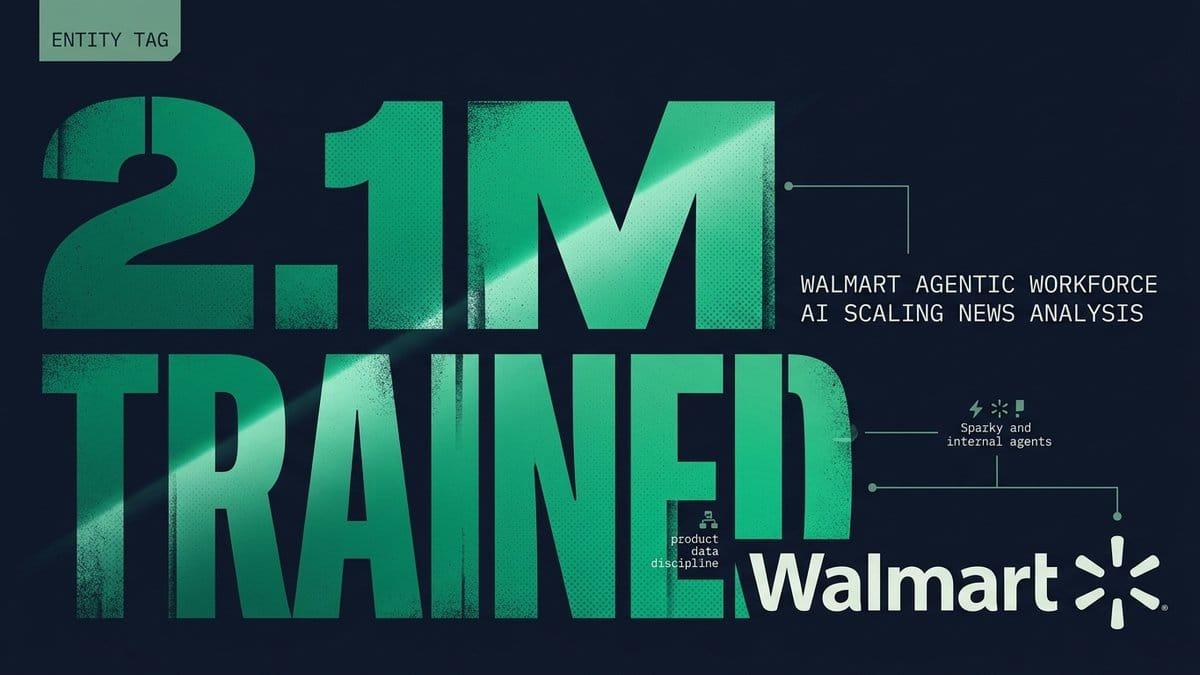
TL;DR: Walmart is rolling out agentic AI training to all 2.1 million employees and is operating multiple internal AI agent platforms, including Sparky for shoppers and proprietary tools for associates. CEO Doug McMillon's annual letter calls AI central to making Walmart shoppers' "primary destination." For brands stocked at Walmart, the discovery surface is no longer just Google, Gemini, ChatGPT, and Copilot. Walmart's own agents are a parallel surface with their own ranking signals, and the brands that win on both will be the ones with the cleanest product data.
When a retailer commits its entire workforce to a technology, that technology is not optional anymore. On April 23, 2026, Walmart's Chief People Officer Donna Morris announced agentic AI training for all 2.1 million employees, spanning Sparky (the customer-facing agent), internal associate copilots, and a portfolio of in-house and partner AI platforms. The same week, McMillon's annual report framed agentic AI as central to making Walmart the shopper's "primary destination".
For most CPG and household brands, the immediate read is the workforce story. The deeper read is what this commits Walmart to do with product data over the next 18 months, and what that requires of every brand stocked on Walmart's shelves.
What did Walmart actually announce?
Three concrete things landed in the same news cycle.
First, Walmart confirmed agentic AI training for the full 2.1 million employees, a population larger than the active-duty US military. This is not a pilot. It is an enterprise-wide capability rollout layered on top of Walmart's existing Walmart Academy training program.
Second, the rollout spans both customer-facing and internal agents. Sparky has been Walmart's consumer-facing AI shopping agent since 2024; the new training extends to associate-facing copilots that handle inventory, scheduling, returns, and store operations. The line between "agent that helps a shopper" and "agent that runs the store" is being deliberately blurred in Walmart's stack.
Third, McMillon's letter does what most retailer annual reports do not. It commits to a destination. The phrase "primary destination" is doing real work here: it signals Walmart's intent to be the surface that AI shopping agents (and shoppers using AI) default to. Combined with Walmart's role as a founding member of the UCP Tech Council (the Universal Commerce Protocol that powers Google AI Mode and Microsoft Copilot), this is Walmart staking position both inside the open-protocol ecosystem and on its own owned surfaces at the same time.
Why this matters for brands stocked at Walmart
For a Procter and Gamble, a Unilever, a Colgate-Palmolive, a Reynolds, or any mid-market CPG selling into Walmart, the operating model shift is concrete. You used to compete on shelf placement, planogram strategy, and Walmart Connect ad spend. You still do. But you now also compete inside Walmart's internal agentic stack, and inside the external AI agents that route shoppers to Walmart.
That breaks down into two parallel optimization surfaces:
The external surface. When a shopper asks ChatGPT, Google's AI Mode, Microsoft Copilot, or Perplexity for "best paper towels" or "natural laundry detergent," the AI's response often features a Walmart product card. Whose product appears in that card depends on the underlying structured product data, retrieval signals, and merchant feed quality. If your brand is mentioned but doesn't surface as a product card, the click goes to a competitor.
The internal surface. When that same shopper opens the Walmart app and asks Sparky for the same recommendation, the ranking is being generated by Walmart's internal agent stack against Walmart's catalog metadata. Sparky's training corpus includes Walmart's product attributes, customer reviews, sales velocity, and inventory signals. Brands with thin descriptions, missing structured attributes, or weak reviews drop in Sparky's rankings the same way they drop in ChatGPT product retrieval. The mechanics are different. The discipline is the same.
The reason Walmart's all-in commitment matters is that the training bar for brand teams just moved. You cannot treat "Walmart Connect performance" and "AI shopping visibility" as two unrelated workstreams when Walmart itself is using the same product data to drive both surfaces.
What about the other big-box and grocery retailers?
The signal Walmart is sending is not isolated. Target, Wayfair, and Etsy are all UCP Tech Council co-founders alongside Walmart and Shopify. Amazon recently joined the council too. Every major US retailer is now publicly aligned with the same protocol direction Walmart anchored.
What Walmart adds, that the others have not yet matched at this scale, is the workforce dimension. Training 2.1 million people is a multi-year capital expenditure that locks the company into agentic operations as a core competency, not an experiment. Other retailers will follow. The brands that build clean catalog data now will compound visibility across every retailer that invests in internal agents over the next 24 months. The brands that wait will be retraining their entire data discipline at the same time their competitors are reading the next quarter's win-loss reports.
What about smaller retailers and DTC brands?
If you are a DTC brand or a sub-mid-market retailer, you might read this and conclude it does not apply. The opposite is true. When Walmart's surface and Walmart-stocked brands set the citation pattern that AI agents learn from, the entire benchmark for "good product data" rises.
A DTC brand with a Shopify store and a Google Merchant Center feed competes for the same product cards on ChatGPT and Gemini that Walmart's brands do. The shopper asking "best running shoes under $100" gets a result set drawn from across the retail web. The retailers and brands with the cleanest structured data win the cards. The shopper rarely sees the difference between a retailer-published product and a manufacturer-published product on the AI surface. The retrieval signal does.
What to do this week
- For each top SKU you sell at Walmart, run the same query on Sparky (Walmart app), Google AI Mode, ChatGPT, and Copilot. Compare which surfaces show your product as a card, which only mention it, and which surface a competitor instead.
- Audit your Walmart item-page metadata. Title, attribute completeness, description length, image count, review count, structured policy fields. Match it against the top-ranked competitor in your category. The gaps in attributes are usually the same gaps that hurt you on external AI agents.
- Treat your Walmart Connect optimization team and your AI visibility team as one workstream, not two. The product data feeding both surfaces is the same underlying asset.
- Set up monthly tracking on whether your products surface as product cards on AI agents for your top 50 category queries. Walmart is not the only retailer about to use internal agents at scale; treating this as an early-warning system pays off across the rest of your channels.
- For brand managers planning 2026 budgets: the new line item is not "agent SEO" or "AI shopping ads." It is product-data quality and ranking visibility. That is where the compounding lives.
Where this leaves the publishing-versus-intelligence question
Walmart's announcement reframes a question retailers and brands have been quietly arguing about for a year. Is agentic commerce a publishing problem (get clean feeds into the right places) or an intelligence problem (know whether you actually win the queries that matter)?
Publishing is becoming infrastructure. Walmart, like most major retailers, will manage feed publishing through its own systems and its retailer-of-record agreements. The brand's job is no longer "get the feed published." It is "make sure that when an agent (Walmart's, Google's, OpenAI's, Microsoft's) decides which product to recommend, your product is the one chosen."
That is the intelligence layer. It runs on continuously checking how each engine retrieves and ranks your products, identifying the catalog gaps that drive ranking outcomes, optimizing the underlying data to close them, and verifying lift across engines. This is what Paz operates: cross-engine product-level visibility tracking, optimization recommendations against agentic commerce optimization signals, and verified ranking improvements over time. With Walmart now committing 2.1M employees to running agentic systems, the brands without that visibility layer are about to discover what flying blind across two surfaces costs.
Frequently asked questions
Is Sparky available to all Walmart shoppers?
Sparky has been rolling out across the Walmart app and Walmart.com since 2024 and is now broadly available to US shoppers. The new April 2026 announcement is about extending agentic AI capability to the workforce, not first-time shopper-facing rollout.
Does Walmart's investment hurt or help brands?
Both, depending on the brand. Brands with strong structured product data benefit because internal Walmart agents have better signals to surface them. Brands with thin metadata get demoted, fast, on both Walmart's surface and external AI surfaces, because the retrieval mechanics reward the same things in both places.
Is this just a marketing announcement?
Two-million-person training programs are not marketing announcements. The capital cost (training time, content development, change management) is a multi-year commitment. CIO Dive, HR Dive, and PYMNTS all reported the same scale independently, and McMillon's annual letter is on the public record. This is operational direction, not press release theater.
What's the connection between Walmart and UCP?
Walmart is a founding member of the Universal Commerce Protocol Tech Council, the open-protocol body that just expanded to include Amazon, Meta, Microsoft, Salesforce, and Stripe. UCP defines how AI agents discover and rank products on Google AI Mode, Microsoft Copilot, and other UCP-compatible surfaces. Walmart helping shape UCP and operating its own internal agents at scale means the same retailer is influencing both the open-protocol layer and an owned channel.
How fast do brands need to respond?
The brands compounding visibility now will look meaningfully different from the laggards by Q3 2026. Sparky is already ranking products for Walmart shoppers; ChatGPT, Google AI Mode, and Copilot are already ranking products for everyone else. Each refresh cycle (typically 2 to 6 weeks per surface) compounds the gap. Catching up later costs more than catching up now.
Is this just a Walmart story?
No. Walmart is the leading edge. Every other top-20 US retailer with the budget to operate internal agents will follow. The general lesson is that internal retailer agents and external AI agents are converging on the same product-data signals. Brands optimizing for one tend to win on the other; brands optimizing for neither lose on both.
When the world's largest retailer commits its workforce to agentic AI, the question stops being whether this matters and becomes how fast you adapt. Brands that treat April 23 as a structural date and build product-data discipline now will compound across every retailer that follows. Brands that treat it as Walmart's news, not theirs, lose share at every retailer that invests in internal agents from here.
How AI-ready are your products?
Check how ChatGPT, Google AI, and Perplexity evaluate any product page. Free score in 30 seconds.