ChatGPT Can Buy From Shopify Brands Again. Discovery Decides Who.
- Author
- By Dor
- Publication date
- Published
- Reading time
- 6 min read
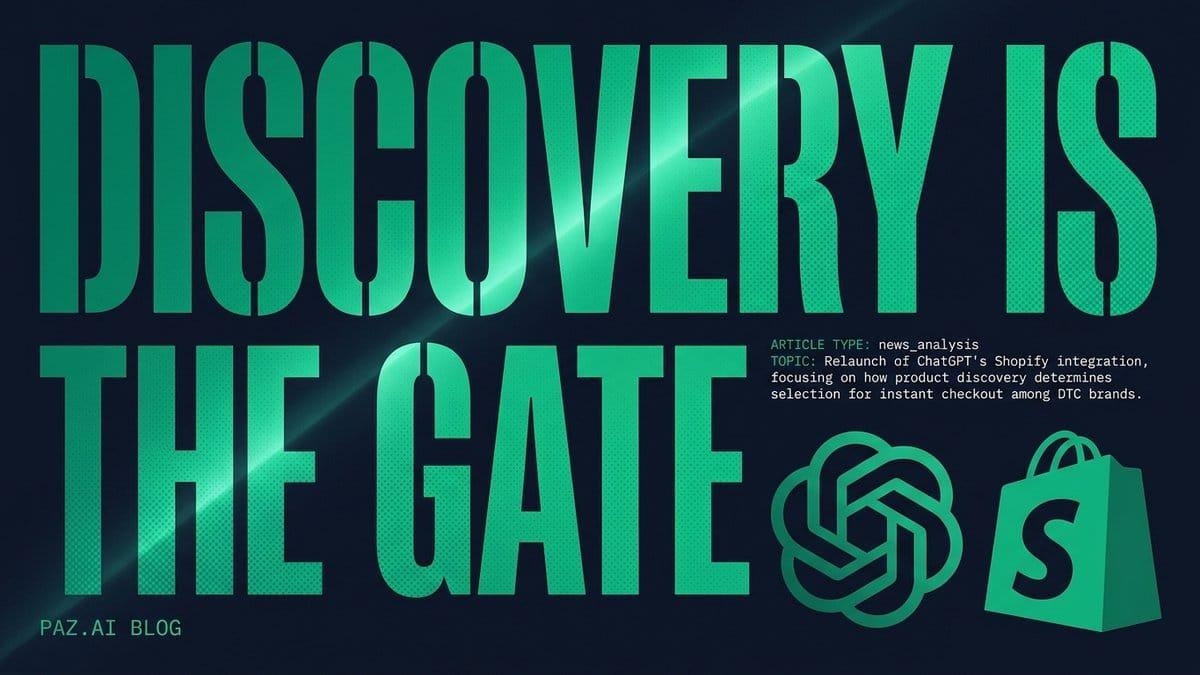
OpenAI retired its first checkout feature in March 2026 after thin merchant adoption. This week it came back, rebuilt on Shopify's native agentic stack, and launched with Spanx, Skims, and Glossier. The mechanism changed. The question for your brand did not: when a shopper asks ChatGPT for a product like yours, does your product show up at all?
TL;DR: OpenAI relaunched in-chat purchasing for Shopify merchants in June 2026, starting with named direct-to-consumer brands and routing through Shopify's own agentic checkout instead of OpenAI's bespoke per-merchant enrollment. The purchase still completes on infrastructure the merchant controls. The new constraint is upstream: you cannot be bought if you are never recommended. Discovery is the gate.
The first version of this feature shipped in late 2025 and was pulled within months. The cited reasons were a 4 percent merchant fee and weak conversion, per Quartz. The relaunch removes the bespoke enrollment friction by running through Shopify's agentic storefront plumbing, which more than a million merchants already sit on. Per Glossy's reporting, the rollout path runs through Etsy sellers and Shopify merchants including Glossier, Skims, Spanx, and Vuori.
That is a different distribution story than the first attempt. Instead of recruiting merchants one at a time, the surface now reaches every brand already running on Shopify's stack. For a direct-to-consumer brand, the buying capability is no longer the hard part. Being the product the agent names is.
What actually changed in the relaunch?
The 2025 feature required each merchant to enroll individually, which is why adoption stalled at roughly 30 brands by early 2026 per Forrester. The June 2026 relaunch runs on Shopify's native agentic plumbing, so any merchant on that stack is reachable without a custom integration. The launch brands are all direct-to-consumer apparel and beauty: Spanx, Skims, Glossier, Vuori.
This matters because the bottleneck moved. When enrollment was the barrier, most brands were simply not present. Now the plumbing is shared. Presence is table-level, and the differentiator is whether the agent surfaces your specific product when a shopper describes what they want.
The shopper still completes the purchase through checkout the merchant controls, not a separate OpenAI wallet. ChatGPT recommends products and the transaction runs on the retailer's own infrastructure.
There is an important detail in how an AI shopping agent handles this: the agent has to choose your product before any checkout happens. The protocols that power agentic purchasing define how a product becomes buyable through an agent. None of them define whether your product gets recommended in the first place. That decision happens earlier, during retrieval, and it is the part most brands never measure with a metric like AI product found rate.
Why discovery, not checkout, is now the revenue question
When the purchase step was the missing piece, brands could reasonably wait. With Shopify's stack handling that step natively, the open variable is discovery, and discovery is decided before a shopper ever sees a buy button. The 40 to 60 percent of conversational shopping that starts as open-ended product search is where the recommendation gets made.
ChatGPT processes a large volume of shopping-intent conversations. OpenAI has described roughly 20 percent of ChatGPT conversations as carrying shopping intent, framing the path as discover, evaluate, then buy. The evaluate-and-buy steps now have native plumbing. The discover step is where most brands are invisible, because they have never been measured on it.
Consider how the assistant actually answers a shopping prompt. It does not run one query. It decomposes the request into multiple sub-queries, a process Google calls query fan-out. A request like "comfortable shapewear for a wedding" fans out into sub-queries about fabric, occasion, sizing, and price. Your product has to be retrievable for each of those facets, not just the headline term, which is the core idea behind passage-level retrieval.
| Era | The hard part | What a brand controlled |
|---|---|---|
| 2025 first launch | Per-merchant enrollment | Whether you were present at all |
| March 2026 retirement | Nothing shipping | Time to prepare |
| June 2026 relaunch | Being recommended | Your product data and how AI reads it |
What makes a Shopify product discoverable to an agent
A product becomes discoverable when its data answers the sub-queries an agent generates, not just the exact phrase a human types. That means structured attributes, clear categorization, and context an AI can parse. Most catalogs ship with five to eight attributes per product. Agents reason better over thirty or more.
The gap is rarely the headline title. It is the missing fabric composition, the absent fit descriptor, the use-case context that lets an agent match a product to "for a wedding" or "for postpartum." Structured product data and product data enrichment are what turn a thin listing into something an agent can retrieve and rank with confidence.
Paz.ai, an agentic commerce optimization platform, measures this directly: how often a brand's products are returned across AI shopping queries, and whether they appear as a full product card or just a brand mention. The split matters. A brand can be named in conversation and still never show as a buyable card, which is the difference between being mentioned and being bought.
How to check your discovery footprint this week
The relaunch makes one thing concrete: if you sell on Shopify, the buy step is handled and your job is to be the recommended product. Here is where to start.
- Run your top 10 category queries through ChatGPT as a shopper would phrase them, including descriptive and occasion-based variants, and record whether your product appears at all.
- Note the format of each appearance. A product card with image and price is a different outcome than a passing brand mention.
- Audit your three best-selling products for attribute depth. Count the structured fields. If you are under 15, you are likely thin for agent retrieval.
- Check that your product data carries use-case and context language, not just specs, so it can match the sub-queries an agent fans out.
- Benchmark against two competitors on the same queries. If they surface as cards and you do not, that is your priority fix.
Tools like our AI Readiness Report score a product on how well its data supports agent retrieval, which is a faster starting point than auditing by hand. The point is to measure discovery as a live metric, the way you already measure conversion.
What this means for the next wave of brands
The launch brands are not special. Spanx, Skims, and Glossier got named first because they are large and visible, but the underlying capability reaches every Shopify merchant on the agentic stack. That breadth is the real signal. Within months, "is my product discoverable in ChatGPT" stops being a question for a handful of pilots and becomes a default revenue surface for the long tail of direct-to-consumer brands.
The brands that treat discovery as a measured, ongoing metric will compound an advantage while competitors are still asking whether agentic shopping is real. It is real, it is shipping, and the buy button is already built. The only thing left to earn is the recommendation.
Frequently Asked Questions
Did OpenAI bring back in-chat purchasing for all merchants?
Not all at once. The June 2026 relaunch starts with named Shopify brands like Spanx, Skims, and Glossier, plus Etsy sellers, and reaches Shopify merchants on the agentic stack. It supports single-item purchases at launch.
Does the shopper buy inside ChatGPT or on my site?
ChatGPT recommends the product and the purchase completes through checkout infrastructure the merchant controls via Shopify's stack, not a separate OpenAI wallet. The merchant keeps the customer relationship and the transaction.
Why does discovery matter more than the checkout feature?
Because the agent has to choose your product before any purchase can happen. With the buy step now handled natively on Shopify, the open variable is whether your product is recommended at all, which is decided during retrieval.
What is query fan-out and why does it affect my catalog?
Query fan-out is how an AI assistant decomposes one shopping request into multiple sub-queries covering different facets. Your product has to be retrievable for each facet, which is why thin product data fails even when the headline term matches.
How many attributes should my product listings have?
Most catalogs ship with five to eight attributes per product. Agents reason more reliably over thirty or more, especially fields covering fit, use case, materials, and occasion. Thin listings are the most common reason a product fails to surface.
Is this the same as the Visa and OpenAI payments deal?
No. The Visa deal is a payment rail for agent-initiated purchases with no firm launch date. The Shopify relaunch is a live discovery and checkout surface with named brands you can buy from today. Different layers.
How AI-ready are your products?
Check how ChatGPT, Google AI, and Perplexity evaluate any product page. Free score in 30 seconds.