A New Shopping App Ranks 10,000 Brands. You Can't Buy Your Spot.
- Author
- By Dor
- Publication date
- Published
- Reading time
- 7 min read
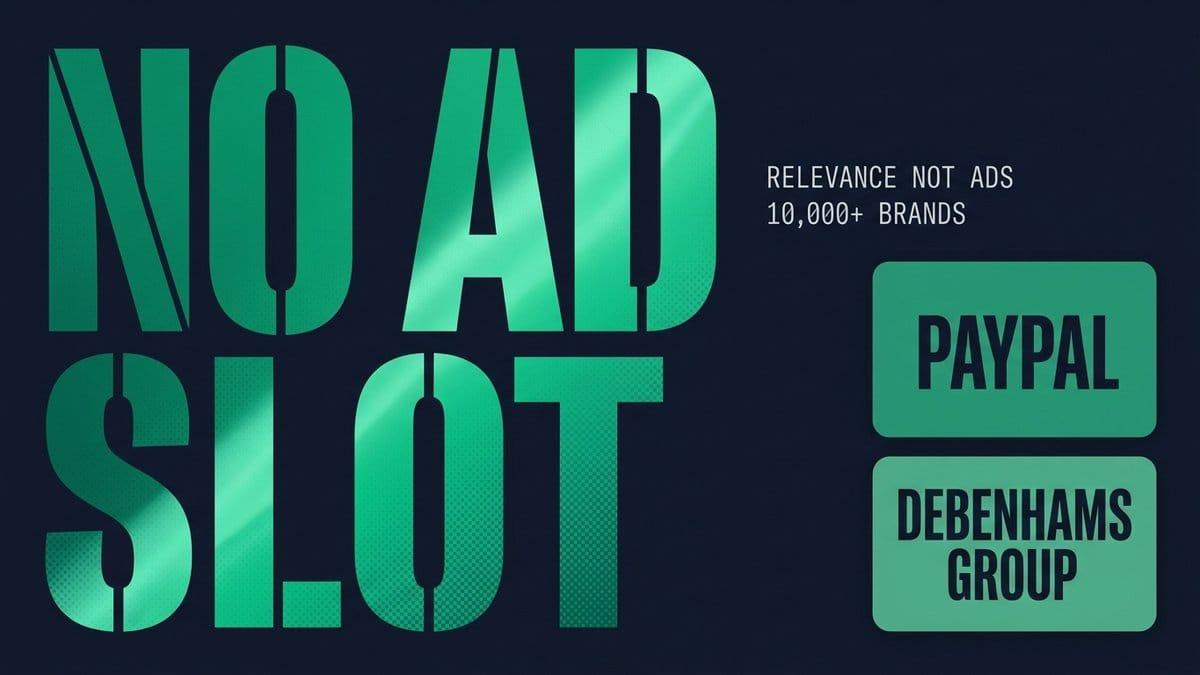
A UK fashion app just went live that ranks more than 10,000 brands by relevance, not by who paid for placement. Debenhams, Karen Millen, Boohoo, and PrettyLittleThing are already on it. If your product data is thin, there is no ad slot to buy your way back into the results.
TL;DR: Hey Savi launched at Money20/20 Europe on June 2, 2026, turning any photo, screenshot, or text into ranked fashion results across 10,000+ brands, ordered by relevance and explicitly not by sponsored placement. Debenhams Group is the first retailer live. For brands, this is a preview of how AI shopping surfaces decide who appears: product-data quality, not ad budget. The fix is making your catalog machine-readable before the next relevance-ranked surface launches.
On June 2, 2026, at Money20/20 Europe in Amsterdam, the AI fashion-search startup Hey Savi launched what it and PayPal describe as the UK's first end-to-end agentic commerce experience, per PayPal's newsroom. A shopper feeds it a photo, a screenshot, or a line of text. The app returns ranked product results across more than 10,000 brands. The ranking is ordered by relevance, and the company is explicit that it is not ordered by sponsored placement.
That one design decision changes the rules for every brand in the catalog. On a paid-search results page, a weak listing can buy its way to the top. On a relevance-ranked surface, it cannot. Your product either earns the spot on the strength of its data, or it does not appear.
What Did Hey Savi and PayPal Actually Launch?
Hey Savi is a brand-agnostic AI fashion search app for women that converts any input into ranked results across 10,000+ brands, with PayPal supplying the payment and product-data connection layer. Debenhams Group, covering Debenhams, Karen Millen, Boohoo, and PrettyLittleThing, is the first UK retailer live.
The mechanics matter for anyone selling apparel. PayPal's role is described in plain terms in the announcement: its technology "connects merchant storefronts to AI platforms, making product data such as pricing, images, descriptions, reviews, and inventory readily accessible." In other words, PayPal pipes the catalog into the AI surface. Hey Savi ranks what it receives.
"This is an important step change for retailers as, for the first time, brands of every size can be discovered by the highest-intent shoppers in fashion. Our brand-agnostic platform democratises discovery ensuring relevance now directly drives revenue." - Sarah Daniel, Co-Founder, Hey Savi (source)
Read that quote as a brand, not as a press release. "Relevance now directly drives revenue" is the polite version of a harder sentence: if your catalog is not relevant and complete enough to rank, you are invisible to those high-intent shoppers, and no media spend changes that. This is the same dynamic playing out across every AI shopping search surface, now shipped as a consumer app with a major retail group live on day one.
Why "Relevance, Not Sponsored Placement" Is the Whole Story
The cleanest way to understand AI shopping is this: it is not paid search with a new coat of paint. On AI surfaces, the system decides what to show based on how well it can read and trust your product data, and there is usually no ad auction to override that judgment.
Most retail teams have spent a decade optimizing for a world where budget can fix a visibility problem. Underperforming on a query? Bid higher. That muscle does not transfer here. When ranking is relevance-first, the inputs are your titles, attributes, descriptions, images, availability, and reviews, the exact fields PayPal named in the launch.
This is why the digital shelf is shifting from a merchandising problem to a data problem. The shelf used to be a place you arranged products and bought endcaps. On an AI surface, the shelf is whatever the model retrieves, and it retrieves based on structure. A brand with 5 thin attributes per product loses to a brand with 30 well-structured ones, regardless of which has the bigger marketing team.
AI surfaces rank on product-data quality, not ad spend. On a relevance-ranked app, there is no sponsored slot to buy your way back into the results.
How AI Decides Whether Your Product Shows Up
When a shopper types or photographs an item, the AI does not run one literal search. It decomposes the request into many sub-queries, a process Google calls query fan-out, and tries to match products against each one. A single "black midi dress under 80 pounds" becomes a fan of narrower checks: silhouette, color, length, price band, occasion, size availability.
This is where most catalogs quietly fail. A study from Surfer SEO analyzing 173,902 URLs found that 68% of AI-cited pages were not in the top 10 organic results, and that content matching fan-out sub-queries saw a 161% lift in citation likelihood. Translated to commerce: products described in rich, specific terms get retrieved for far more sub-queries than products with sparse data, even when the sparse-data brand is bigger.
| Ranking input | Paid search era | AI shopping surface |
|---|---|---|
| What moves you up | Bid amount + keywords | Product-data completeness + relevance |
| Can budget fix low visibility? | Yes | No |
| What gets read | Ad copy + landing page | Titles, attributes, images, availability, reviews |
| Failure mode | Outbid by competitor | Not retrieved at all |
The takeaway is uncomfortable but clarifying. If you cannot see how often your products surface across these fan-out sub-queries, you are flying blind on the only metric that now matters. Measuring your AI product found rate across real shopping queries is the starting point, not catalog cleanup for its own sake.
This Surface Won't Be the Last
Hey Savi is one app, in one country, in one category. The reason it matters is the pattern. Over the past year, agentic discovery has fragmented from a handful of US platforms into an expanding set of surfaces: assistant integrations from large retailers, shopping experiences inside ChatGPT and Gemini, and now vertical, relevance-ranked consumer apps in Europe.
Every new surface is another place where your brand is either findable or invisible, and almost all of them rank on data quality rather than ad spend. A brand that structures its catalog once for machine readability benefits everywhere those feeds flow. A brand that waits optimizes per-surface, late, and at higher cost.
PayPal's "Agentic Commerce Services" is worth watching specifically because it is a reusable connector. The launch language implies Debenhams' catalog could flow to other AI platforms beyond Hey Savi. If that holds, the data you fix for one app pays off across many. That is the argument for treating catalog readiness as infrastructure, not a one-off campaign, and it is closely tied to how headless commerce setups already decouple product data from any single storefront.
For apparel specifically, the stakes are sharp because fashion queries are attribute-heavy. Fit, fabric, occasion, color, and size availability all feed the fan-out. Fashion brands with shallow product data are exactly the ones that vanish when a shopper asks for something specific.
What to Do This Week
- Audit how a shopper would describe your top 20 products in natural language. Write the queries out, including attributes like fit, material, occasion, and price band. These are the sub-queries an AI surface will fan out into.
- Check whether your catalog answers those sub-queries. Open your product feed and confirm each item carries structured attributes for the things shoppers actually ask about, not just a title and price. Aim for 25 to 30 attributes per SKU, not 5.
- Measure your found rate, not just your rankings. Run real shopping queries against the AI surfaces your customers use and count how often your products appear at all. A tool like our AI Readiness Report scores this in about 30 seconds.
- Prioritize availability and image data. Relevance-ranked surfaces weight in-stock, correctly-sized, well-imaged products. Out-of-stock or image-poor items get demoted regardless of brand size.
- Treat the fix as feed infrastructure. Structure the catalog once for machine readability through product feed optimization so the same enriched data flows to every new surface, instead of patching each one separately.
Frequently Asked Questions
What is Hey Savi?
Hey Savi is a brand-agnostic AI fashion search app for women, launched at Money20/20 Europe on June 2, 2026, with PayPal. It turns a photo, screenshot, or text into ranked product results across more than 10,000 brands, ordered by relevance rather than sponsored placement, with Debenhams Group as the first UK retailer.
Does Hey Savi let shoppers buy inside the app?
Yes. PayPal supplies the payment layer and surfaces live pricing and availability so shoppers can purchase within the experience. The notable shift for brands is upstream of checkout: whether your product is discovered and ranked at all, which depends on product-data quality.
Why can't brands pay to rank higher on Hey Savi?
The platform explicitly orders results by relevance, not sponsored placement. Ranking is driven by how well the AI can read and match your product data to a shopper's intent. There is no ad auction layered on top, so completeness and structure decide visibility.
What product data matters most for AI shopping surfaces?
Titles, attributes, descriptions, images, availability, and reviews, the same fields PayPal named when describing what it makes "readily accessible" to AI platforms. For fashion, attribute depth around fit, fabric, color, occasion, and size availability is especially decisive.
How is this different from paid search?
On paid search, a higher bid can lift a weak listing. On a relevance-ranked AI surface, it cannot. The system retrieves and ranks based on data quality and intent match, so a thin catalog stays invisible no matter the budget behind it.
How do I know if my catalog is AI-ready?
Run real shopping queries against the AI surfaces your customers use and measure how often your products appear. Score your structured-data completeness against what AI agents need, which is typically 25 to 30 attributes per product rather than a handful.
A single app in the UK does not change a retail strategy on its own. The pattern behind it does. Discovery is moving to surfaces that rank on what your data says, not on what your media budget can buy, and the brands that structure their catalogs early will keep showing up as each new surface arrives. The ones that wait will keep finding out, one launch at a time, that there is no slot left to buy.
How AI-ready are your products?
Check how ChatGPT, Google AI, and Perplexity evaluate any product page. Free score in 30 seconds.