Forrester: "Everyone Has FOMO." The Real Bottleneck Is Catalog Readiness.
- Author
- By Dor
- Publication date
- Published
- Reading time
- 6 min read
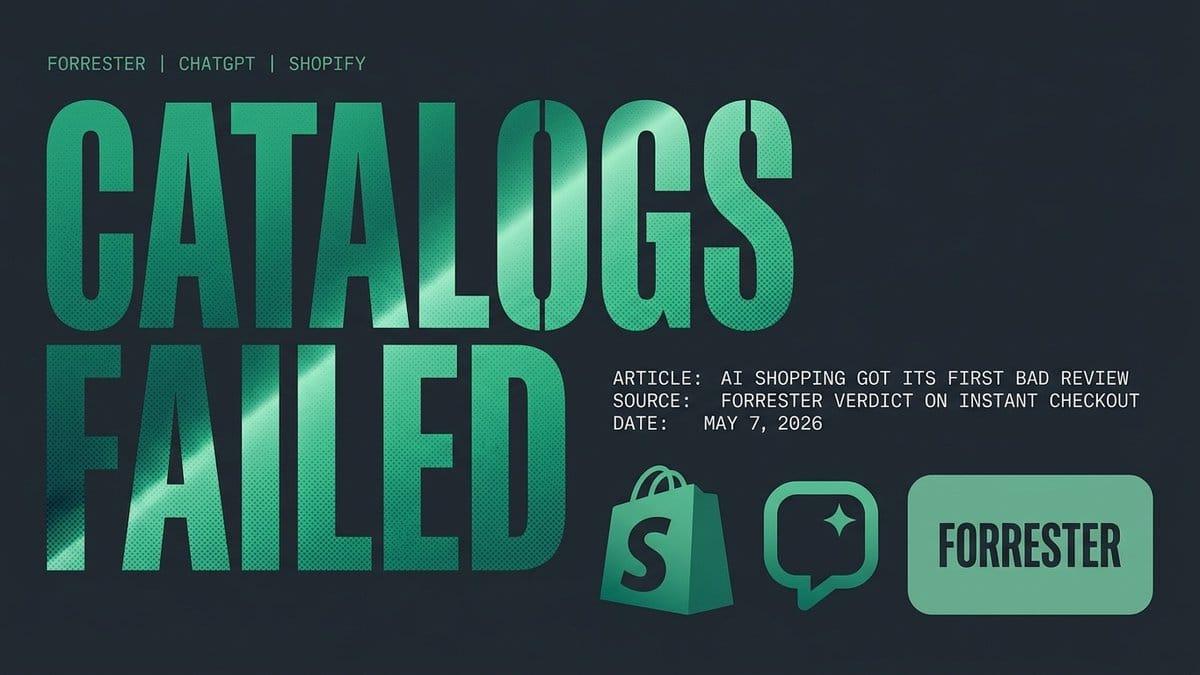
Fast Company published the first long-form mainstream retrospective on the ChatGPT Instant Checkout rollout on May 7, 2026. The headline analyst quote, from Forrester's Emily Pfeiffer, reframes the last seven months of agentic commerce: the rush outran the data layer underneath it. The protocols are fine, the payment rails are live, and AI-driven discovery is accelerating. What broke was the product catalog.
TL;DR: A Forrester analyst and a major commerce-data CEO are now on record calling the ChatGPT Instant Checkout rollout premature. The integrations that did ship struggled because product data was not ready for AI retrieval, not because the protocol or checkout flow was wrong. AI traffic to US retail sites still grew 393% in Q1 2026. The retailers winning the new discovery-and-redirect model are the ones with structured, agent-ready catalogs. That layer is exactly what Paz.ai monitors, optimizes, and publishes.
What Fast Company actually reported
Emily Pfeiffer, Principal Analyst at Forrester covering AI and commerce, told Fast Company "nobody has figured it out, but everyone has FOMO. Everyone is prematurely rushing to market." Omar Qari, CEO of Logicbroker, said "Shopify has major egg on their face."
The Fast Company article makes a specific claim that matters more than the quotes. When Shopify and OpenAI announced Instant Checkout in September 2025, they promised that millions of Shopify merchants would soon be shoppable inside ChatGPT, alongside Etsy sellers and Walmart. Only a tiny fraction of those integrations actually shipped. Etsy pivoted to a native ChatGPT app on May 5. Walmart pulled out of ChatGPT Checkout earlier in the spring and accelerated its own AI-powered beauty shopping tools instead. The Instant Checkout program itself was discontinued in March 2026 after seven months of poor conversion and merchant pushback.
Forrester on the record: "Nobody has figured it out, but everyone has FOMO. Everyone is prematurely rushing to market." Emily Pfeiffer, Principal Analyst at Forrester, May 7, 2026.
Why the integrations stumbled (it was not the protocol)
The reflexive explanation is that the Agentic Commerce Protocol was wrong, or that in-chat checkout was the wrong UX, or that consumers were not ready. Those are partial answers. The deeper issue is that most participating catalogs were not ready to be retrieved by an agent. The protocol is fine; the agentic storefront it powers needs structured catalog data underneath it.
When an AI agent decomposes a shopping query into eight to twelve sub-queries via query fan-out, it needs structured product data at the passage level: clean attributes, specific use cases, comparable specs, in-stock signals, return policy. Most product feeds were built for human shoppers and Google Shopping crawls. They have a title, a price, a few bullet points, and one image. That is not enough surface area for an agent that is trying to answer "best moisturizer for combination skin under $40 that ships in two days."
Surfer SEO's December 2025 analysis of 173,902 URLs found that 68% of AI-cited pages are not in the top 10 organic results. The pages that win citations match specific sub-queries with structured passage-level data. The pages that lose are the ones that read well to a human but expose almost nothing to a retrieval system.
| Layer | Status as of May 2026 | Who is fixing it |
|---|---|---|
| Payment rails (Stripe, Visa, Mastercard, PayPal) | Production ready, 800ms checkout SLA per Stripe | Card networks + processors |
| Protocol layer (ACP, UCP, MCP, AP2) | Live, multiple competing standards | Stripe, OpenAI, Google, Shopify, Anthropic |
| Identity + trust (Visa TAP, Cloudflare, Skyfire) | Live in pilots | Card networks + infra |
| Structured product data | 18% of pages actually AI-ready | Brands + tools |
| Retrieval / discovery surface | Live across ChatGPT, Google AI Mode, Perplexity, Copilot | AI platforms |
Three of those five layers are essentially solved. The catalog layer is where the rollout broke, and it is the layer Paz.ai is built for. Paz monitors how your products appear across ChatGPT, Google AI Mode, and Perplexity, enriches catalog attributes for agent retrieval, and publishes structured feeds to the AI commerce surfaces that matter.
What Etsy and Walmart actually did
Etsy is the cleanest example of a retailer that read the data and adapted. Etsy was an Instant Checkout launch partner in September 2025. The company publicly disclosed that the program "did not see large volume of sales." On May 5, 2026, Etsy launched a native app inside ChatGPT that lets shoppers tag @Etsy in any prompt and search the 100M+ listing catalog conversationally, per TechCrunch's coverage of the announcement. The model is discovery and redirect: shoppers click through to Etsy.com to complete the purchase. Etsy keeps the customer relationship, the login, the loyalty data, and the post-purchase experience.
Walmart took a different but consistent approach. They pulled out of ChatGPT Checkout earlier this year and accelerated their own AI shopping interfaces. The May 5 expansion of Walmart's AI beauty shopping (referenced above) lets shoppers describe outcomes ("a moisturizer for combination skin that doesn't break me out") instead of typing brand or SKU keywords. That works because Walmart spent the last 18 months enriching catalog attributes specifically for outcome-based queries.
Both retailers reached the same conclusion. The scarce resource is not the checkout button. It is structured catalog data that an agent can actually retrieve, compare, and recommend. Retailers without that layer are invisible to the agent regardless of which protocol the agent speaks.
What this means for mid-market merchants
The "everyone has FOMO" line lands hardest on the mid-market: brands and retailers between $50M and $1B in revenue who watched enterprise peers chase Instant Checkout integrations and felt left behind. The first integration model underdelivered. The discovery-and-redirect model is delivering real volume right now. AI traffic to US retail sites rose 393% in Q1 2026 per data shared at Gladly Connect Live on May 6. Instacart disclosed that its Cart Assistant is now used by 25% of US customers, up from a limited test six months ago, in Q1 2026 earnings coverage on PYMNTS.
The market did not stop. It moved to a model where AI agents recommend products based on catalog signals and link the shopper to the merchant's own site to complete the purchase. Catalog readiness is what determines who shows up in those surfaces, and waiting for the next protocol cycle is the most expensive option on the table.
Key stat: AI agent traffic to US retail sites grew 393% in Q1 2026, per data shared at Gladly Connect Live (May 6, 2026). The discovery model is scaling even as in-chat checkout shrunk.
What to do this week
- Run the AI Readiness Score on one hero product. 30 seconds, paz.ai homepage. You get a 0-100 rating with a four-layer breakdown: Product Mapping, Structured Attributes, Attribute Context, Product Context. That tells you whether your catalog answers an agent or a human.
- Map your top 50 SKUs to outcome-based queries. Walmart did this for beauty. Etsy did this for gifting. The pattern is shopper intent in plain language ("for sensitive skin," "ships before Mother's Day"), not SKU keywords.
- Pick two distribution surfaces. Choose two of (ChatGPT app, Google Merchant Center for AI Mode, Perplexity, Copilot Shopping). Optimizing for all four simultaneously is the FOMO Forrester is calling out.
- Track the two metrics that matter. Found Rate (how often your products surface in agent queries) and Product Card Rate (how often the agent shows your product with image, price, and link versus a brand mention). Most brands are mentioned but not shown as a card; the gap is where revenue leaks.
- Stop optimizing for in-chat checkout. OpenAI discontinued Instant Checkout in March. The shopper buys on your site. Optimize the agent's path to your PDP.
Frequently Asked Questions
Did ChatGPT Instant Checkout actually fail, or was it just early?
Both. OpenAI discontinued Instant Checkout in March 2026 after seven months. Only about 30 merchants were live, conversion was poor, and brands rejected being reduced to anonymous fulfillment centers without traffic, customer data, or loyalty data. The retrospective is now mainstream, with Forrester explicitly describing the rollout as premature.
What replaced Instant Checkout?
The current model is discovery and redirect. ChatGPT, Google AI Mode, Copilot, and Perplexity recommend products based on structured catalog data and link the shopper to the merchant's own website to complete the purchase. The merchant keeps the customer relationship, login, and loyalty data. Etsy's May 5 native ChatGPT app is the cleanest example.
Why does catalog readiness matter more than the protocol?
Most product feeds were built for human shoppers and Google Shopping crawlers. They have a title, price, a few bullets, and one image. AI agents decompose a query into eight to twelve sub-queries via query fan-out and need structured passage-level data to match each one. Surfer SEO found 68% of AI-cited pages are not even in the top 10 organic results, because the retrieval signal is different from the ranking signal. The catalog is the input. Without the right input, the protocol is irrelevant.
Should mid-market retailers wait for the next protocol?
No. The protocols are converging (UCP, ACP, MCP, AP2 are all being adopted by major surfaces) and the catalog work is the same regardless of which protocol an agent speaks. Brands waiting for protocol clarity are losing months of agent visibility now. Catalog readiness is protocol-agnostic.
How is Paz.ai different from a PIM or feed-management tool?
Paz.ai is an agentic commerce optimization platform. It monitors how products appear across ChatGPT, Google AI Mode, and Perplexity, enriches catalog attributes for AI retrieval, and publishes structured feeds to AI commerce surfaces (Google Merchant Center, OpenAI Commerce, ChatGPT App). PIM tools store data; feed managers send it to Google Shopping. Paz is built specifically for agent retrieval. The AI Readiness Score shows you where your catalog stands today.
The Forrester quote is the first time mainstream business press has put a name to what the data already showed: the FOMO layer rushed past the catalog layer. Retailers who treat product data as the primary asset, not the checkout button, are the ones agents are going to surface for the next twelve months.
How AI-ready are your products?
Check how ChatGPT, Google AI, and Perplexity evaluate any product page. Free score in 30 seconds.