10 Agentic Commerce Protocols, Zero Interop: The 2026 Guide
- Author
- By Dor
- Publication date
- Published
- Last updated
- Updated
- Reading time
- 7 min read
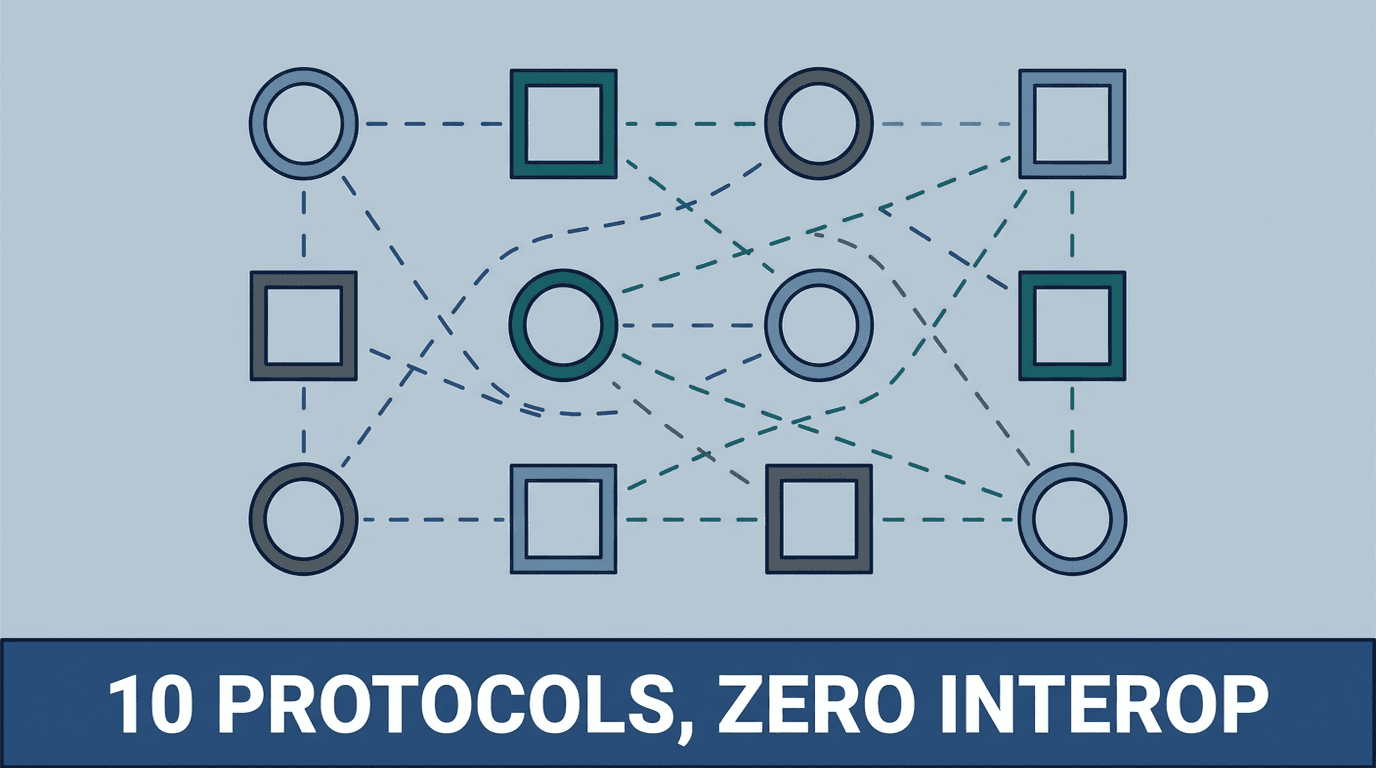
There are ten active agentic commerce protocols in the market, and none of them talk to each other. That's what a retailer walks into when they ask their engineering team, "so, how do we get our catalog into AI shopping?" The answer used to be "pick ACP." In April 2026, it is a spreadsheet.
TL;DR: Ten agentic commerce protocols are live or piloting in Q2 2026 with zero interoperability. Betting on the wrong one locks you out of specific AI surfaces. This guide sorts them by function (discovery vs. payment), shows which overlap, and gives retailers a decision framework for where to invest engineering time now.
The fragmentation isn't a bug. Every major platform wants to own a slice of how AI agents interact with commerce, and each is shipping a spec that serves its own stack. Retailers do the integration math.
What Are the 10 Agentic Commerce Protocols Live in 2026?
As of April 2026, ten protocols are live or in active pilot across three functional layers: discovery/catalog, payment/checkout, and transport. They were catalogued in a recent state-of-the-industry writeup by Benji Fisher (DEV Community, April 18, 2026) alongside the April 2026 Digital Applied protocol matrix.
Here is the list, grouped by what they actually do:
Discovery and catalog protocols:
- ACP (Agentic Commerce Protocol) - Stripe and OpenAI, Apache 2.0. Powers product discovery and merchant redirect for ChatGPT and Microsoft Copilot. 25+ partners including URBN, Etsy, Coach, Kate Spade, Revolve.
- UCP (Universal Commerce Protocol) - Google and Shopify. Cart, catalog, and identity linking for Google AI Mode and Gemini. As of April 18, UCP formally added Google's Agent2Agent Protocol (A2A) as a transport alongside REST, MCP, and Embedded.
- Shopify Agents - Shopify-native, sits on top of UCP for Shopify merchants.
- Amazon Buy for Me - Amazon-only agent checkout inside the Amazon app.
Payment and intent protocols:
- Mastercard Verifiable Intent - cryptographic proof that an agent is acting on behalf of a known cardholder.
- Stripe MPP (Merchant Payment Protocol) - Stripe's agent-payments spec.
- Visa Ready for Agentic Commerce - Visa's agent credential program.
- x402 - an HTTP 402 Payment Required spec used by some agent frameworks.
- Klarna Agent Mode - Klarna BNPL for agent transactions.
- Google Agentic Checkout - Google's merchant-side checkout hook tied to UCP.
MCP (Model Context Protocol) from Anthropic is not a commerce protocol itself, but several of the above use MCP as a wire transport. REST remains the universal fallback.
Key Stat: 10 active agentic commerce protocols in Q2 2026 with zero interoperability. Source: Digital Applied protocol matrix, April 15, 2026.
Which Protocols Matter for Product Discovery?
Only three protocols currently decide whether an AI agent can find your products: ACP, UCP, and the platform-native variants (Shopify Agents, Amazon Buy for Me). Everything else is about how the agent pays, not whether the agent sees you.
That distinction matters because discovery and payment are decoupled. OpenAI scaled back ChatGPT Instant Checkout in March 2026 after Forrester reported "lackluster performance" and only a handful of merchants ever went live (Ecommerce Fastlane, April 16, 2026). ChatGPT now operates as a discovery and recommendation engine, redirecting users to merchant sites. The AI recommends, the shopper buys on the retailer's site.
So when retailers ask "which protocol should I support?" the discovery-layer answer is narrow:
| AI Surface | Discovery Protocol | Your Action |
|---|---|---|
| ChatGPT | ACP (product feed syndication) | Syndicate catalog via ACP or platform integration |
| Microsoft Copilot | ACP | Same feed, Copilot reads the ACP index |
| Google AI Mode and Gemini | UCP | Syndicate catalog via UCP |
| Amazon Rufus | Amazon Buy for Me | Amazon seller feed, not applicable outside Amazon |
| Shopify-native agents | Shopify Agents (on UCP) | Shopify handles transport; you handle catalog quality |
The practical implication: if you sell on your own domain and want to show up in both ChatGPT and Google AI Mode, you need two catalog integrations. That's the interop problem in a sentence.
What About the Payment Protocols?
The six payment-layer protocols are competing to become the standard for how agents settle transactions. Most retailers don't need to pick yet.
Two reasons. First, the discovery-first model means checkout still happens on the retailer's site, with the retailer's existing PSP. The agent hands the shopper to the merchant, and the merchant runs the sale. Second, World launched AgentKit on April 17 with Okta, Vercel, Browserbase, and Exa to add a "proof of human" credential above the payment layer (World.org, April 17, 2026), which means the trust stack keeps adding layers before anything settles.
Salesforce Commerce Cloud's April pilot is a good reference point. CMO Gordon Evans confirmed "dozens of retailers" are enrolled, including Crocs and Pacsun (Digital Commerce 360, April 13, 2026). The integration is syndication-based: Salesforce feeds the merchant's catalog to ChatGPT for discovery, while checkout remains on the merchant's Salesforce storefront. The shopper buys on the retailer's site.
"The idea is that we have syndication between the merchant's product catalog and ChatGPT so that it makes the merchant's product catalog more discoverable, more accurate and generally delivering better results for the shopper."
Gordon Evans, CMO, Salesforce Commerce Cloud (Digital Commerce 360, April 13, 2026)
That is the prevailing enterprise pattern in Q2 2026, and it is what any serious agentic commerce strategy should anchor to this quarter.
How Should Retailers Decide Where to Invest Engineering Time?
If you have limited engineering bandwidth, the right order is discovery first, payments later. Here is how to spend the next two quarters without betting wrong.
Q2 2026: Catalog quality and dual-syndication. Get your product data into a state where it can be syndicated to both ACP (ChatGPT, Copilot) and UCP (Google AI Mode, Gemini). This is a data problem, not a protocol problem. Agents rank on attribute completeness, structured data, and freshness. Product feed optimization determines whether you show up at all.
Q3 2026: Monitor what's working. Once you're syndicating, track which AI surfaces are actually returning your products and with what prominence. AI shopping monitoring tells you whether ACP or UCP is driving more found-rate for your category, and where to double down.
Q4 2026: Evaluate payment protocols only if you sell inside a platform. Amazon seller? Amazon Buy for Me matters. Shopify merchant? Shopify Agents handles transport for you. On your own stack? Your existing checkout and PSP still handle the transaction. Let the ecosystem pick a winner among Stripe MPP, Visa Ready, and Mastercard Verifiable Intent.
One honest caveat: Forrester still characterizes agentic commerce as experimental, and consumer adoption is uneven (35% of Gen Z, 23% of Gen X have used AI shopping assistants per late-2025 surveys). The window is open, not proven. Invest proportional to your category's AI referral traffic, and use the AI readiness assessment to benchmark your catalog before spending engineering cycles on transport.
What to Do This Week
Concrete steps for a VP of Ecommerce reading this on Monday morning:
- Count your protocol surface area. List every AI surface where your products could appear: ChatGPT, Copilot, Google AI Mode, Gemini, Perplexity, Shopify agents, Amazon Rufus. Mark which ones you currently syndicate to. For most catalogs the answer is zero or one.
- Audit your top 20% of SKUs for attribute completeness. Count structured attributes per product. Fewer than 20 machine-readable fields (title, brand, GTIN, category path, material, dimensions, use case, audience, compliance tags) means you are not ready for ACP or UCP ranking.
- Ask your ecommerce platform how they handle ACP and UCP. Salesforce, Shopify, commercetools, and Adobe Commerce are all shipping syndication today. Get on the pilot list.
- Don't pick a payment protocol yet. Unless a specific partner demands it, let Mastercard, Visa, Stripe, and Klarna fight it out another two quarters.
- Start a monitoring baseline. Capture where you currently appear in AI shopping queries for your top five category terms. You cannot measure lift against nothing. That is what Paz.ai, an agentic commerce optimization platform, does for retailers tracking found-rate across ChatGPT, Google AI, and Perplexity.
The Interop Problem Is Not Going Away
Ten protocols with zero interoperability is a market that has not consolidated. These things usually settle through acquisition, through a dominant platform winning, or through a standards body forcing it. None of that has happened yet in agentic commerce, and retailers waiting for the winners will still be waiting when AI traffic is 20% of their revenue.
The defensible move is to treat protocols as interchangeable transport and invest in the data layer underneath. Catalog quality, attribute density, and structured product context are portable across ACP, UCP, and whatever ships next. Transport specs come and go. Good product data compounds.
Frequently Asked Questions
How many agentic commerce protocols exist in 2026?
Ten protocols are active as of April 2026: ACP, UCP, Shopify Agents, Amazon Buy for Me, Mastercard Verifiable Intent, Stripe MPP, x402, Google Agentic Checkout, Visa Ready, and Klarna Agent Mode. None are interoperable. MCP (Anthropic) is used as a transport under several of them but is not itself a commerce protocol.
What is the difference between ACP and UCP?
ACP, co-developed by Stripe and OpenAI, powers product discovery inside ChatGPT and Microsoft Copilot. UCP, co-developed by Google and Shopify, powers Google AI Mode and Gemini. ACP is Apache 2.0. UCP formally added Google's A2A transport on April 18, 2026, making it the most transport-pluggable standard. Most retailers need both for full AI shopping coverage.
Do retailers need to pick a payment protocol now?
No. The market has settled on a discovery-first model where the AI recommends and the shopper completes purchase on the retailer's site. Existing PSPs and checkout flows handle the transaction. Stripe MPP, Mastercard Verifiable Intent, and Visa Ready matter only for true in-agent checkout, which most AI surfaces do not yet support.
What happens if I only support one protocol?
You get discovery on the AI surfaces that use that protocol and you are invisible on the rest. ACP-only means ChatGPT and Copilot but not Google AI Mode or Gemini. UCP-only is the reverse. Dual-syndication is the baseline for 2026, and catalog quality matters more than the transport.
Will these protocols eventually merge?
Probably, but not quickly. The parallel is early payment card networks or early mobile operating systems: consolidation came through market share, not standards harmonization. Retailers who treat protocols as interchangeable transport and invest in structured product data stay portable no matter which specs survive.
Paz.ai, an agentic commerce optimization platform, helps retailers monitor, optimize, and publish their product catalogs across every AI shopping channel. Run a free AI readiness assessment to see where your catalog stands today.
How AI-ready are your products?
Check how ChatGPT, Google AI, and Perplexity evaluate any product page. Free score in 30 seconds.