Adobe Just Committed to Every Agentic Commerce Protocol. Here's What That Means for Your Stack.
- Author
- By Dor
- Publication date
- Published
- Last updated
- Updated
- Reading time
- 5 min read
February 24, 2026
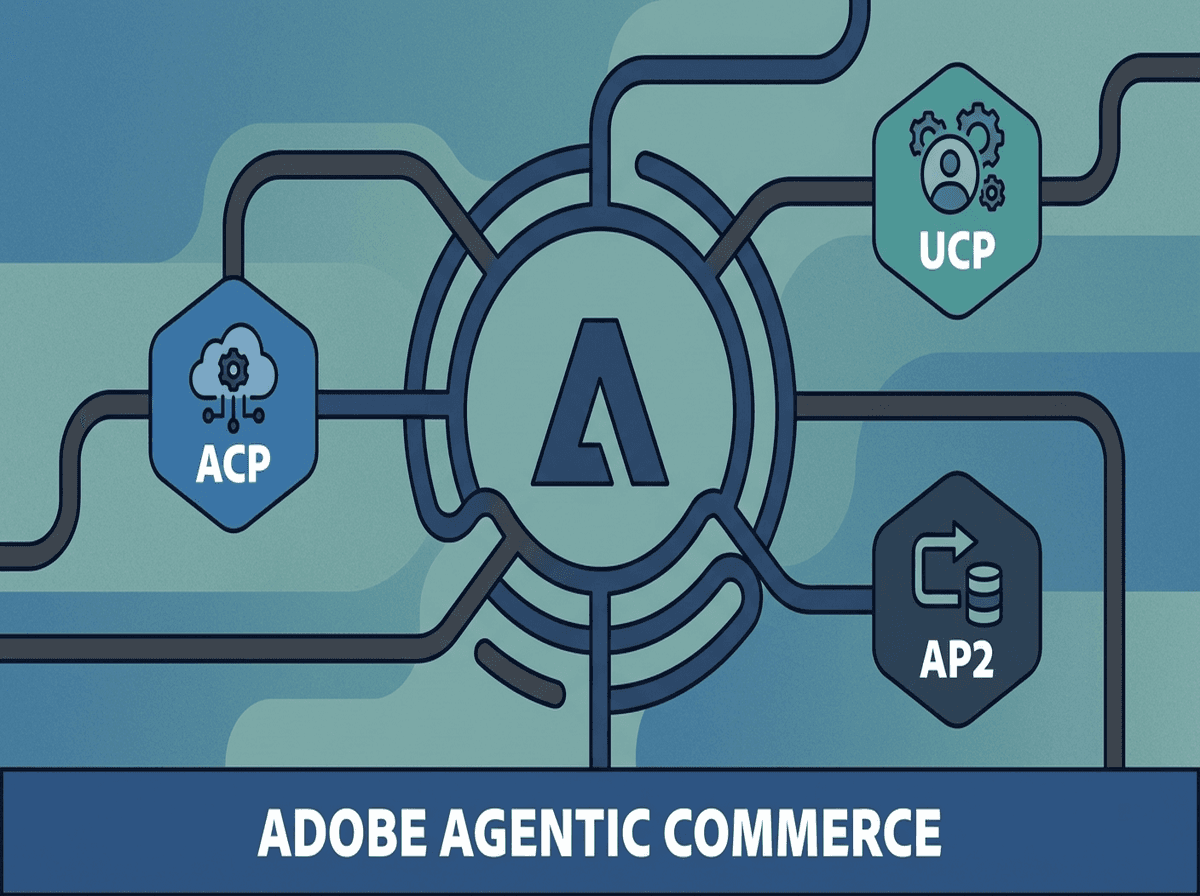
On February 18, Adobe announced that Adobe Commerce will support UCP, ACP, and the Agent Payments Protocol (AP2). That makes it the first major commerce platform to commit to all three agentic commerce standards at once.
This isn't a checkbox exercise. It's a signal that the multi-protocol future of agentic commerce is here, and platforms that don't pick a lane (or all the lanes) will lose access to an entirely new class of buyers: AI agents acting on behalf of humans.
Let's break down what each protocol does, how they differ, and what Adobe merchants should actually do about it.
The Numbers Are Already Screaming
AI-referred traffic to retail is exploding, and the shoppers it sends convert better than traditional channels.
During the 2025 holiday season, traffic to U.S. retail sites from generative AI tools rose 693% year over year (Adobe, January 2026). That's roughly 7x. The total online holiday spend hit a record $257.8 billion.
And this wasn't just tire-kicking. Adobe's Digital Insights data showed that shoppers referred from AI platforms converted at higher rates and generated more revenue per visit than those arriving through traditional channels like paid search or affiliates. In October 2025 alone, AI-referred visitors were 16% more likely to convert (Adobe, October 2025).
The message is clear: AI surfaces are becoming a real acquisition channel. The question is whether your commerce stack can transact natively inside them.
Three Protocols, Three Philosophies
UCP, ACP, and AP2 each solve different parts of the agentic commerce puzzle, from discovery to payment.
Here's where it gets interesting. There isn't one "agentic commerce protocol." There are three, built by different players with different priorities.
| UCP (Universal Commerce Protocol) | ACP (Agent Commerce Protocol) | AP2 (Agent Payments Protocol) | |
|---|---|---|---|
| Led by | OpenAI + Stripe | Google (with Visa, PayPal, others) | |
| Launched | January 2026 | September 2025 | September 2025 |
| Primary focus | Full commerce lifecycle | Agent-to-merchant checkout | Secure agent payments |
| Scope | Product Discovery, Cart Management, Identity Linking, Checkout, Order Management, Vertical Capabilities (6 capabilities) | Product search, order placement, payment processing via Stripe | Payment authorization, user intent verification, transaction security |
| Compatible with | MCP, A2A, AP2 | Stripe's payment infrastructure | UCP, MCP, A2A |
| Live with | Etsy, Wayfair in Google AI Mode (Feb 2026); Shopify, Target, Walmart integrations coming | ChatGPT Operator | Multiple payment providers |
| Best analogy | The full-stack API for commerce | The checkout bridge between AI and merchants | The trust layer for agent-led payments |
UCP is the most ambitious. It defines six capabilities spanning the entire purchase lifecycle, and Google's Vidhya Srinivasan confirmed on February 11 that Wayfair and Etsy are already live with UCP-powered checkout inside AI Mode in Google Search and the Gemini app.
ACP is narrower but already deployed. It powers purchases inside ChatGPT's Operator, letting an AI agent submit orders on a user's behalf while the merchant retains brand identity and customer ownership. Think of it as the commerce layer for OpenAI's ecosystem.
AP2 is the trust layer. It doesn't handle discovery or cart management. It handles the hard part: letting an AI agent make a payment on behalf of a user in a way that's secure, verifiable, and privacy-preserving. It works alongside UCP and plays well with MCP and A2A.
What Adobe's Move Actually Signals
By adopting all three protocols, Adobe is betting that merchants need to be present everywhere AI agents transact.
Adobe isn't picking sides, and that's the point. As Loni Stark, VP of Strategy and Product at Adobe, put it: "Brands face a dual imperative: optimizing for AI agent discoverability while deepening direct customer relationships through superior experiences."
What this means practically: Adobe Commerce merchants will be able to expose their catalogs, pricing, and inventory as machine-readable data that AI agents on Gemini, ChatGPT, and other LLM surfaces can consume natively. That's product discovery through UCP, checkout through ACP, and secure payments through AP2.
For the broader market, Adobe's move signals three things:
1. Protocol fragmentation is real, but manageable. The three protocols are complementary, not competing. UCP is the lifecycle standard. ACP is the OpenAI checkout path. AP2 is the payment security layer. Supporting all three isn't redundant; it's table stakes for full coverage.
2. The middleware opportunity is massive. Most merchants won't implement three protocols from scratch. Expect a wave of integration layers, adapters, and managed services that abstract the protocol complexity. If you're building in this space, pay attention.
3. Catalog readiness is the bottleneck. Protocols don't help if your product data isn't structured, current, and machine-readable. The real work for most retailers starts with their data layer, not their protocol layer.
What Adobe Commerce Merchants Should Do Now
Start with structured data and catalog readiness. Protocol support is coming; your data quality determines whether it matters.
Don't wait for Adobe to ship full protocol support before acting. Here's a practical sequence:
Audit your product data. AI agents need clean, structured, semantically rich product information. If your catalog has inconsistent attributes, missing descriptions, or stale inventory data, fix that first. It matters more than any protocol.
Monitor the rollout. Adobe committed to supporting these standards but hasn't shipped them yet. Watch for the Adobe Commerce release notes and developer documentation. Early adopters will have an advantage.
Think about your AI surface strategy. Where do you want AI agents to find you? Google AI Mode (UCP)? ChatGPT (ACP)? Both? Your answer shapes your integration priorities.
Don't build custom integrations. With three protocols converging, building bespoke agent integrations is a waste. Wait for the standardized implementations and invest your engineering time in data quality and personalization instead.
FAQ
Q: Do I need to support all three protocols? It depends on your reach goals. UCP gets you into Google's AI surfaces. ACP gets you into ChatGPT. AP2 handles payment security across both. For maximum coverage, yes, you'll want all three, and Adobe's commitment means you won't have to build them yourself.
Q: When will Adobe Commerce actually ship protocol support? Adobe announced the commitment on February 18, 2026, but hasn't given a specific ship date. Based on their typical release cadence, expect developer previews in the coming months. The Digital Commerce 360 coverage from February 23 suggests they're already making catalogs machine-readable.
Q: Will this work for Magento Open Source, or just Adobe Commerce? The announcement specifically covers Adobe Commerce. Magento Open Source users will likely need community extensions or third-party solutions, though the open nature of UCP means anyone can implement it.
Related: Anthropic's MCP donation to Linux Foundation
Q: How is this different from traditional SEO or marketplace listings? Traditional SEO optimizes for human search behavior. Agentic commerce protocols optimize for AI agent behavior. The agent doesn't browse your website; it queries your catalog programmatically, adds items to a cart, and completes checkout, all without a human ever visiting your storefront. It's a fundamentally different channel.
Q: What about Shopify? Are they doing the same thing? Shopify was a co-developer of UCP alongside Google, and already provides MCP tools that are UCP-compliant. They're arguably ahead on protocol support. Adobe's move closes the gap and brings these standards to the enterprise commerce segment.
How AI-ready are your products?
Check how ChatGPT, Google AI, and Perplexity evaluate any product page. Free score in 30 seconds.


