The Retailer's Guide to Agentic Commerce
- Author
- By Dor
- Publication date
- Published
- Last updated
- Updated
- Reading time
- 7 min read
Executive Summary
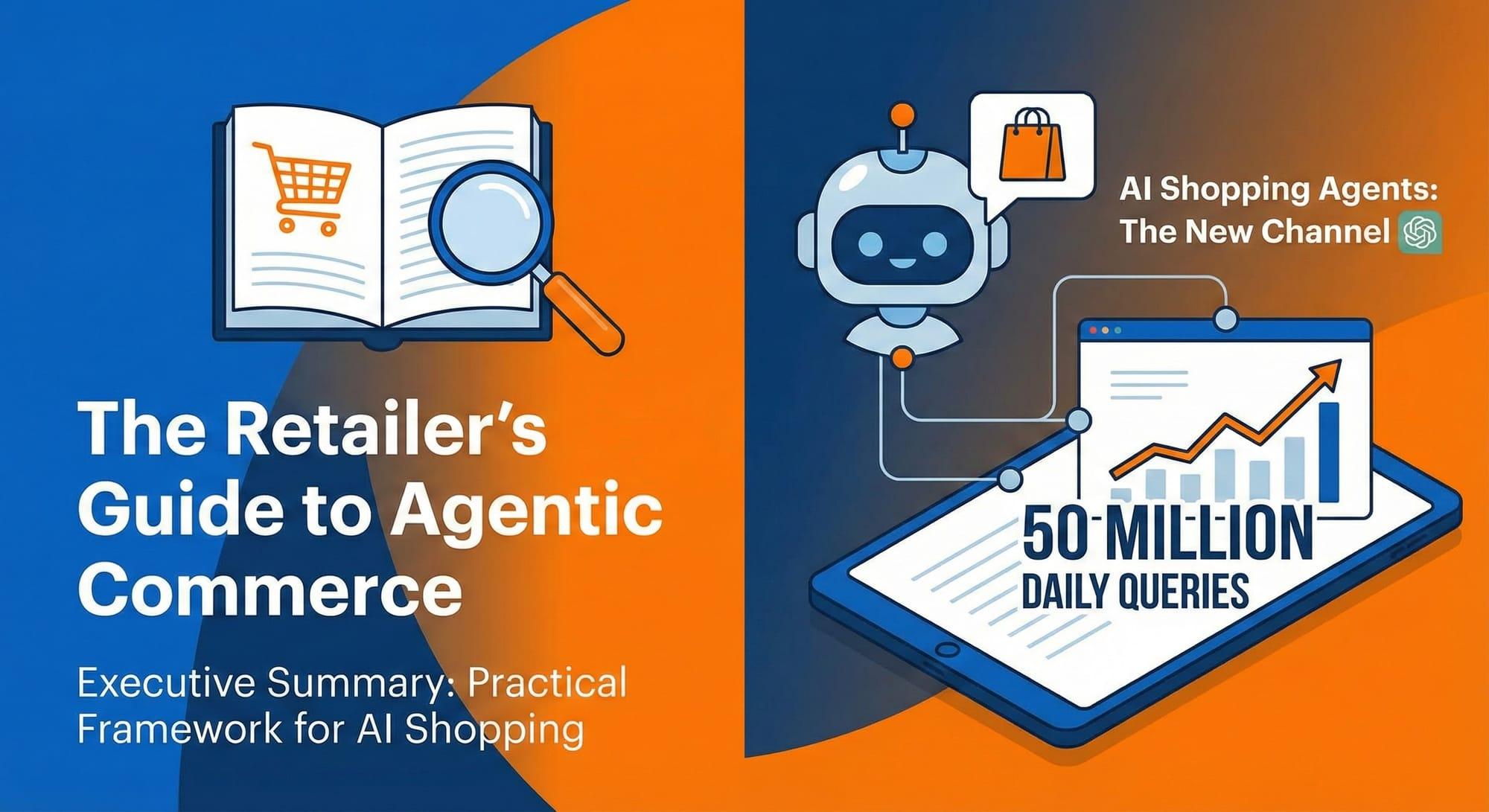
AI shopping agents are no longer a future consideration-they're processing 50 million shopping queries daily on ChatGPT alone. This guide provides retail executives and e-commerce leaders with a practical framework for capturing this emerging channel.
You'll learn:
- What agentic commerce is and why it matters now
- The three strategic approaches retailers are taking
- Protocol landscape and which integrations to prioritize
- Implementation roadmap from zero to live in weeks
- Success metrics and optimization strategies
Bottom Line: Retailers with AI agent integration are seeing 7x better sales growth than those without. The time to act is now.
Part 1: Understanding Agentic Commerce
What Is Agentic Commerce?
Agentic commerce refers to AI systems that autonomously:
- Research products based on user intent
- Recommend specific items with reasoning
- Execute purchases with minimal human intervention
- Manage post-purchase activities (tracking, returns, reorders)
Unlike traditional search, AI agents don't just show results-they make decisions. A consumer asking ChatGPT "I need running shoes for my marathon training, budget $150" receives a specific recommendation, not a list of links.
Why It Matters Now
Three converging factors have created urgency:
1. Consumer Adoption Has Hit Critical Mass
- 61% of consumers have used AI for shopping (3x vs. 2024)
- 66% of frequent shoppers use AI assistants regularly
- Shopping queries on ChatGPT doubled in first half of 2025
2. Platform Infrastructure Is Ready
- ChatGPT Instant Checkout live with major retailers
- Perplexity achieving 92% conversion rates
- Amazon Rufus integrated across 250M users
3. Protocol Standards Are Emerging
- ACP (Stripe/OpenAI) in production
- MCP approaching 90% enterprise adoption
- Linux Foundation unifying standards via AAIF
The Stakes
The data on retailer outcomes is stark:
| Metric | With AI Integration | Without AI Integration |
|---|---|---|
| Sales Growth | 13% | 2% |
| AI Traffic Growth | 7x baseline | Minimal |
| AI Order Growth | 11x baseline | Minimal |
| Conversion Rate | +100% (Rufus) | Baseline |
Source: Shopify, Amazon, Salesforce 2025 data
Part 2: Three Strategic Approaches
Retailers are pursuing three distinct strategies. Each has tradeoffs.
Strategy 1: Build (Proprietary)
Example: Albertsons
Albertsons built a proprietary AI shopping assistant that reduced average shopping time from 46 minutes to 4 minutes. The system uses Nvidia AI infrastructure and integrates deeply with their loyalty program, inventory systems, and fulfillment operations.
Pros:
- Complete control over customer experience
- Deep integration with proprietary data
- Competitive differentiation
Cons:
- Significant engineering investment ($10M+)
- Long development timeline (12-18 months)
- Ongoing maintenance burden
- Limited to owned properties
Best For: Large retailers with engineering resources, unique customer data assets, and desire for maximum differentiation.
Strategy 2: Partner (Platform Integration)
Example: Instacart + ChatGPT
Instacart partnered with OpenAI to enable grocery shopping directly within ChatGPT. Consumers can browse, build carts, and checkout without leaving the conversation-powered by Instacart's network of 1,800+ retailers.
Pros:
- Faster time to market (weeks vs. months)
- Access to established user base
- Reduced technical complexity
- Platform handles protocol evolution
Cons:
- Less control over experience
- Platform fees and revenue share
- Dependence on partner roadmap
- Brand visibility challenges
Best For: Mid-market retailers seeking speed, specialty retailers without engineering resources, brands prioritizing reach over control.
Strategy 3: Hybrid (Both Channels)
Example: Walmart
Walmart operates both Sparky (proprietary AI assistant on walmart.com) and integration with ChatGPT's shopping features. This captures customers regardless of their entry point while maintaining a differentiated owned experience.
Pros:
- Maximum market coverage
- Owned and partnered channels
- Flexibility as market evolves
- Multiple data sources
Cons:
- Higher total investment
- Potential experience fragmentation
- Complex inventory synchronization
- Multiple integrations to maintain
Best For: Large omnichannel retailers with resources to support both approaches and desire for market leadership.
Decision Framework
| Factor | Build | Partner | Hybrid |
|---|---|---|---|
| Time to Market | 12-18 months | 2-4 weeks | 3-6 months |
| Initial Investment | $10M+ | $50K-500K | $2-5M |
| Engineering Team | 10+ dedicated | 1-2 integration | 5-10 mixed |
| Control Level | Complete | Limited | Moderate |
| Scale Ceiling | Owned traffic | Platform reach | Maximum |
Part 3: The Protocol Landscape
Understanding Your Options
Three protocols dominate the current landscape:
Agentic Commerce Protocol (ACP)
Developed by Stripe and OpenAI, ACP is the most commercially mature protocol:
- Live Integrations: Etsy (all U.S. sellers), Target (multi-item carts), Walmart (groceries)
- Coming Soon: 1M+ Shopify merchants
- Ecosystem Partners: PayPal, Worldpay, commercetools, Salesforce
- Key Capability: End-to-end checkout within ChatGPT
Agent-to-Agent Protocol (AP2)
Google's protocol focuses on payment network integration:
- Ecosystem: 60+ organizations building
- Focus: Multi-vendor commerce, payment orchestration
- Partners: Visa TAP, major payment networks
- Key Capability: Cross-platform agent communication
Model Context Protocol (MCP)
Anthropic's protocol has achieved widespread enterprise adoption:
- Adoption: 97M+ monthly SDK downloads
- Governance: Now under Linux Foundation via AAIF
- Key Capability: Standardized AI-to-system connectivity
Protocol Prioritization
For most retailers, we recommend this prioritization:
Priority 1: ACP
- Largest immediate opportunity (ChatGPT shopping)
- Production-ready with proven integrations
- Clear path via Shopify or direct integration
Priority 2: MCP
- Enterprise standard for AI connectivity
- Broad platform support
- Foundation for multiple AI agents
Priority 3: AP2
- Watch and prepare
- Important for Google ecosystem
- Less immediate commercial application
The Multi-Protocol Imperative
Betting on a single protocol is risky. The market will likely remain fragmented for 3-5 years, and consumers use multiple AI platforms:
- ChatGPT users also use Perplexity (30% overlap)
- Claude and Gemini growing in shopping use cases
- Enterprise buyers may require MCP compliance
A middleware approach that abstracts protocol complexity while enabling multi-platform reach is optimal for most retailers.
Part 4: Implementation Roadmap
Phase 1: Foundation (Weeks 1-2)
Catalog Preparation
Your product data is the foundation. AI agents require:
| Attribute | Traditional SEO | AI Optimization |
|---|---|---|
| Title | Keyword-focused | Natural language queries |
| Description | Feature lists | Conversational, use-case driven |
| Attributes | Basic specs | Rich, semantic attributes |
| Images | Product shots | Multi-angle, context images |
| Inventory | Daily sync | Real-time accuracy |
Action Items:
- Audit product data completeness
- Identify attribute gaps
- Establish real-time inventory feeds
- Review description quality
Phase 2: Integration (Weeks 2-3)
Platform Connection
Connect your commerce platform to AI agent infrastructure:
If Shopify:
- Enable ChatGPT shopping integration
- Configure product feed sync
- Set up express checkout
If Other Platform:
- Implement ACP endpoints
- Configure product discovery APIs
- Establish checkout flow integration
Key Technical Requirements:
- Product catalog API
- Real-time inventory
- Cart management
- Payment tokenization
- Order webhook handling
Phase 3: Optimization (Weeks 3-4)
AI-Specific Enhancements
Optimize for how AI agents query and recommend:
Query Optimization:
- Map common shopping queries to products
- Add semantic keywords naturally
- Include use cases and scenarios
- Specify compatibility and alternatives
Recommendation Optimization:
- Ensure complete attribute coverage
- Add comparison data points
- Include social proof signals
- Specify ideal customer profiles
Phase 4: Launch & Learn (Week 4+)
Go-Live Checklist:
- Product feed syncing correctly
- Checkout flow tested end-to-end
- Inventory accuracy verified
- Payment processing confirmed
- Order fulfillment integrated
- Analytics tracking configured
Post-Launch:
- Monitor AI-attributed traffic
- Track conversion by AI source
- Identify top-performing products
- Iterate based on query data
Part 5: Success Metrics
Leading Indicators
Track these metrics weekly during initial rollout:
| Metric | Target | Measurement |
|---|---|---|
| AI Traffic Share | >1% of total | GA4 referral tracking |
| AI Sessions | Week-over-week growth | Platform analytics |
| Product Coverage | 100% of catalog | Feed sync reports |
| Inventory Accuracy | >99% | Sync error rates |
| Response Time | <200ms | API monitoring |
Lagging Indicators
These metrics indicate commercial success:
| Metric | Benchmark | Best-in-Class |
|---|---|---|
| AI Conversion Rate | Match site average | +38% vs. average |
| AI Revenue Share | 1-2% in 6 months | 5%+ in 12 months |
| Average Order Value | Match baseline | +10-20% (AI users) |
| Return Rate | Same as baseline | Lower (better matching) |
| Customer LTV | Baseline | Higher (AI discovery) |
Attribution Setup
Properly attributing AI-driven sales requires:
- UTM Parameters: Configure AI platforms to pass attribution
- Referral Tracking: Identify traffic from chat.openai.com, perplexity.ai, etc.
- Conversion Events: Track checkout completions by source
- Order Tagging: Flag orders originating from AI channels
Part 6: Common Pitfalls
Pitfall 1: Treating AI Like Traditional SEO
Mistake: Keyword-stuffing product descriptions
Reality: AI agents understand context and penalize manipulation
Solution: Write naturally for how humans describe needs
Pitfall 2: Incomplete Product Data
Mistake: Assuming existing catalog data is sufficient
Reality: AI agents need rich attributes to make recommendations
Solution: Audit and enhance data completeness before launch
Pitfall 3: Ignoring Inventory Accuracy
Mistake: Daily or weekly inventory syncs
Reality: AI agents recommend out-of-stock products = broken trust
Solution: Real-time inventory feeds or conservative buffer
Pitfall 4: Single Platform Focus
Mistake: Building only for ChatGPT
Reality: Consumers use multiple AI platforms
Solution: Multi-protocol architecture from day one
Pitfall 5: No Attribution Strategy
Mistake: Launching without tracking infrastructure
Reality: Can't prove ROI or optimize without data
Solution: Configure attribution before go-live
Part 7: Future Outlook
2025: Foundation Year
- Protocol standards mature
- Major retailers launch integrations
- Consumer adoption accelerates
- Attribution methods improve
2026: Acceleration Year
- AI handles 20% of e-commerce tasks
- Multi-protocol becomes standard
- Voice commerce integration
- Autonomous reordering scales
2027-2030: Transformation
- $300-500B in AI-influenced U.S. commerce
- 15-25% of e-commerce through AI agents
- Full checkout autonomy for trusted purchases
- AI agents negotiate on consumer behalf
The Competitive Window
The current moment represents a rare opportunity. Retailers who establish AI presence now will:
- Build brand recognition with AI agents
- Accumulate performance data
- Iterate while stakes are lower
- Be positioned for acceleration
Those who wait will face:
- Crowded, competitive landscape
- Higher customer acquisition costs
- Established competitor advantages
- Steeper learning curves
Conclusion: Your Next Steps
Agentic commerce isn't coming-it's here. The 7x sales advantage for AI-integrated retailers, the $67 billion in AI-influenced Cyber Week sales, and the 805% traffic growth are data points from the past quarter, not projections.
Immediate Actions:
- This Week: Audit your product data readiness
- This Month: Choose build/partner/hybrid strategy
- This Quarter: Launch initial AI platform integration
- This Year: Achieve multi-protocol coverage
The retailers who act decisively will capture disproportionate share of the fastest-growing commerce channel in a generation.
About Paz.ai
Paz.ai is the agentic commerce platform that gets your catalog AI-ready in weeks, not months. Our platform:
- Connects to your existing commerce platform
- Optimizes product data for AI discovery
- Distributes across all major AI shopping agents
- Tracks performance with detailed analytics
Go live in 2 weeks. No engineering required.
Appendix: Resource Library
Protocol Documentation
- ACP - OpenAI Developer Documentation
- MCP - Anthropic Model Context Protocol
- AP2 - Google Agent-to-Agent Protocol
Industry Research
- McKinsey - The Future of Agentic Commerce
- Bain & Company - How Agentic AI Will Reshape US Retail
- Morgan Stanley - Agentic Commerce Market Impact
- CB Insights - The Agentic Commerce Market Map
- Mordor Intelligence - Agentic AI in Retail Market
- Digital Commerce 360 - How AI Shopping Agents Are Rewiring Retail
Platform Guides
- Shopify - ChatGPT Shopping Integration
- Salesforce - Agentforce Commerce
- Adobe - AI Commerce Capabilities
Additional Sources
- eMarketer - AI Shopping Tools Gain Traction
- Business of Fashion - AI's Transformation of Online Shopping
- Criteo - Agentic Commerce Is Emerging
- Ignitiv - How Agentic AI Will Reshape Commerce in 2026
Related: Visa, Mastercard, and PayPal
This guide was prepared by Paz.ai based on publicly available data, industry research, and direct experience implementing agentic commerce solutions.
How AI-ready are your products?
Check how ChatGPT, Google AI, and Perplexity evaluate any product page. Free score in 30 seconds.