From Groceries to Everything: What DoorDash's AI Expansion Plans Mean for Local Commerce
- Author
- By Dor
- Publication date
- Published
- Last updated
- Updated
- Reading time
- 6 min read
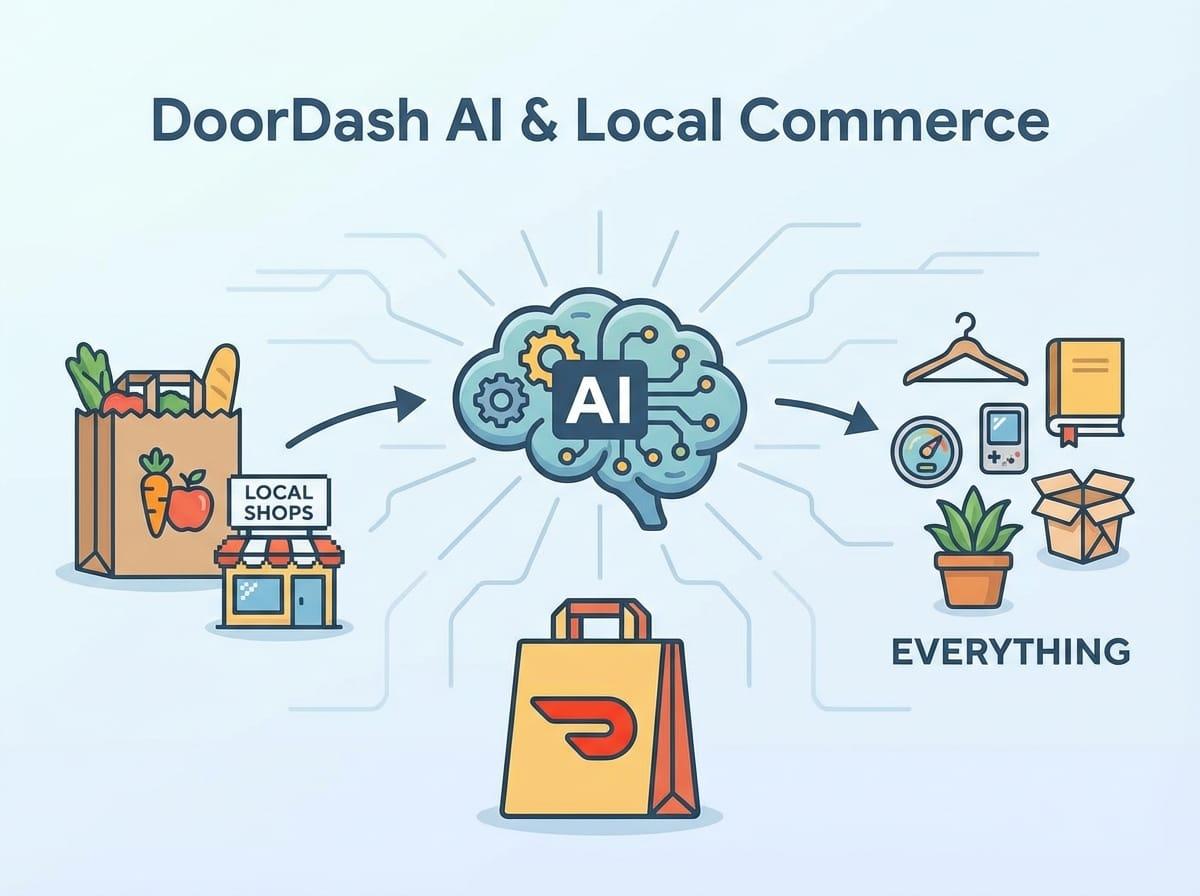
Key finding: DoorDash has evolved from food delivery to a comprehensive on-demand platform, now offering retail, alcohol, and convenience items. Their AI-powered logistics network and consumer behavior data position them to compete with Amazon and other e-commerce giants across multiple verticals.
TL;DR: DoorDash launched its ChatGPT app on December 17, 2025, creating a branded storefront inside ChatGPT powered by MCP. The company plans to expand "beyond groceries to more local categories." Restaurants, alcohol, and convenience stores are the logical next verticals. Local merchants have a narrow window to prepare their catalogs for conversational commerce before DoorDash becomes the default discovery channel.
The race to become the AI-powered local commerce hub just accelerated. On December 17, 2025, DoorDash launched its ChatGPT app, a branded storefront inside ChatGPT powered by the Model Context Protocol (MCP). Users can now discover recipes, convert ingredients into shoppable lists, and order from local stores in under an hour.
"As we expand this experience to more shopping categories, our focus is on building AI tools that give people time back and make local shopping easier," said Andy Fang, DoorDash Co-founder, in the company's official announcement.
That single sentence signals a strategic pivot that should have every local merchant paying attention.
What Did DoorDash Actually Announce?
DoorDash's ChatGPT app launched on December 17, 2025, making it the second major grocery player (after Instacart) to establish a branded storefront inside OpenAI's conversational interface.
What is a ChatGPT app? Think of it as a storefront inside ChatGPT. Powered by MCP (Model Context Protocol), these apps give brands a dedicated presence within the AI assistant. When users enable DoorDash in their ChatGPT settings, they're adding DoorDash as a trusted commerce partner that ChatGPT can call on to fulfill shopping requests.
Here's how it works:
- Users enable DoorDash in ChatGPT account settings
- Ask for recipe suggestions tailored to preferences
- ChatGPT converts ingredients into a shoppable grocery list
- Complete checkout on the DoorDash app with delivery in under an hour
Unlike Instacart's integration with full embedded checkout, DoorDash's experience requires users to transition to the DoorDash app to complete purchases. But this distinction matters less than the strategic direction. DoorDash is positioning its ChatGPT app as a discovery channel that catches consumers "at the moment they're deciding to make a meal."
The bigger picture: ChatGPT apps represent an entirely new sales channel. Just as brands rushed to build mobile apps and Shopify stores, the next frontier is establishing presence inside AI assistants. DoorDash now has a storefront where 300+ million weekly active ChatGPT users can discover and order through natural conversation.
Which Verticals Are Next?
DoorDash's announcement explicitly states plans to expand "beyond groceries to more local categories." Their existing platform makes the expansion roadmap clear.
Restaurants remain DoorDash's core business. AI-powered restaurant ordering is a natural extension. At their Dash Forward 2025 event, the company unveiled AI-powered recommendations that "tailor suggestions to consumer tastes and past orders," currently live in San Francisco and Manhattan.
Alcohol is already scaled: 31 US states plus DC have alcohol delivery enabled, with nearly 50% growth in liquor stores on DoorDash Marketplace in 2024. The conversational commerce use case is obvious: "I'm hosting a cocktail party. What should I serve?" ChatGPT suggests cocktails and surfaces local liquor stores with delivery.
Convenience stores already partner with DoorDash for on-demand delivery. Conversational AI makes impulse purchases frictionless: "I need batteries and snacks for movie night" becomes a 30-minute delivery.
What Local Merchants Should Prepare Right Now
Here's the uncomfortable truth: most local merchants are not ready for conversational commerce discovery.
When a consumer asks ChatGPT "What's a good Thai restaurant near me for a Tuesday dinner?" the AI evaluates different factors than Google Search:
- Rich, conversational product descriptions (not keyword-stuffed titles)
- Real-time availability and pricing
- Menu items described in natural language
"AI is unlocking an entirely new search and discovery experience for consumers that's dynamic and personalized." — Andy Fang, Co-founder, DoorDash
Most retailers lack infrastructure to optimize catalogs for AI discovery while supporting multiple platforms. This is precisely what Paz.ai addresses: transforming existing retail catalogs into AI-ready storefronts across ChatGPT, Perplexity, Google AI Mode, and emerging platforms.
1. Audit Your Catalog for Conversational Discovery
Traditional e-commerce catalogs optimize for keyword search. Conversational AI needs context.
Before: "Pad Thai - $14.99"
After: "Classic Pad Thai - rice noodles stir-fried with tamarind sauce, egg, bean sprouts, and crushed peanuts. Mild spice level, vegetarian-friendly with tofu option. Serves one, ready in 25 minutes."
For merchants with thousands of SKUs, manually rewriting descriptions isn't realistic. Paz.ai uses AI to automatically enhance product descriptions for conversational discovery, filling missing attributes and optimizing language for how AI agents search and recommend products.
2. Launch Your Own ChatGPT App
DoorDash's ChatGPT app isn't magic reserved for billion-dollar platforms. Any retailer can create a branded storefront inside ChatGPT using MCP.
Paz.ai enables retailers to generate their own ChatGPT apps in a few clicks, creating a fully customizable storefront inside the AI assistant. Instead of hoping ChatGPT recommends your products through a third-party aggregator like DoorDash, you can have your own branded app that users enable directly. Your inventory, your branding, your customer relationship.
3. Prepare for Multi-Platform AI Discovery
The AI commerce landscape now includes:
- ChatGPT: 50 million shopping queries daily
- Perplexity: 52.5% market share of agentic traffic
- Google AI Mode: Agentic checkout with Wayfair, Chewy, and Quince
Each platform has its own protocol requirements: OpenAI's Agentic Commerce Protocol (ACP) for product feeds, MCP for ChatGPT apps, and Google's AP2. Paz.ai solves this by ingesting your catalog once and automatically generating compliant feeds for each platform, plus deploying your own ChatGPT app as an additional direct sales channel.
Key Stat: AI-driven traffic grew 805% year-over-year on Black Friday 2025, and shoppers arriving via AI were 38% more likely to complete purchases. Source: Adobe Analytics
How DoorDash Positions as a Local Commerce Hub
DoorDash's multi-year strategy becomes clear when you connect the dots:
| Investment | Purpose |
|---|---|
| Grocery expansion | Capture more share of wallet beyond restaurants |
| ChatGPT app (MCP) | Own a branded storefront inside the AI assistant |
| AI-powered recommendations | Personalize suggestions across all verticals |
| "Beyond groceries" expansion | Become the default local commerce layer |
Competitive landscape:
- Instacart: Grocery depth (1,800+ retailers), full ChatGPT checkout, but limited restaurant/retail coverage
- Uber Eats: Global restaurant scale, but no announced AI agent integrations
- Amazon: Alexa+ shopping, Rufus assistant, but blocking external AI crawlers
- DoorDash: Multi-vertical local commerce with ChatGPT app live
DoorDash's bet is that owning a branded storefront inside ChatGPT across multiple categories creates a moat single-vertical players can't match.
The Broader Implications for Agentic Commerce
ChatGPT Apps Are the New Storefronts
Just as the 2010s saw brands rush to build mobile apps and the late 2010s saw Shopify storefronts rise, the 2020s will be defined by AI storefronts. DoorDash's ChatGPT app is an early example of what every consumer brand will eventually need: a branded presence inside AI assistants where conversations convert to transactions.
The difference from previous platform shifts? The barrier to entry is lower. Building a mobile app required significant development resources. Launching a ChatGPT app through Paz.ai takes clicks, not months.
The Window Is Closing
Retailers with AI agents saw 7x higher sales growth (13% vs 2%) during Cyber Week 2025 compared to those without, according to Salesforce data.
"2025 will likely be the last year consumers shop as they do now." — SAP Emarsys
DoorDash's expansion "to more shopping categories" will happen in 2026. Merchants who wait will be preparing catalogs while competitors capture market share.
Frequently Asked Questions
What is a ChatGPT app? A branded storefront inside ChatGPT, powered by MCP. When users enable a brand's app, they're adding it as a trusted commerce partner the AI can call on to fulfill requests.
Can any retailer launch a ChatGPT app like DoorDash? Yes. Paz.ai enables merchants to generate fully customizable ChatGPT apps in a few clicks, creating a direct sales channel inside AI assistants rather than relying solely on aggregators.
What is agentic commerce? AI agents autonomously browsing, comparing, and purchasing products on behalf of consumers, executing complete transactions from discovery through checkout.
The Bottom Line
DoorDash's ChatGPT app is a grocery play today and a local commerce platform play tomorrow. By launching a branded storefront inside ChatGPT powered by MCP, DoorDash has established direct presence where 300+ million users have conversations that lead to purchases.
For local merchants, the strategic question isn't whether to prepare for AI commerce. It's whether you'll be ready before DoorDash's expansion reaches your category, and whether you'll rely solely on aggregators or establish your own direct presence in AI assistants.
Start by auditing your product catalog for conversational discovery. For merchants who want to move faster, Paz.ai provides the infrastructure to transform existing catalogs into AI-ready storefronts and launch your own ChatGPT app in clicks, not months.
The 805% year-over-year growth in AI traffic isn't slowing down. Neither is DoorDash's ambition to own local commerce discovery. The window to prepare is now.
Related: Instacart's ChatGPT checkout
Sources:
How AI-ready are your products?
Check how ChatGPT, Google AI, and Perplexity evaluate any product page. Free score in 30 seconds.