Amazon's Buy for Me Controversy: Why Retailers Are Losing Control of Their Catalogs
- Author
- By Dor
- Publication date
- Published
- Last updated
- Updated
- Reading time
- 8 min read
Key finding: Amazon quietly removed its "Buy for Me" feature after user backlash over AI-powered gift suggestions that missed personal context. The feature used customer data to recommend purchases but failed to understand emotional nuance and relationship dynamics, highlighting current limitations in AI personalization.
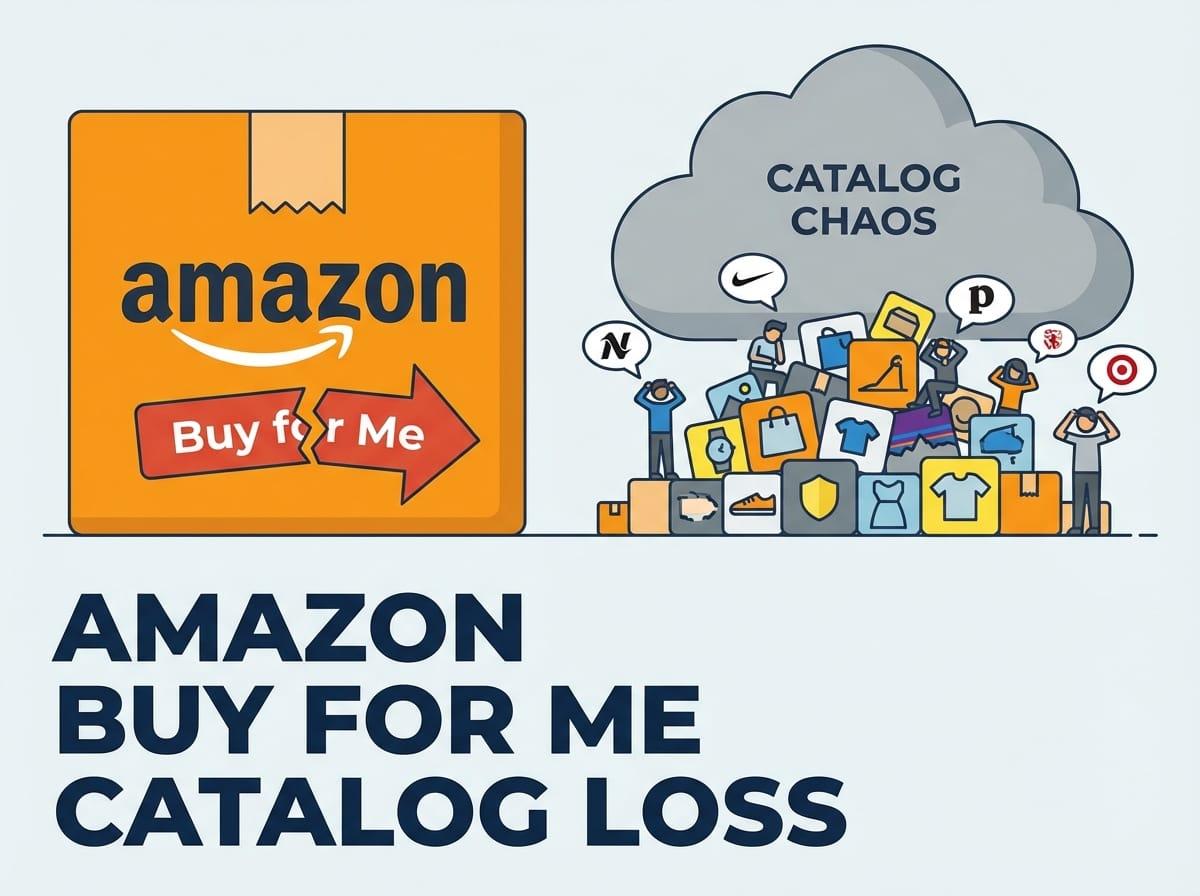
TL;DR: Amazon's "Buy for Me" feature lists products from third-party websites without merchant permission, turning independent brands into unwitting fulfillment partners. This controversy highlights a fundamental divide in agentic commerce: walled-garden approaches that scrape and sell versus open protocols that require merchant consent.
Angie Chua, founder of stationery brand Bobo Design Studio, discovered something unsettling in late December: orders flooding in from an address she had never authorized, for products she had never agreed to sell. The email address was buyforme.amazon. Her products were being sold on Amazon's platform. She had never opted in. She had never been asked. And when she checked, one of her vinyl stickers was displayed with a photo of pants she had never sold.
What Is Amazon's Buy for Me Feature?
Amazon's "Buy for Me" is an AI-powered tool within the Alexa+ ecosystem that allows customers to purchase products from third-party websites directly through Amazon's interface. When a customer searches for something not available in Amazon's main catalog, the AI can find it on an independent retailer's website and complete the purchase on the customer's behalf.
The feature grew rapidly. According to Amazon's November 2025 announcement, products available through Buy for Me increased from 65,000 at launch to over 500,000. Amazon reports that Alexa+ users complete 3x more on-device purchases compared to classic Alexa users.
The problem? Merchants never consented.
📊 KEY STAT: Over 180 brands reported believing their products were listed without permission, according to surveys and reports tracking the controversy through early January 2026.
How the Controversy Unfolded
Most merchants learned about their unauthorized listings the same way: through a viral Instagram video. On December 28, Chua posted about her experience, which garnered nearly 16,000 likes. Other business owners searched Amazon for their brands and discovered they too had been listed without permission.
The complaints poured in from brands using Shopify, WooCommerce, and Squarespace.
Amanda Stewart, founder of children's clothing brand Mochi Kids, told Modern Retail: "We've not wanted to sell on Amazon on purpose, and so seeing our stuff on there was surprising and very frustrating."
Emi Moon, founder of Peachie Kei, raised reputational concerns: "The big issue is that it's a reputational thing. I don't want to be associated with Amazon."
Chelsea Ward of Sketchy Notions summarized the frustration: "It's just another level of stress that none of us small businesses need."
| Issue | Impact |
|---|---|
| No opt-in required | Brands appear on Amazon without consent |
| Product errors | Wrong images, incorrect descriptions |
| Out-of-stock orders | Customers order items no longer available |
| Pricing discrepancies | AI may not reflect current promotions |
| Customer service burden | Orders don't sync, creating support headaches |
| Tax liability concerns | Unexpected wholesale purchase obligations |
The Hypocrisy Problem
The controversy takes on sharper edges when you consider Amazon's own legal strategy. In November 2025, Amazon filed a lawsuit against Perplexity AI in the U.S. District Court for the Northern District of California. The allegation? That Perplexity's Comet browser deployed agents that "concealed" themselves to scrape Amazon's website and make purchases without approval.
Perplexity called the lawsuit a "bully tactic."
From the perspective of small merchants, Amazon appears to be doing exactly what it accuses others of doing, only at a much larger scale. The company that built a legal case around unauthorized scraping is now scraping third-party websites to populate its own AI shopping feature.
"They just opted us into this program that we had no idea existed and essentially turned us into drop shippers for them, against our will." — Angie Chua, CEO, Bobo Design Studio
Amazon's response? A spokesperson told CNBC: "'Shop Direct' and 'Buy For Me' are programs we're testing that help customers discover brands and products not currently sold in Amazon's store, while helping businesses reach new customers and drive incremental sales. Businesses can opt out at any time by emailing branddirect@amazon.com, and we remove them from these programs promptly."
Opt out. Not opt in. That is the battle line for agentic commerce.
Walled Gardens vs. Open Protocols: Two Visions for Agentic Commerce
The Buy for Me controversy is not just about Amazon. It is a preview of a fundamental schism in how agentic commerce will develop: walled-garden approaches that prioritize platform control versus open protocol approaches that prioritize merchant consent.
The Walled-Garden Model
Amazon's approach places the platform at the center of the customer relationship. The AI agent scrapes product data from merchant websites, presents it within Amazon's interface, and processes payments through Amazon's system. The merchant becomes a fulfillment partner, whether they agreed to it or not.
The benefits to Amazon are obvious:
- Expand product selection without inventory risk
- Capture transaction fees
- Keep customers within the Amazon ecosystem
- Leverage AI to intermediate every purchase
The cost to merchants:
- Loss of brand control
- Customer relationship mediated by Amazon
- Pricing and inventory errors reflect poorly on the brand
- No negotiating power once listed
The Open Protocol Model
The alternative is emerging through protocols like ACP (Agentic Commerce Protocol), UCP (Universal Commerce Protocol), and Shopify's Checkout Kit. These systems require merchants to explicitly integrate, meaning products only appear in AI shopping experiences when brands have consented.
ACP, developed by Stripe and OpenAI, powers ChatGPT Instant Checkout. Merchants must implement ACP endpoints to participate. The protocol explicitly preserves merchant control over product availability, pricing strategies, and transaction acceptance.
UCP, launched by Google at NRF 2026, was co-developed with Shopify, Etsy, Wayfair, Target, and Walmart. Sundar Pichai emphasized in his keynote: "The retailer remains the merchant of record, allowing them to own and shape the customer relationship."
Shopify's response to the controversy was swift. The platform quietly added default language to its robots.txt file across all storefronts: "Robots & Agent Policy – Checkouts are for humans. Automated scraping, 'buy-for-me' agents, or any end-to-end flow that completes payment without a final review step is not permitted."
| Aspect | Walled Garden (Amazon) | Open Protocols (ACP/UCP) |
|---|---|---|
| Consent | Opt-out required | Opt-in required |
| Merchant control | Limited | Full |
| Brand relationship | Mediated by platform | Direct |
| Pricing control | Platform may override | Merchant sets |
| Data ownership | Platform captures | Merchant retains |
Retailers evaluating their agentic commerce strategy need infrastructure that supports consent-based protocols. Paz.ai helps merchants integrate with ACP, UCP, and MCP without rebuilding their commerce stack, ensuring products appear only where brands have authorized them.
What This Means for Retailers
The agentic commerce market is accelerating rapidly.
📊 KEY STAT: Morgan Stanley projects agentic commerce could reach $385 billion by 2030 in their bull case scenario. The decisions retailers make today will determine their position in that market.
The question for every retailer: Which side of the consent divide do you want to be on?
If you do nothing, your products may appear in agentic shopping experiences without your knowledge. Amazon's Buy for Me is the first high-profile example, but it will not be the last. Any AI agent can scrape publicly available product pages and attempt to complete purchases.
If you choose open protocols, you maintain control. ACP, UCP, and similar standards require merchant integration. Your products appear in ChatGPT, Google's AI Mode, Microsoft Copilot, and other platforms only when you have configured your systems to support them.
The competitive advantage goes to retailers who participate intentionally, not those who are scraped passively.
Protecting Your Brand in the Agentic Era
For retailers concerned about unauthorized listings, here are immediate actions:
1. Audit your presence Search for your brand on Amazon and check whether products appear through Buy for Me. Search your own domain on ChatGPT, Perplexity, and Google's AI Mode to see how your products are being surfaced.
2. Update your robots.txt Follow Shopify's lead. Add explicit language prohibiting unauthorized scraping and automated checkout flows. While robots.txt is advisory rather than legally binding, it establishes clear intent.
3. Opt out of unauthorized programs If your products appear on Amazon's Buy for Me without consent, email branddirect@amazon.com to request removal. Document everything.
4. Evaluate open protocol adoption Review ACP, UCP, and platform-specific integrations like Shopify's Agentic Storefronts. These allow you to participate in AI commerce on your terms.
5. Structure your product data for AI Whether you participate in open protocols or not, AI agents will increasingly influence product discovery. Ensure your product descriptions, images, and metadata are optimized for conversational commerce.
Need help implementing consent-based AI commerce? Paz.ai provides the infrastructure to make your products AI-discoverable through open protocols while maintaining full control over where and how they appear.
The Bigger Picture: Who Controls the Customer Relationship?
The Buy for Me controversy is ultimately about intermediation. When AI agents sit between consumers and merchants, who owns the customer relationship?
In the walled-garden model, the platform owns it. The merchant becomes a supplier, fulfilling orders that the platform generates. This is the model that turned many brands into Amazon third-party sellers, competing on price within Amazon's marketplace while Amazon captured the customer data.
In the open protocol model, the merchant retains ownership. AI agents facilitate discovery and checkout, but the brand controls the experience. The merchant is the merchant of record. The customer relationship remains direct.
"2025 will likely be the last year consumers shop as they do now." — SAP Emarsys
How that shopping evolves depends on decisions being made right now. Will agentic commerce be a system where AI agents work for consumers while respecting merchant consent? Or will it be a system where dominant platforms scrape, list, and intermediate without permission?
The controversy over buyforme.amazon is the first battle in a much larger war.
Frequently Asked Questions
What is Amazon's Buy for Me feature?
Buy for Me is an AI-powered shopping tool within Amazon's Alexa+ ecosystem. It allows customers to purchase products from third-party websites directly through Amazon's interface, even when those products are not available in Amazon's main catalog. The AI scrapes merchant websites, presents products to customers, and completes purchases on their behalf.
How do I opt out of Amazon Buy for Me?
Merchants can request removal by emailing branddirect@amazon.com. Amazon claims removal happens promptly, though the default is opt-out rather than opt-in, meaning products may appear without prior consent.
What are ACP and UCP?
ACP (Agentic Commerce Protocol) is an open standard developed by Stripe and OpenAI that powers ChatGPT Instant Checkout. UCP (Universal Commerce Protocol) is a newer standard launched by Google at NRF 2026, co-developed with Shopify, Walmart, Target, and others. Both require merchant integration and preserve merchant control over the shopping experience.
How can retailers protect themselves from unauthorized AI scraping?
Retailers can update their robots.txt files to prohibit automated scraping and checkout flows, implement authentication for checkout processes, audit their presence across AI shopping platforms, and adopt open protocols that require explicit consent for participation.
Why is the Buy for Me controversy significant?
It highlights the fundamental divide in agentic commerce: walled-garden approaches that scrape and sell without consent versus open protocols that require merchant integration. This distinction will shape how AI commerce develops and who controls the customer relationship.
The Window Is Closing
The agentic commerce landscape is being defined right now. Open protocols like ACP and UCP are gaining momentum. Google, Shopify, Walmart, and Target are building a consent-based ecosystem. Meanwhile, Amazon is testing the limits of what can be scraped and sold without permission.
Retailers who wait to see how this plays out risk finding themselves on the wrong side of the intermediation divide. The merchants who act now, by adopting open protocols and asserting control over their product data, will shape the future of AI commerce.
Those who do not may find themselves fulfilling orders from buyforme.amazon, whether they like it or not.
Ready to take control of your AI commerce presence? Paz.ai helps retailers integrate with consent-based protocols, optimize product catalogs for AI discovery, and maintain ownership of their customer relationships. The brands acting now will define how agentic commerce evolves.
Related: Etsy's AI checkout
Sources:
- Modern Retail: Brands say Amazon's 'Buy for Me' is listing products without permission
- CNBC: Amazon's AI shopping tool sparks backlash
- Morgan Stanley: Agentic Commerce Market Outlook
- HUMAN Security: AI Agent Statistics
- Salesforce: Cyber Week AI Agents Sales
- Google UCP Official Site
- ACP GitHub Repository
- Shopify: AI Bot Boundaries
- SAP Emarsys: 2025 Holiday Shopping
- Amazon: Agentic AI Shopping
How AI-ready are your products?
Check how ChatGPT, Google AI, and Perplexity evaluate any product page. Free score in 30 seconds.