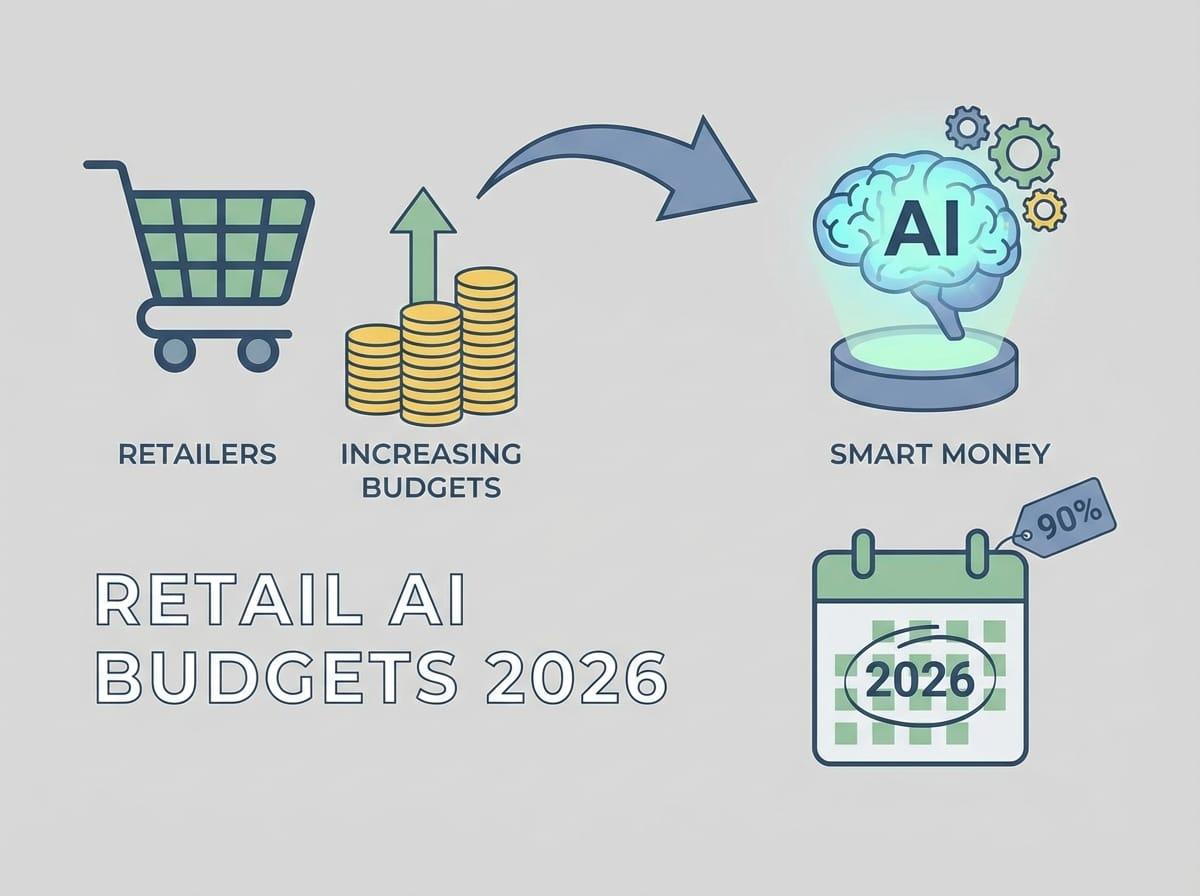
90% of Retailers Are Increasing AI Budgets in 2026: Where the Smart Money Is Going
- Author
- By Dor
- Publication date
- Published
- Last updated
- Updated
- Reading time
- 7 min read
Where Is Retail AI Money Actually Going?
As of January 2026, retail AI investment has matured from experimental pilots to operational infrastructure. According to NVIDIA's third annual State of AI in Retail and CPG survey, 91% of the industry is now actively using or assessing AI, up from 82% just two years ago. The shift from "exploring" to "deploying" is accelerating.
The survey reveals three dominant investment categories:
| Investment Category | % of Retailers Prioritizing | Primary ROI Driver |
|---|---|---|
| Supply Chain & Inventory | 51% | Operational efficiency |
| Customer Experience | 45% | Revenue optimization |
| Agentic AI | 47% | Speed and personalization |
📊 Key Stat: 89% of retailers report AI contributing to revenue growth, with 30% citing increases exceeding 10% year-over-year.
What separates the winners from the experimenters is not the size of the investment. It is where they deploy it.
The ROI Hierarchy: Which AI Investments Pay Back Fastest?
Not all AI investments deliver equal returns. Based on industry benchmarks and retailer performance data, here is the ROI hierarchy for retail AI in 2026:
Tier 1: Immediate Payback (1-6 Months)
Demand Forecasting and Inventory Optimization
AI-driven demand forecasting delivers approximately 200-400% ROI over 12 months while reducing inventory costs by 20-35% and preventing 65% of stockouts. According to SR Analytics research, AI forecasting cuts overstock by approximately 40% and improves prediction accuracy by around 50%.
Target's approach offers a masterclass here. The retailer deployed more than 10,000 new AI licenses in 2025 and rolled out its demand forecasting engine across all categories. The result? Target achieved its best on-shelf availability in years, with AI-generated forecasts improving with every iteration. According to Retail Dive, Target now uses AI to "infer inventory inaccuracies from analyzing underlying data patterns" and make automatic adjustments to trigger replenishment.
Customer Service Automation
Leading AI implementations now deflect over half of retail queries. Freshworks reports that Freddy AI Agents deflect 53% of tickets, slashing first response time from 12 minutes to 12 seconds and resolution time from over an hour to just 2 minutes. Walmart cut customer service resolution times by 40% using AI assistance.
"It fundamentally changes how people shop: moving from humans searching for products to AI bringing the right products, at the best price, directly to them." — Lori Schafer, CEO, Digital Wave Technology
Tier 2: Medium-Term Returns (6-12 Months)
Personalization Engines
AI-powered product recommendations drive a 10-30% increase in average order value (AOV), according to McKinsey research on personalization. Lowe's Mylow shopping assistant, powered by ChatGPT, is already generating double the conversion rate for online shoppers compared to those who do not use it. According to Modern Retail, Lowe's Mylow Companion service increases in-store customer satisfaction scores by 200 basis points.
Supply Chain Intelligence
McKinsey estimates that AI-driven supply chain systems cut inventory levels by 20-30% while reducing logistics costs by 5-20% through better planning, routing, and demand sensing.
Tier 3: Strategic Investment (12+ Months)
Agentic Commerce Infrastructure
This is where the smart money is moving in 2026. While the payback period is longer, the competitive moat is deeper.
📊 Key Stat: Retailers with AI agents saw 7x higher sales growth (13% vs 2%) during Cyber Week 2025, according to Salesforce data.
As we covered in our analysis of Cyber Week 2025, AI agents influenced $67 billion in global sales, representing 20% of all orders. This is no longer a future state. It is current reality.
How Target, Lowe's, and Kroger Are Allocating AI Budgets
The most instructive data comes not from surveys but from watching what leading retailers actually do with their AI investments.
Target: Operational AI at Scale
Target will invest an additional $1 billion in 2026 as part of a $5 billion capital plan covering new stores, remodels, and technology upgrades including digital fulfillment capabilities. According to Digital Commerce 360, Target's AI priorities include:
- Demand forecasting: Automated predictions across all categories
- Inventory inference: AI models that detect out-of-stocks from data patterns
- Price optimization: AI-assisted markdown and clearance timing
- ChatGPT integration: Custom Target app in beta with multi-item cart support
Target's approach is distinctly operational, automating manual tasks that directly impact margin and availability rather than chasing headline-grabbing AI pilots.
Lowe's: Customer-Facing AI at Enterprise Scale
Lowe's achieved a milestone that puts it in an "elite tier" of companies operating AI at enterprise scale: 100 billion tokens processed via OpenAI, earning recognition through OpenAI's Tokens of Appreciation program. Their AI investment portfolio includes:
| Initiative | Launch Date | Business Impact |
|---|---|---|
| Mylow Virtual Advisor | March 2025 | 2x conversion rate |
| Mylow Companion (stores) | May 2025 | 200 bps satisfaction increase |
| Code review automation | 2025 | Double-digit productivity gains |
| Agentic commerce tools | 2026 | In development |
"Achieving this milestone places Lowe's in an elite tier of companies that are not just experimenting with AI, but operating at a true enterprise scale," said SVP of Digital Commerce Joe Cano. The first half of 2026 will focus on personalizing the website to each specific user based on first-party data.
Kroger: AI-Powered Grocery at the Edge
Kroger announced an expanded relationship with Google Cloud at NRF 2026 to deploy Gemini Enterprise for Customer Experience nationwide. The AI features include:
- Agentic integration: Completing complex tasks from single instructions
- Meal assistant: Converting requests into guided recipes with shoppable ingredient lists
- Shrink reduction: AI tools providing granular inventory visibility that "allows us to see much better inventory levels, sell-through on a by-store level"
- Cart Assistant: Instacart's AI-powered assistant on the Kroger iOS app
Kroger projects a $400 million improvement in e-commerce profitability by 2026, driven by streamlined operations and AI-enabled efficiency across fulfillment networks.
"Accelerating our AI efforts is a natural step for Kroger, given our long history of leadership in data and machine learning. Where we've implemented AI in different parts of the organization, we're seeing results with more competitive pricing, shrink improvements and faster fulfillment." — Ron Sargent, Chairman and Interim CEO, Kroger
The Agentic Commerce Investment Case
NVIDIA's survey reveals that 47% of retailers are now using or assessing agentic AI, with 20% already deploying active AI agents and another 21% expecting deployment within one year.
The goals driving agentic AI investment:
- 57% target increased process speed and efficiency
- 40% seek enhanced personalization
- 40% want improved real-time decision-making
But here is the critical insight: agentic commerce requires infrastructure investment across multiple protocols. As of January 2026, retailers must navigate ACP (Stripe/OpenAI), MCP (Anthropic), UCP (Google/Shopify), and A2A (Google). Shopify's Winter 2026 Edition makes every store "agent-ready by default" with one setup selling across ChatGPT, Perplexity, and Microsoft Copilot. But enterprise retailers without this infrastructure face significant integration complexity.
"AI agents are no longer just a cost-saving measure, they're an incredible purchase and productivity accelerator in commerce." — Caila Schwartz, Director of Consumer Insights, Salesforce
A Framework for Evaluating AI Investment Priorities
Based on the data, here is a practical framework for retail AI budget allocation in 2026:
The 40-30-20-10 Model
| Allocation | Category | Rationale |
|---|---|---|
| 40% | Operations (forecasting, inventory, supply chain) | Fastest ROI, proven returns, directly impacts margin |
| 30% | Customer Experience (personalization, search, service) | Revenue optimization, competitive differentiation |
| 20% | Agentic Infrastructure (protocols, catalog optimization) | Future-proofing, emerging channel capture |
| 10% | Experimentation (emerging tech, physical AI) | Innovation pipeline, strategic optionality |
Investment Decision Checklist
Before approving any AI project, ask:
- What is the payback timeline? Prioritize initiatives with measurable returns in 6 months or less for early phases
- Does it reduce cost or increase revenue? The best investments do both (demand forecasting reduces overstock while preventing stockouts)
- Is it operational or experimental? Fund operational AI first; experiments should earn their expansion
- Does it create competitive moat? Agentic infrastructure investments compound over time
📊 Key Stat: 68% of retailers invested less than $5 million in AI infrastructure in 2025, while only 12% invested more than $50 million. The gap between leaders and laggards is widening.
What Happens If You Wait?
The cost of inaction is no longer theoretical. Consider the competitive divergence already visible:
Embraced AI Early:
- Walmart captures 20% of ChatGPT referral traffic
- Retailers with AI agents saw 7x higher sales growth during Cyber Week
- Shopify merchants saw 11x increase in AI-driven orders since January 2025
Delayed or Blocked AI:
- Amazon's ChatGPT referral traffic fell 18% month-over-month to under 3% after blocking AI crawlers
- Retailers without AI agents grew sales at just 2% during Cyber Week
SAP Emarsys put it starkly: "2025 will likely be the last year consumers shop as they do now." The retailers investing aggressively in AI infrastructure today are not just optimizing current operations. They are building the rails for how commerce will work in 2027 and beyond.
Frequently Asked Questions
What percentage of retailers are increasing AI budgets in 2026?
According to NVIDIA's State of AI in Retail and CPG 2026 survey, 90% of retailers plan to increase AI budgets this year, with 58% expecting significant increases of 10% or more year-over-year. This reflects a shift from experimental pilots to operational deployment across the industry.
Which AI investments deliver the fastest ROI for retailers?
Demand forecasting and inventory optimization deliver the fastest returns, with approximately 200-400% ROI over 12 months and payback periods of 1-6 months. Customer service automation follows closely, with retailers like Walmart achieving 40% reductions in resolution time. Personalization engines typically show returns in 6-12 months.
What is agentic commerce and why are retailers investing in it?
Agentic commerce is the practice of AI agents autonomously browsing, comparing, and purchasing products on behalf of consumers. Retailers are investing because AI agents influenced $67 billion in Cyber Week 2025 sales, and retailers with agents saw 7x higher sales growth than those without. NVIDIA's survey shows 47% of retailers are now using or assessing agentic AI.
How are Target, Lowe's, and Kroger prioritizing their AI investments?
Target focuses on operational AI, including demand forecasting, inventory optimization, and price management, with over 10,000 AI licenses deployed. Lowe's emphasizes customer-facing AI with its Mylow assistant driving 2x conversion rates. Kroger is deploying Google's Gemini for personalized grocery experiences and projects $400 million in e-commerce profitability improvement by 2026.
What is the recommended budget allocation for retail AI in 2026?
Industry best practice suggests the 40-30-20-10 model: 40% on operations (forecasting, inventory, supply chain), 30% on customer experience (personalization, search, service), 20% on agentic infrastructure (protocols, catalog optimization), and 10% on experimentation and emerging technologies.
How much are leading retailers investing in AI infrastructure?
Investment levels vary significantly. According to NVIDIA's industry research, 68% of retailers invested less than $5 million in AI infrastructure in 2025, while only 12% invested more than $50 million. Target is committing an additional $1 billion to business investment in 2026, with significant portions allocated to technology and AI capabilities.
The Bottom Line
The question is no longer whether to invest in AI. 90% of your competitors already are. The question is whether your investments are going to the right places.
The highest-ROI investments in 2026 are operational: demand forecasting, inventory optimization, and supply chain intelligence. Customer-facing AI like personalization and service automation comes next. And for retailers serious about long-term competitive positioning, agentic commerce infrastructure is the strategic bet that compounds over time.
Related: 20% of Cyber Week orders
Retailers who treat AI as a line item will fall behind. Those who treat it as the operating system for modern commerce will capture the growth.
Ready to make your catalog visible to AI shopping agents? See how Paz.ai helps retailers optimize for agentic commerce with unified protocol support and AI-ready catalog infrastructure.
How AI-ready are your products?
Check how ChatGPT, Google AI, and Perplexity evaluate any product page. Free score in 30 seconds.